
- Top Rated
The Project Gutenberg eBook of The Voyages of Doctor Dolittle, by Hugh Lofting.
Time: 2010-12-5 17:23:32 Author: Infant Toys Source: Mini Figures Views: Comments:0Summary: THE VOYAGES OF DOCTOR DOLITTLE[i]THE VOYAGES OF DOCTOR DOLITTLETranscriber's note: Image with tissue robot kits for 8 year olds under 30 dollarsTHE VOYAGES OF DOCTOR DOLITTLE
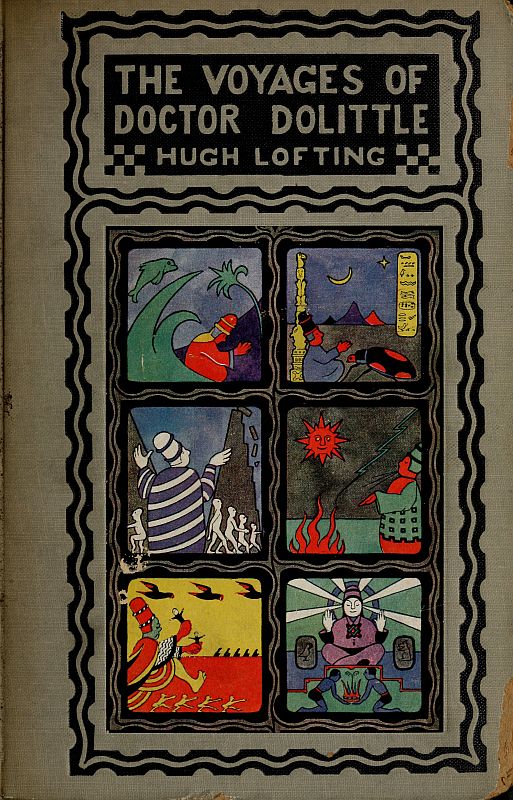
[i]
THE VOYAGES OF DOCTOR DOLITTLE
 Transcriber's note: Image with tissue paper overlay
I
HIS LANDING
ON THE
ISLANDII
HIS MEETING
WITH THE
BEETLEIII
HE LIBERATES
THE LOST
FAMILIESIV
HE MAKES
FIREV
HE LEADS THE
PEOPLE TO
VICTORY IN
WARVI
HE IS
CROWNED
KING
THE
POPSIPETEL
PICTURE-HISTORY OF
KING JONG THINKALOT[ii]
[iii] TheVOYAGES of
DOCTOR DOLITTLE
ILLUSTRATED BY THE AUTHOR
BY HUGH LOFTING
Published by
FREDK. A. STOKES Co.
at 443 Fourth Avenue New York A.D. 1922[iv]
Copyright,robot kits for 8 year olds under 30 dollars 1922, by
Frederick A. Stokes Company
All rights reserved, including that of translation
into foreign languagesFirst Printing, August 18, 1922 Second Printing, November 10, 1922 Third Printing, February 28, 1923 Fourth Printing, June 20, 1923 Fifth Printing, August 16, 1923 Sixth Printing, November 30, 1923 Seventh Printing, April 18, 1925 Eighth Printing, March 19, 1926 Ninth Printing, July 30, 1927 Tenth Printing, April 11, 1928 Eleventh Printing, June 19, 1929 Twelfth Printing, September 12, 1930 Thirteenth Printing, August 10, 1931 Fourteenth Printing, September 1, 1933
Printed in the United States of America[v]
To
Colin
and
Elizabeth[vi]
[vii]CONTENTS
PART ONE CHAPTER PAGE Prologue 1 I The Cobbler’s Son 3 II I Hear of the Great Naturalist 8 III The Doctor’s Home 15 IV The Wiff-Waff 24 V Polynesia 32 VI The Wounded Squirrel 41 VII Shellfish Talk 45 VIII Are You a Good Noticer? 50 IX The Garden of Dreams 55 X The Private Zoo 60 XI My Schoolmaster, Polynesia 65 XII My Great Idea 70 XIII A Traveler Arrives 75 XIV Chee-Chee’s Voyage 80 XV I Become a Doctor’s Assistant 84 PART TWO I The Crew of “The Curlew” 88 II Luke the Hermit 91 III Jip and the Secret 95 IV Bob 99 V Mendoza 105 VI The Judge’s Dog 111 VII The End of the Mystery 116 VIII Three Cheers 121 IX The Purple Bird-of-Paradise 126 X Long Arrow, the Son of Golden Arrow 129 XI Blind Travel 135[viii] XII Destiny and Destination 140 PART THREE I The Third Man 144 II Good-Bye! 151 III Our Troubles Begin 155 IV Our Troubles Continue 160 V Polynesia Has a Plan 167 VI The Bed-Maker of Monteverde 172 VII The Doctor’s Wager 177 VIII The Great Bullfight 184 IX We Depart in a Hurry 193 PART FOUR I Shellfish Languages Again 198 II The Fidgit’s Story 205 III Bad Weather 221 IV Wrecked! 225 V Land! 233 VI The Jabizri 239 VII Hawk’s-Head Mountain 245 PART FIVE I A Great Moment 253 II “The Men of the Moving Land” 262 III Fire 266 IV What Makes an Island Float 271 V War! 275 VI General Polynesia 282 VII The Peace of the Parrots 287 VIII The Hanging Stone 291 IX The Election 300 X The Coronation of King Jong 308[ix] PART SIX I New Popsipetel 314 II Thoughts of Home 322 III The Red Man’s Science 328 IV The Sea-Serpent 332 V The Shellfish Riddle Solved at Last 340 VI The Last Cabinet Meeting 346 VII The Doctor’s Decision 350 [x]
[xi]ILLUSTRATIONS
The Popsipetel Picture-History of King Jong Thinkalot (in colors) Frontispiece PAGE “I would sit on the river-wall with my feet dangling over the water” 5 “And in her right foot she carried a lighted candle!” 22 “‘Being a good noticer is terribly important’” 53 A traveler arrives 77 “On the bed sat the Hermit” 101 “Sat scowling down upon the amazed and gaping jury” 115 “‘What else can I think?’” 133 “‘Boy, where’s the skipper?’” 147 “In these lower levels we came upon the shadowy shapes of dead ships” (in colors) 162 “The Doctor started chatting in Spanish to the bed-maker” 175 “Did acrobatics on the beast’s horns” 189 “‘He talks English!’” 201 “I was alone in the ocean!” 226 “It was a great moment” 257 The Terrible Three 279 [xii]“Working away with their noses against the end of the island” 293 “The Whispering Rocks” 295 “Had to chase his butterflies with a crown upon his head” 317 “‘Tiptoe incognito,’ whispered Bumpo” 353 [xiii]
THE VOYAGES OF DOCTOR DOLITTLE
[1]
THE VOYAGES OF
DOCTOR DOLITTLEPROLOGUE
ALL that I have written so far aboutDoctor Dolittle I heard long after ithappened from those who had knownhim—indeed a great deal of it tookplace before I was born. But I now come to setdown that part of the great man’s life which Imyself saw and took part in.
Many years ago the Doctor gave me permissionto do this. But we were both of us so busy thenvoyaging around the world, having adventures andfilling note-books full of natural history that Inever seemed to get time to sit down and write ofour doings.
Now of course, when I am quite an old man,my memory isn’t so good any more. But wheneverI am in doubt and have to hesitate and think, Ialways ask Polynesia, the parrot.
That wonderful bird (she is now nearly twohundred and fifty years old) sits on the top of mydesk, usually humming sailor songs to herself, whileI write this book. And, as every one who ever mether knows, Polynesia’s memory is the most marvelous[2]memory in the world. If there is any happeningI am not quite sure of, she is always able to putme right, to tell me exactly how it took place, whowas there and everything about it. In fact sometimesI almost think I ought to say that this bookwas written by Polynesia instead of me.
Very well then, I will begin. And first of allI must tell you something about myself and howI came to meet the Doctor.
[3]
PART I
THE FIRST CHAPTER
THE COBBLER’S SONMY name was Tommy Stubbins, son ofJacob Stubbins, the cobbler of Puddleby-on-the-Marsh;and I was nine anda half years old. At that time Puddlebywas only quite a small town. A river ranthrough the middle of it; and over this river therewas a very old stone bridge, called Kingsbridge,which led you from the market-place on one side tothe churchyard on the other.
Sailing-ships came up this river from the seaand anchored near the bridge. I used to go downand watch the sailors unloading the ships upon theriver-wall. The sailors sang strange songs as theypulled upon the ropes; and I learned these songs byheart. And I would sit on the river-wall with myfeet dangling over the water and sing with the men,pretending to myself that I too was a sailor.
For I longed always to sail away with those braveships when they turned their backs on PuddlebyChurch and went creeping down the river again,across the wide lonely marshes to the sea. Ilonged to go with them out into the world to seek[4]my fortune in foreign lands—Africa, India, Chinaand Peru! When they got round the bend in theriver and the water was hidden from view, you couldstill see their huge brown sails towering over theroofs of the town, moving onward slowly—likesome gentle giants that walked among the houseswithout noise. What strange things would theyhave seen, I wondered, when next they came back toanchor at Kingsbridge! And, dreaming of thelands I had never seen, I’d sit on there, watchingtill they were out of sight.
Three great friends I had in Puddleby in thosedays. One was Joe, the mussel-man, who lived ina tiny hut by the edge of the water under the bridge.This old man was simply marvelous at makingthings. I never saw a man so clever with his hands.He used to mend my toy ships for me which Isailed upon the river; he built windmills out ofpacking-cases and barrel-staves; and he could makethe most wonderful kites from old umbrellas.
Joe would sometimes take me in his mussel-boat,and when the tide was running out we would paddledown the river as far as the edge of the sea to getmussels and lobsters to sell. And out there on thecold lonely marshes we would see wild geese flying,and curlews and redshanks and many other kinds ofseabirds that live among the samfire and the longgrass of the great salt fen. And as we crept up theriver in the evening, when the tide had turned, we[5]
[6]would see the lights on Kingsbridge twinkle in thedusk, reminding us of tea-time and warm fires.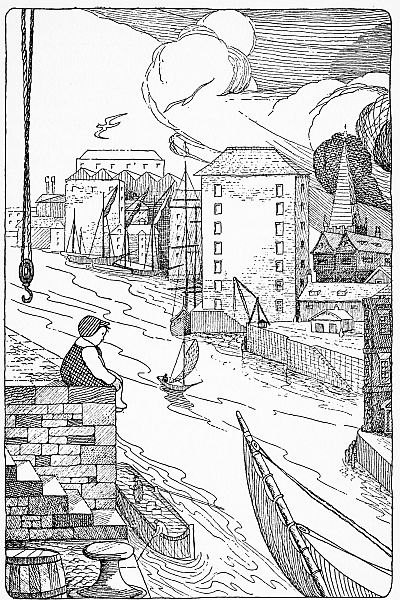 “I would sit on the river-wall with my feet danglingover the water”
Another friend I had was Matthew Mugg, thecat’s-meat-man. He was a funny old person witha bad squint. He looked rather awful but he wasreally quite nice to talk to. He knew everybody inPuddleby; and he knew all the dogs and all the cats.In those times being a cat’s-meat-man was a regularbusiness. And you could see one nearly any daygoing through the streets with a wooden tray fullof pieces of meat stuck on skewers crying, “Meat!M-E-A-T!” People paid him to give this meat totheir cats and dogs instead of feeding them on dog-biscuitsor the scraps from the table.
I enjoyed going round with old Matthew and seeingthe cats and dogs come running to the garden-gateswhenever they heard his call. Sometimeshe let me give the meat to the animals myself; and Ithought this was great fun. He knew a lot aboutdogs and he would tell me the names of the differentkinds as we went through the town. He had severaldogs of his own; one, a whippet, was a very fastrunner, and Matthew used to win prizes with her atthe Saturday coursing races; another, a terrier, wasa fine ratter. The cat’s-meat-man used to make abusiness of rat-catching for the millers and farmersas well as his other trade of selling cat’s-meat.
My third great friend was Luke the Hermit.But of him I will tell you more later on.
[7]
I did not go to school; because my father was notrich enough to send me. But I was extremely fondof animals. So I used to spend my time collectingbirds’ eggs and butterflies, fishing in the river, ramblingthrough the countryside after blackberries andmushrooms and helping the mussel-man mend hisnets.
Yes, it was a very pleasant life I lived in thosedays long ago—though of course I did not thinkso then. I was nine and a half years old; and, likeall boys, I wanted to grow up—not knowing howwell off I was with no cares and nothing to worryme. Always I longed for the time when I should beallowed to leave my father’s house, to take passagein one of those brave ships, to sail down the riverthrough the misty marshes to the sea—out intothe world to seek my fortune.
[8]
THE SECOND CHAPTER
I HEAR OF THE GREAT NATURALISTONE early morning in the Springtime,when I was wandering among the hillsat the back of the town, I happened tocome upon a hawk with a squirrel in itsclaws. It was standing on a rock and the squirrelwas fighting very hard for its life. The hawk wasso frightened when I came upon it suddenly like this,that it dropped the poor creature and flew away. Ipicked the squirrel up and found that two of its legswere badly hurt. So I carried it in my arms back tothe town.
When I came to the bridge I went into the mussel-man’shut and asked him if he could do anything forit. Joe put on his spectacles and examined it carefully.Then he shook his head.
“Yon crittur’s got a broken leg,” he said—“andanother badly cut an’ all. I can mend youyour boats, Tom, but I haven’t the tools nor thelearning to make a broken squirrel seaworthy. Thisis a job for a surgeon—and for a right smart onean’ all. There be only one man I know who couldsave yon crittur’s life. And that’s John Dolittle.”
[9]
“Who is John Dolittle?” I asked. “Is he avet?”
“No,” said the mussel-man. “He’s no vet.Doctor Dolittle is a nacheralist.”
“What’s a nacheralist?”
“A nacheralist,” said Joe, putting away hisglasses and starting to fill his pipe, “is a manwho knows all about animals and butterflies andplants and rocks an’ all. John Dolittle is a verygreat nacheralist. I’m surprised you never heardof him—and you daft over animals. He knowsa whole lot about shellfish—that I know from myown knowledge. He’s a quiet man and don’t talkmuch; but there’s folks who do say he’s the greatestnacheralist in the world.”
“Where does he live?” I asked.
“Over on the Oxenthorpe Road, t’other side thetown. Don’t know just which house it is, but ’mostanyone ’cross there could tell you, I reckon. Goand see him. He’s a great man.”
So I thanked the mussel-man, took up my squirrelagain and started off towards the Oxenthorpe Road.
The first thing I heard as I came into the market-placewas some one calling “Meat! M-E-A-T!”
“There’s Matthew Mugg,” I said to myself.“He’ll know where this Doctor lives. Matthewknows everyone.”
So I hurried across the market-place and caughthim up.
[10]
“Matthew,” I said, “do you know Doctor Dolittle?”
“Do I know John Dolittle!” said he. “Well, Ishould think I do! I know him as well as I knowmy own wife—better, I sometimes think. He’s agreat man—a very great man.”
“Can you show me where he lives?” I asked. “Iwant to take this squirrel to him. It has a brokenleg.”
“Certainly,” said the cat’s-meat-man. “I’ll begoing right by his house directly. Come along andI’ll show you.”
So off we went together.
“Oh, I’ve known John Dolittle for years andyears,” said Matthew as we made our way out of themarket-place. “But I’m pretty sure he ain’t homejust now. He’s away on a voyage. But he’s liableto be back any day. I’ll show you his house andthen you’ll know where to find him.”
All the way down the Oxenthorpe Road Matthewhardly stopped talking about his great friend, DoctorJohn Dolittle—“M. D.” He talked so muchthat he forgot all about calling out “Meat!” untilwe both suddenly noticed that we had a whole processionof dogs following us patiently.
“Where did the Doctor go to on this voyage?”I asked as Matthew handed round the meat to them.
“I couldn’t tell you,” he answered. “Nobodynever knows where he goes, nor when he’s going,[11]nor when he’s coming back. He lives all alone exceptfor his pets. He’s made some great voyagesand some wonderful discoveries. Last time hecame back he told me he’d found a tribe of Red Indiansin the Pacific Ocean—lived on two islands,they did. The husbands lived on one island and thewives lived on the other. Sensible people, some ofthem savages. They only met once a year, whenthe husbands came over to visit the wives for a greatfeast—Christmas-time, most likely. Yes, he’s awonderful man is the Doctor. And as for animals,well, there ain’t no one knows as much about ’em aswhat he does.”
“How did he get to know so much about animals?”I asked.
The cat’s-meat-man stopped and leant down towhisper in my ear.
“He talks their language,” he said in a hoarse,mysterious voice.
“The animals’ language?” I cried.
“Why certainly,” said Matthew. “All animalshave some kind of a language. Some sorts talkmore than others; some only speak in sign-language,like deaf-and-dumb. But the Doctor, he understandsthem all—birds as well as animals. Wekeep it a secret though, him and me, because folksonly laugh at you when you speak of it. Why, hecan even write animal-language. He reads aloudto his pets. He’s wrote history-books in monkey-talk,[12]poetry in canary language and comic songs formagpies to sing. It’s a fact. He’s now busylearning the language of the shellfish. But he saysit’s hard work—and he has caught some terriblecolds, holding his head under water so much. He’sa great man.”
“He certainly must be,” I said. “I do wish hewere home so I could meet him.”
“Well, there’s his house, look,” said the cat’s-meat-man—“thatlittle one at the bend in the roadthere—the one high up—like it was sitting on thewall above the street.”
We were now come beyond the edge of the town.And the house that Matthew pointed out was quitea small one standing by itself. There seemed to bea big garden around it; and this garden was muchhigher than the road, so you had to go up a flight ofsteps in the wall before you reached the front gateat the top. I could see that there were many finefruit trees in the garden, for their branches hungdown over the wall in places. But the wall was sohigh I could not see anything else.
When we reached the house Matthew went upthe steps to the front gate and I followed him. Ithought he was going to go into the garden; but thegate was locked. A dog came running down fromthe house; and he took several pieces of meat whichthe cat’s-meat-man pushed through the bars of thegate, and some paper bags full of corn and bran.[13]I noticed that this dog did not stop to eat the meat,as any ordinary dog would have done, but he tookall the things back to the house and disappeared.He had a curious wide collar round his neck whichlooked as though it were made of brass or something.Then we came away.
“The Doctor isn’t back yet,” said Matthew, “orthe gate wouldn’t be locked.”
“What were all those things in paper-bags yougave the dog?” I asked.
“Oh, those were provisions,” said Matthew—“thingsfor the animals to eat. The Doctor’s houseis simply full of pets. I give the things to the dog,while the Doctor’s away, and the dog gives them tothe other animals.”
“And what was that curious collar he was wearinground his neck?”
“That’s a solid gold dog-collar,” said Matthew.“It was given to him when he was with the Doctoron one of his voyages long ago. He saved a man’slife.”
“How long has the Doctor had him?” I asked.
“Oh, a long time. Jip’s getting pretty old now.That’s why the Doctor doesn’t take him on his voyagesany more. He leaves him behind to take careof the house. Every Monday and Thursday Ibring the food to the gate here and give it himthrough the bars. He never lets any one come insidethe garden while the Doctor’s away—not even[14]me, though he knows me well. But you’ll alwaysbe able to tell if the Doctor’s back or not—becauseif he is, the gate will surely be open.”
So I went off home to my father’s house and putmy squirrel to bed in an old wooden box full ofstraw. And there I nursed him myself and tookcare of him as best I could till the time should comewhen the Doctor would return. And every day Iwent to the little house with the big garden on theedge of the town and tried the gate to see if it werelocked. Sometimes the dog, Jip, would come downto the gate to meet me. But though he alwayswagged his tail and seemed glad to see me, he neverlet me come inside the garden.
[15]
THE THIRD CHAPTER
THE DOCTOR’S HOMEONE Monday afternoon towards the endof April my father asked me to takesome shoes which he had mended to ahouse on the other side of the town.They were for a Colonel Bellowes who was veryparticular.
I found the house and rang the bell at the frontdoor. The Colonel opened it, stuck out a very redface and said, “Go round to the tradesmen’s entrance—goto the back door.” Then he slammedthe door shut.
I felt inclined to throw the shoes into the middleof his flower-bed. But I thought my father mightbe angry, so I didn’t. I went round to the backdoor, and there the Colonel’s wife met me and tookthe shoes from me. She looked a timid littlewoman and had her hands all over flour as thoughshe were making bread. She seemed to be terriblyafraid of her husband whom I could still hearstumping round the house somewhere, gruntingindignantly because I had come to the front door.Then she asked me in a whisper if I would have a[16]bun and a glass of milk. And I said, “Yes, please.”
After I had eaten the bun and milk, I thankedthe Colonel’s wife and came away. Then Ithought that before I went home I would go andsee if the Doctor had come back yet. I had beento his house once already that morning. But Ithought I’d just like to go and take another look.My squirrel wasn’t getting any better and I wasbeginning to be worried about him.
So I turned into the Oxenthorpe Road andstarted off towards the Doctor’s house. On theway I noticed that the sky was clouding over andthat it looked as though it might rain.
I reached the gate and found it still locked. Ifelt very discouraged. I had been coming hereevery day for a week now. The dog, Jip, cameto the gate and wagged his tail as usual, and thensat down and watched me closely to see that Ididn’t get in.
I began to fear that my squirrel would die beforethe Doctor came back. I turned away sadly, wentdown the steps on to the road and turned towardshome again.
I wondered if it were supper-time yet. Ofcourse I had no watch of my own, but I noticed agentleman coming towards me down the road; andwhen he got nearer I saw it was the Colonel out fora walk. He was all wrapped up in smart overcoatsand mufflers and bright-colored gloves. It was[17]not a very cold day but he had so many clothes onhe looked like a pillow inside a roll of blankets.I asked him if he would please tell me the time.
He stopped, grunted and glared down at me—hisred face growing redder still; and when he spokeit sounded like the cork coming out of a gingerbeer-bottle.
“Do you imagine for one moment,” he spluttered,“that I am going to get myself all unbuttonedjust to tell a little boy like you the time!” And hewent stumping down the street, grunting harderthan ever.
I stood still a moment looking after him andwondering how old I would have to be, to have himgo to the trouble of getting his watch out. Andthen, all of a sudden, the rain came down intorrents.
I have never seen it rain so hard. It got dark,almost like night. The wind began to blow; thethunder rolled; the lightning flashed, and in amoment the gutters of the road were flowing likea river. There was no place handy to take shelter,so I put my head down against the driving wind andstarted to run towards home.
I hadn’t gone very far when my head bumpedinto something soft and I sat down suddenly onthe pavement. I looked up to see whom I had runinto. And there in front of me, sitting on the wetpavement like myself, was a little round man with a[18]very kind face. He wore a shabby high hat andin his hand he had a small black bag.
“I’m very sorry,” I said. “I had my head downand I didn’t see you coming.”
To my great surprise, instead of getting angry atbeing knocked down, the little man began to laugh.
“You know this reminds me,” he said, “of a timeonce when I was in India. I ran full tilt into awoman in a thunderstorm. But she was carryinga pitcher of molasses on her head and I had treaclein my hair for weeks afterwards—the fliesfollowed me everywhere. I didn’t hurt you,did I?”
“No,” I said. “I’m all right.”
“It was just as much my fault as it was yours, youknow,” said the little man. “I had my head downtoo—but look here, we mustn’t sit talking like this.You must be soaked. I know I am. How far haveyou got to go?”
“My home is on the other side of the town,” Isaid, as we picked ourselves up.
“My Goodness, but that wasa wet pavement!”said he. “And I declare it’s coming down worsethan ever. Come along to my house and get dried.A storm like this can’t last.”
He took hold of my hand and we started runningback down the road together. As we ran I beganto wonder who this funny little man could be, andwhere he lived. I was a perfect stranger to him,[19]and yet he was taking me to his own home to getdried. Such a change, after the old red-faced Colonelwho had refused even to tell me the time!Presently we stopped.
“Here we are,” he said.
I looked up to see where we were and found myselfback at the foot of the steps leading to the littlehouse with the big garden! My new friend wasalready running up the steps and opening the gatewith some keys he took from his pocket.
“Surely,” I thought, “this cannot be the greatDoctor Dolittle himself!”
I suppose after hearing so much about him I hadexpected some one very tall and strong and marvelous.It was hard to believe that this funny littleman with the kind smiling face could be really he.Yet here he was, sure enough, running up the stepsand opening the very gate which I had been watchingfor so many days!
The dog, Jip, came rushing out and started jumpingup on him and barking with happiness. Therain was splashing down heavier than ever.
“Are you Doctor Dolittle?” I shouted as we spedup the short garden-path to the house.
“Yes, I’m Doctor Dolittle,” said he, opening thefront door with the same bunch of keys. “Get in!Don’t bother about wiping your feet. Never mindthe mud. Take it in with you. Get in out of therain!”
[20]
I popped in, he and Jip following. Then heslammed the door to behind us.
The storm had made it dark enough outside; butinside the house, with the door closed, it was asblack as night. Then began the most extraordinarynoise that I have ever heard. It sounded like allsorts and kinds of animals and birds calling andsqueaking and screeching at the same time. I couldhear things trundling down the stairs and hurryingalong passages. Somewhere in the dark a duck wasquacking, a cock was crowing, a dove was cooing,an owl was hooting, a lamb was bleating and Jipwas barking. I felt birds’ wings fluttering andfanning near my face. Things kept bumping intomy legs and nearly upsetting me. The whole fronthall seemed to be filling up with animals. Thenoise, together with the roaring of the rain, wastremendous; and I was beginning to grow a littlebit scared when I felt the Doctor take hold of myarm and shout into my ear.
“Don’t be alarmed. Don’t be frightened.These are just some of my pets. I’ve been awaythree months and they are glad to see me homeagain. Stand still where you are till I strike alight. My Gracious, what a storm!—Just listento that thunder!”
So there I stood in the pitch-black dark, while allkinds of animals which I couldn’t see chattered andjostled around me. It was a curious and a funny[21]feeling. I had often wondered, when I had lookedin from the front gate, what Doctor Dolittle wouldbe like and what the funny little house would haveinside it. But I never imagined it would be anythinglike this. Yet somehow after I had felt theDoctor’s hand upon my arm I was not frightened,only confused. It all seemed like some queerdream; and I was beginning to wonder if I wasreally awake, when I heard the Doctor speakingagain:
“My blessed matches are all wet. They won’tstrike. Have you got any?”
“No, I’m afraid I haven’t,” I called back.
“Never mind,” said he. “Perhaps Dab-Dab canraise us a light somewhere.”
Then the Doctor made some funny clickingnoises with his tongue and I heard some one trundleup the stairs again and start moving about in therooms above.
Then we waited quite a while without anythinghappening.
“Will the light be long in coming?” I asked.“Some animal is sitting on my foot and my toes aregoing to sleep.”
“No, only a minute,” said the Doctor. “She’llbe back in a minute.”
And just then I saw the first glimmerings of alight around the landing above. At once all theanimals kept quiet.
[22]
 “And in her right foot she carried a lighted candle!”
[23]
“I thought you lived alone,” I said to the Doctor.
“So I do,” said he. “It is Dab-Dab who isbringing the light.”
I looked up the stairs trying to make out who wascoming. I could not see around the landing but Iheard the most curious footstep on the upper flight.It sounded like some one hopping down from onestep to the other, as though he were using only oneleg.
As the light came lower, it grew brighter andbegan to throw strange jumping shadows on thewalls.
“Ah—at last!” said the Doctor. “Good oldDab-Dab!”
And then I thought I reallymust be dreaming.For there, craning her neck round the bend of thelanding, hopping down the stairs on one leg, came aspotless white duck. And in her right foot shecarried a lighted candle!
[24]
THE FOURTH CHAPTER
THE WIFF-WAFFWHEN at last I could look around meI found that the hall was indeedsimply full of animals. It seemed tome that almost every kind of creaturefrom the countryside must be there: a pigeon, awhite rat, an owl, a badger, a jackdaw—there waseven a small pig, just in from the rainy garden, carefullywiping his feet on the mat while the light fromthe candle glistened on his wet pink back.
The Doctor took the candlestick from the duckand turned to me.
“Look here,” he said: “you must get thosewet clothes off—by the way, what is your name?”
“Tommy Stubbins,” I said.
“Oh, are you the son of Jacob Stubbins, the shoemaker?”
“Yes,” I said.
“Excellent bootmaker, your father,” said theDoctor. “You see these?” and he held up his rightfoot to show me the enormous boots he was wearing.“Your father made me those boots four yearsago, and I’ve been wearing them ever since—perfectlywonderful boots—Well now, look here,[25]Stubbins. You’ve got to change those wet things—andquick. Wait a moment till I get some morecandles lit, and then we’ll go upstairs and find somedry clothes. You’ll have to wear an old suit ofmine till we can get yours dry again by thekitchen-fire.”
So presently when more candles had been lightedround different parts of the house, we went upstairs;and when we had come into a bedroom the Doctoropened a big wardrobe and took out two suits ofold clothes. These we put on. Then we carriedour wet ones down to the kitchen and started a firein the big chimney. The coat of the Doctor’swhich I was wearing was so large for me that Ikept treading on my own coat-tails while I was helpingto fetch the wood up from the cellar. But verysoon we had a huge big fire blazing up the chimneyand we hung our wet clothes around on chairs.
“Now let’s cook some supper,” said the Doctor.—“You’llstay and have supper with me, Stubbins,of course?”
Already I was beginning to be very fond of thisfunny little man who called me “Stubbins,” insteadof “Tommy” or “little lad” (I did so hate to becalled “little lad”!) This man seemed to beginright away treating me as though I were a grown-upfriend of his. And when he asked me to stop andhave supper with him I felt terribly proud andhappy. But I suddenly remembered that I had[26]not told my mother that I would be out late. Sovery sadly I answered,
“Thank you very much. I would like to stay,but I am afraid that my mother will begin to worryand wonder where I am if I don’t get back.”
“Oh, but my dear Stubbins,” said the Doctor,throwing another log of wood on the fire, “yourclothes aren’t dry yet. You’ll have to wait forthem, won’t you? By the time they are ready toput on we will have supper cooked and eaten—Didyou see where I put my bag?”
“I think it is still in the hall,” I said. “I’ll goand see.”
I found the bag near the front door. It wasmade of black leather and looked very, very old.One of its latches was broken and it was tied upround the middle with a piece of string.
“Thank you,” said the Doctor when I brought itto him.
“Was that bag all the luggage you had for yourvoyage?” I asked.
“Yes,” said the Doctor, as he undid the pieceof string. “I don’t believe in a lot of baggage.It’s such a nuisance. Life’s too short to fuss withit. And it isn’t really necessary, you know—WheredidI put those sausages?”
The Doctor was feeling about inside the bag.First he brought out a loaf of new bread. Nextcame a glass jar with a curious metal top to it. He[27]held this up to the light very carefully before heset it down upon the table; and I could see thatthere was some strange little water-creature swimmingabout inside. At last the Doctor brought outa pound of sausages.
“Now,” he said, “all we want is a frying-pan.”
We went into the scullery and there we foundsome pots and pans hanging against the wall. TheDoctor took down the frying-pan. It was quiterusty on the inside.
“Dear me, just look at that!” said he. “That’sthe worst of being away so long. The animals arevery good and keep the house wonderfully cleanas far as they can. Dab-Dab is a perfect marvelas a housekeeper. But some things of course theycan’t manage. Never mind, we’ll soon clean it up.You’ll find some silver-sand down there, under thesink, Stubbins. Just hand it up to me, will you?”
In a few moments we had the pan all shinyand bright and the sausages were put over thekitchen-fire and a beautiful frying smell went allthrough the house.
While the Doctor was busy at the cooking I wentand took another look at the funny little creatureswimming about in the glass jar.
“What is this animal?” I asked.
“Oh that,” said the Doctor, turning round—“that’sa Wiff-Waff. Its full name is hippocampuspippitopitus. But the natives just call it a Wiff-Waff—on[28]account of the way it waves its tail, swimming,I imagine. That’s what I went on this lastvoyage for, to get that. You see I’m very busy justnow trying to learn the language of the shellfish.They havelanguages, of that I feel sure. I can talka little shark language and porpoise dialect myself.But what I particularly want to learn now is shellfish.”
“Why?” I asked.
“Well, you see, some of the shellfish are theoldest kind of animals in the world that we know of.We find their shells in the rocks—turned to stone—thousandsof years old. So I feel quite sure thatif I could only get to talk their language, I should beable to learn a whole lot about what the world waslike ages and ages and ages ago. You see?”
“But couldn’t some of the other animals tell youas well?”
“I don’t think so,” said the Doctor, prodding thesausages with a fork. “To be sure, the monkeys Iknew in Africa some time ago were very helpful intelling me about bygone days; but they only wentback a thousand years or so. No, I am certain thatthe oldest history in the world is to be had from theshellfish—and from them only. You see most ofthe other animals that were alive in those very ancienttimes have now become extinct.”
“Have you learned any shellfish language yet?”I asked.
[29]
“No. I’ve only just begun. I wanted this particularkind of a pipe-fish because he is half a shellfishand half an ordinary fish. I went all the wayto the Eastern Mediterranean after him. But I’mvery much afraid he isn’t going to be a great deal ofhelp to me. To tell you the truth, I’m rather disappointedin his appearance. He doesn’t lookveryintelligent, does he?”
“No, he doesn’t,” I agreed.
“Ah,” said the Doctor. “The sausages are doneto a turn. Come along—hold your plate near andlet me give you some.”
Then we sat down at the kitchen-table and starteda hearty meal.
It was a wonderful kitchen, that. I had manymeals there afterwards and I found it a better placeto eat in than the grandest dining-room in the world.It was so cozy and home-like and warm. It was sohandy for the food too. You took it right off thefire, hot, and put it on the table and ate it. Andyou could watch your toast toasting at the fenderand see it didn’t burn while you drank your soup.And if you had forgotten to put the salt on the table,you didn’t have to get up and go into another roomto fetch it; you just reached round and took the bigwooden box off the dresser behind you. Then thefireplace—the biggest fireplace you ever saw—waslike a room in itself. You could get right inside iteven when the logs were burning and sit on the wide[30]seats either side and roast chestnuts after the mealwas over—or listen to the kettle singing, or tellstories, or look at picture-books by the light of thefire. It was a marvelous kitchen. It was like theDoctor, comfortable, sensible, friendly and solid.
While we were gobbling away, the door suddenlyopened and in marched the duck, Dab-Dab, and thedog, Jip, dragging sheets and pillow-cases behindthem over the clean tiled floor. The Doctor, seeinghow surprised I was, explained:
“They’re just going to air the bedding for me infront of the fire. Dab-Dab is a perfect treasure ofa housekeeper; she never forgets anything. I hada sister once who used to keep house for me (poor,dear Sarah! I wonder how she’s getting on—Ihaven’t seen her in many years). But she wasn’tnearly as good as Dab-Dab. Have another sausage?”
The Doctor turned and said a few words to thedog and duck in some strange talk and signs. Theyseemed to understand him perfectly.
“Can you talk in squirrel language?” I asked.
“Oh yes. That’s quite an easy language,” saidthe Doctor. “You could learn that yourself withouta great deal of trouble. But why do you ask?”
“Because I have a sick squirrel at home,” I said.“I took it away from a hawk. But two of its legsare badly hurt and I wanted very much to have yousee it, if you would. Shall I bring it to-morrow?”
[31]
“Well, if its leg is badly broken I think I hadbetter see it to-night. It may be too late to domuch; but I’ll come home with you and take a lookat it.”
So presently we felt the clothes by the fire andmine were found to be quite dry. I took them upstairsto the bedroom and changed, and when Icame down the Doctor was all ready waiting for mewith his little black bag full of medicines and bandages.
“Come along,” he said. “The rain has stoppednow.”
Outside it had grown bright again and the eveningsky was all red with the setting sun; and thrusheswere singing in the garden as we opened the gate togo down on to the road.
[32]
THE FIFTH CHAPTER
POLYNESIA“I THINK your house is the most interestinghouse I was ever in,” I said as we set offin the direction of the town. “May I comeand see you again to-morrow?”
“Certainly,” said the Doctor. “Come any dayyou like. To-morrow I’ll show you the garden andmy private zoo.”
“Oh, have you a zoo?” I asked.
“Yes,” said he. “The larger animals are too bigfor the house, so I keep them in a zoo in the garden.It is not a very big collection but it is interesting inits way.”
“It must be splendid,” I said, “to be able to talkall the languages of the different animals. Do youthink I could ever learn to do it?”
“Oh surely,” said the Doctor—“with practise.You have to be very patient, you know. You reallyought to have Polynesia to start you. It was shewho gave me my first lessons.”
“Who is Polynesia?” I asked.
“Polynesia was a West African parrot I had.She isn’t with me any more now,” said the Doctorsadly.
[33]
“Why—is she dead?”
“Oh no,” said the Doctor. “She is still living,I hope. But when we reached Africa she seemedso glad to get back to her own country. She weptfor joy. And when the time came for me to comeback here I had not the heart to take her awayfrom that sunny land—although, it is true, she didoffer to come. I left her in Africa—Ah well! Ihave missed her terribly. She wept again when weleft. But I think I did the right thing. She wasone of the best friends I ever had. It was she whofirst gave me the idea of learning the animal languagesand becoming an animal doctor. I oftenwonder if she remained happy in Africa, andwhether I shall ever see her funny, old, solemn faceagain—Good old Polynesia!—A most extraordinarybird—Well, well!”
Just at that moment we heard the noise of someone running behind us; and turning round we sawJip the dog rushing down the road after us, as fastas his legs could bring him. He seemed very excitedabout something, and as soon as he came up tous, he started barking and whining to the Doctor ina peculiar way. Then the Doctor too seemed toget all worked up and began talking and makingqueer signs to the dog. At length he turned to me,his face shining with happiness.
“Polynesia has come back!” he cried. “Imagineit. Jip says she has just arrived at the house.[34]My! And it’s five years since I saw her—Excuseme a minute.”
He turned as if to go back home. But the parrot,Polynesia, was already flying towards us. TheDoctor clapped his hands like a child getting a newtoy; while the swarm of sparrows in the roadwayfluttered, gossiping, up on to the fences, highlyscandalized to see a gray and scarlet parrot skimmingdown an English lane.
On she came, straight on to the Doctor’sshoulder, where she immediately began talking asteady stream in a language I could not understand.She seemed to have a terrible lot to say. Andvery soon the Doctor had forgotten all about meand my squirrel and Jip and everything else; till atlength the bird clearly asked him something aboutme.
“Oh excuse me, Stubbins!” said the Doctor. “Iwas so interested listening to my old friend here.We must get on and see this squirrel of yours—Polynesia,this is Thomas Stubbins.”
The parrot, on the Doctor’s shoulder, noddedgravely towards me and then, to my great surprise,said quite plainly in English,
“How do you do? I remember the night youwere born. It was a terribly cold winter. Youwere a very ugly baby.”
“Stubbins is anxious to learn animal language,”said the Doctor. “I was just telling him about you[35]and the lessons you gave me when Jip ran up andtold us you had arrived.”
“Well,” said the parrot, turning to me, “I mayhave started the Doctor learning but I never couldhave done even that, if he hadn’t first taught me tounderstand what Iwas saying when I spoke English.You see, many parrots can talk like a person,but very few of them understand what they aresaying. They just say it because—well, becausethey fancy it is smart or, because they know theywill get crackers given them.”
By this time we had turned and were going towardsmy home with Jip running in front and Polynesiastill perched on the Doctor’s shoulder. Thebird chattered incessantly, mostly about Africa; butnow she spoke in English, out of politeness to me.
“How is Prince Bumpo getting on?” asked theDoctor.
“Oh, I’m glad you asked me,” said Polynesia.“I almost forgot to tell you. What do you think?—Bumpois in England!”
“In England!—You don’t say!” cried the Doctor.“What on earth is he doing here?”
“His father, the king, sent him here to a placecalled—er—Bullford, I think it was—to studylessons.”
“Bullford!—Bullford!” muttered the Doctor.“I never heard of the place—Oh, you mean Oxford.”
[36]
“Yes, that’s the place—Oxford,” said Polynesia“I knew it had cattle in it somewhere. Oxford—that’sthe place he’s gone to.”
“Well, well,” murmured the Doctor. “FancyBumpo studying at Oxford—Well, well!”
“There were great doings in Jolliginki when heleft. He was scared to death to come. He wasthe first man from that country to go abroad. Hethought he was going to be eaten by white cannibalsor something. You know what those niggersare—that ignorant! Well!—But his father madehim come. He said that all the black kings weresending their sons to Oxford now. It was thefashion, and he would have to go. Bumpo wantedto bring his six wives with him. But the kingwouldn’t let him do that either. Poor Bumpowent off in tears—and everybody in the palace wascrying too. You never heard such a hullabaloo.”
“Do you know if he ever went back in search ofThe Sleeping Beauty?” asked the Doctor.
“Oh yes,” said Polynesia—“the day after youleft. And a good thing for him he did: the kinggot to know about his helping you to escape; andhe was dreadfully wild about it.”
“And The Sleeping Beauty?—did he ever findher?”
“Well, he brought back something which he saidwas The Sleeping Beauty. Myself, I think it wasan albino niggeress. She had red hair and the[37]biggest feet you ever saw. But Bumpo was no endpleased with her and finally married her amid greatrejoicings. The feastings lasted seven days. Shebecame his chief wife and is now known out thereas the Crown-Princess Bumpah—you accent thelast syllable.”
“And tell me, did he remain white?”
“Only for about three months,” said the parrot.“After that his face slowly returned to its naturalcolor. It was just as well. He was so conspicuousin his bathing-suit the way he was, with his facewhite and the rest of him black.”
“And how is Chee-Chee getting on?—Chee-Chee,”added the Doctor in explanation to me, “wasa pet monkey I had years ago. I left him too inAfrica when I came away.”
“Well,” said Polynesia frowning,—“Chee-Cheeis not entirely happy. I saw a good deal of him thelast few years. He got dreadfully homesick foryou and the house and the garden. It’s funny, butI was just the same way myself. You rememberhow crazy I was to get back to the dear old land?And Africa isa wonderful country—I don’t carewhat anybody says. Well, I thought I was goingto have a perfectly grand time. But somehow—Idon’t know—after a few weeks it seemed to gettiresome. I just couldn’t seem to settle down.Well, to make a long story short, one night I madeup my mind that I’d come back here and find you.[38]So I hunted up old Chee-Chee and told him aboutit. He said he didn’t blame me a bit—felt exactlythe same way himself. Africa was so deadly quietafter the life we had led with you. He missed thestories you used to tell us out of your animal books—andthe chats we used to have sitting round thekitchen-fire on winter nights. The animalsout there were very nice to us and all that. Butsomehow the dear kind creatures seemed a bitstupid. Chee-Chee said he had noticed it too.But I suppose it wasn’t they who had changed; itwas we who were different. When I left, poorold Chee-Chee broke down and cried. He said hefelt as though his only friend were leaving him—though,as you know, he has simply millions of relativesthere. He said it didn’t seem fair that Ishould have wings to fly over here any time I liked,and him with no way to follow me. But mark mywords, I wouldn’t be a bit surprised if he found away to come—some day. He’s a smart lad, isChee-Chee.”
At this point we arrived at my home. Myfather’s shop was closed and the shutters were up;but my mother was standing at the door lookingdown the street.
“Good evening, Mrs. Stubbins,” said the Doctor.“It is my fault your son is so late. I made himstay to supper while his clothes were drying. Hewas soaked to the skin; and so was I. We ran into[39]one another in the storm and I insisted on his cominginto my house for shelter.”
“I was beginning to get worried about him,”said my mother. “I am thankful to you, Sir, forlooking after him so well and bringing him home.”
“Don’t mention it—don’t mention it,” saidthe Doctor. “We have had a very interestingchat.”
“Who might it be that I have the honor ofaddressing?” asked my mother staring at the grayparrot perched on the Doctor’s shoulder.
“Oh, I’m John Dolittle. I dare say your husbandwill remember me. He made me some veryexcellent boots about four years ago. Theyreally are splendid,” added the Doctor, gazingdown at his feet with great satisfaction.
“The Doctor has come to cure my squirrel,Mother,” said I. “He knows all about animals.”
“Oh, no,” said the Doctor, “not all, Stubbins,not all about them by any means.”
“It is very kind of you to come so far to lookafter his pet,” said my mother. “Tom is alwaysbringing home strange creatures from the woodsand the fields.”
“Is he?” said the Doctor. “Perhaps he willgrow up to be a naturalist some day. Whoknows?”
“Won’t you come in?” asked my mother. “Theplace is a little untidy because I haven’t finished[40]the spring cleaning yet. But there’s a nice fireburning in the parlor.”
“Thank you!” said the Doctor. “What acharming home you have!”
And after wiping his enormous boots very, verycarefully on the mat, the great man passed intothe house.
[41]
THE SIXTH CHAPTER
THE WOUNDED SQUIRRELINSIDE we found my father busy practisingon the flute beside the fire. This he alwaysdid, every evening, after his work was over.
The Doctor immediately began talking tohim about flutes and piccolos and bassoons; andpresently my father said,
“Perhaps you perform upon the flute yourself,Sir. Won’t you play us a tune?”
“Well,” said the Doctor, “it is a long time sinceI touched the instrument. But I would like to try.May I?”
Then the Doctor took the flute from my fatherand played and played and played. It was wonderful.My mother and father sat as still as statues,staring up at the ceiling as though they were inchurch; and even I, who didn’t bother much aboutmusic except on the mouth-organ—even I felt allsad and cold and creepy and wished I had been abetter boy.
“Oh I think that was just beautiful!” sighed mymother when at length the Doctor stopped.
“You are a great musician, Sir,” said my father,[42]“a very great musician. Won’t you please playus something else?”
“Why certainly,” said the Doctor—“Oh, butlook here, I’ve forgotten all about the squirrel.”
“I’ll show him to you,” I said. “He is upstairsin my room.”
So I led the Doctor to my bedroom at the top ofthe house and showed him the squirrel in the packing-casefilled with straw.
The animal, who had always seemed very muchafraid of me—though I had tried hard to make himfeel at home, sat up at once when the Doctor cameinto the room and started to chatter. The Doctorchattered back in the same way and the squirrelwhen he was lifted up to have his leg examined,appeared to be rather pleased than frightened.
I held a candle while the Doctor tied the leg upin what he called “splints,” which he made out ofmatch-sticks with his pen-knife.
“I think you will find that his leg will get betternow in a very short time,” said the Doctor closingup his bag. “Don’t let him run about for at leasttwo weeks yet, but keep him in the open air andcover him up with dry leaves if the nights get cool.He tells me he is rather lonely here, all by himself,and is wondering how his wife and children aregetting on. I have assured him you are a man tobe trusted; and I will send a squirrel who lives inmy garden to find out how his family are and to[43]bring him news of them. He must be kept cheerfulat all costs. Squirrels are naturally a verycheerful, active race. It is very hard for them tolie still doing nothing. But you needn’t worryabout him. He will be all right.”
Then we went back again to the parlor and mymother and father kept him playing the flute tillafter ten o’clock.
Although my parents both liked the Doctortremendously from the first moment that they sawhim, and were very proud to have him come andplay to us (for we were really terribly poor) theydid not realize then what a truly great man he wasone day to become. Of course now, when almosteverybody in the whole world has heard aboutDoctor Dolittle and his books, if you were to goto that little house in Puddleby where my fatherhad his cobbler’s shop you would see, set in the wallover the old-fashioned door, a stone with writingon it which says: “JOHN DOLITTLE, THE FAMOUSNATURALIST, PLAYED THE FLUTE IN THIS HOUSEIN THE YEAR 1839.”
I often look back upon that night long, longago. And if I close my eyes and think hard I cansee that parlor just as it was then: a funny littleman in coat-tails, with a round kind face, playingaway on the flute in front of the fire; my mother onone side of him and my father on the other, holdingtheir breath and listening with their eyes shut;[44]myself, with Jip, squatting on the carpet at hisfeet, staring into the coals; and Polynesia perchedon the mantlepiece beside his shabby high hat,gravely swinging her head from side to side in timeto the music. I see it all, just as though it werebefore me now.
And then I remember how, after we had seen theDoctor out at the front door, we all came backinto the parlor and talked about him till it was stilllater; and even after I did go to bed (I had neverstayed up so late in my life before) I dreamedabout him and a band of strange clever animals thatplayed flutes and fiddles and drums the whole nightthrough.
[45]
THE SEVENTH CHAPTER
SHELLFISH TALKTHE next morning, although I had goneto bed so late the night before, I wasup frightfully early. The first sparrowswere just beginning to chirp sleepilyon the slates outside my attic window when Ijumped out of bed and scrambled into my clothes.
I could hardly wait to get back to the littlehouse with the big garden—to see the Doctor andhis private zoo. For the first time in my life Iforgot all about breakfast; and creeping down thestairs on tip-toe, so as not to wake my mother andfather, I opened the front door and popped outinto the empty, silent street.
When I got to the Doctor’s gate I suddenlythought that perhaps it was too early to call onany one: and I began to wonder if the Doctorwould be up yet. I looked into the garden. Noone seemed to be about. So I opened the gatequietly and went inside.
As I turned to the left to go down a path betweensome hedges, I heard a voice quite close tome say,
“Good morning. How early you are!”
[46]
I turned around, and there, sitting on the topof a privet hedge, was the gray parrot, Polynesia.
“Good morning,” I said. “I suppose I am ratherearly. Is the Doctor still in bed?”
“Oh no,” said Polynesia. “He has been up anhour and a half. You’ll find him in the housesomewhere. The front door is open. Just pushit and go in. He is sure to be in the kitchen cookingbreakfast—or working in his study. Walk rightin. I am waiting to see the sun rise. But upon myword I believe it’s forgotten to rise. It is an awfulclimate, this. Now if we were in Africa the worldwould be blazing with sunlight at this hour of themorning. Just see that mist rolling over thosecabbages. It is enough to give you rheumatism tolook at it. Beastly climate—Beastly! Really Idon’t know why anything but frogs ever stay inEngland—Well, don’t let me keep you. Runalong and see the Doctor.”
“Thank you,” I said. “I’ll go and look forhim.”
When I opened the front door I could smellbacon frying, so I made my way to the kitchen.There I discovered a large kettle boiling away overthe fire and some bacon and eggs in a dish uponthe hearth. It seemed to me that the bacon wasgetting all dried up with the heat. So I pulled thedish a little further away from the fire and wenton through the house looking for the Doctor.
[47]
I found him at last in the Study. I did notknow then that it was called the Study. It wascertainly a very interesting room, with telescopesand microscopes and all sorts of other strangethings which I did not understand about butwished I did. Hanging on the walls were picturesof animals and fishes and strange plants andcollections of birds’ eggs and sea-shells in glasscases.
The Doctor was standing at the main table inhis dressing-gown. At first I thought he was washinghis face. He had a square glass box before himfull of water. He was holding one ear under thewater while he covered the other with his left hand.As I came in he stood up.
“Good morning, Stubbins,” said he. “Going tobe a nice day, don’t you think? I’ve just beenlistening to the Wiff-Waff. But he is very disappointing—very.”
“Why?” I said. “Didn’t you find that he hasany language at all?”
“Oh yes,” said the Doctor, “he has a language.But it is such a poor language—only a few words,like ‘yes’ and ‘no’—‘hot’ and ‘cold.’ That’s allhe can say. It’s very disappointing. You see hereally belongs to two different families of fishes.I thought he was going to be tremendously helpful—Well,well!”
“I suppose,” said I, “that means he hasn’t very[48]much sense—if his language is only two or threewords?”
“Yes, I suppose it does. Possibly it is the kindof life he leads. You see, they are very rare now,these Wiff-Waffs—very rare and very solitary.They swim around in the deepest parts of the oceanentirely by themselves—always alone. So I presumethey really don’t need to talk much.”
“Perhaps some kind of a bigger shellfish wouldtalk more,” I said. “After all, he is very small,isn’t he?”
“Yes,” said the Doctor, “that’s true. Oh Ihave no doubt that there are shellfish who are goodtalkers—not the least doubt. But the big shellfish—thebiggest of them, are so hard to catch.They are only to be found in the deep parts of thesea; and as they don’t swim very much, but justcrawl along the floor of the ocean most of thetime, they are very seldom taken in nets. Ido wish I could find some way of goingdown to the bottom of the sea. I couldlearn a lot if I could only do that. But we areforgetting all about breakfast—Have you hadbreakfast yet, Stubbins?”
I told the Doctor that I had forgotten all aboutit and he at once led the way into the kitchen.
“Yes,” he said, as he poured the hot water fromthe kettle into the tea-pot, “if a man could onlymanage to get right down to the bottom of the[49]sea, and live there a while, he would discover somewonderful things—things that people have neverdreamed of.”
“But men do go down, don’t they?” I asked—“diversand people like that?”
“Oh yes, to be sure,” said the Doctor. “Diversgo down. I’ve been down myself in a diving-suit,for that matter. But my!—they only go wherethe sea is shallow. Divers can’t go down where itis really deep. What I would like to do is to godown to the great depths—where it is miles deep—Well,well, I dare say I shall manage it some day.Let me give you another cup of tea.”
[50]
THE EIGHTH CHAPTER
ARE YOU A GOOD NOTICER?JUST at that moment Polynesia came into theroom and said something to the Doctor inbird language. Of course I did not understandwhat it was. But the Doctor at onceput down his knife and fork and left the room.
“You know it is an awful shame,” said the parrotas soon as the Doctor had closed the door.“Directly he comes back home, all the animals overthe whole countryside get to hear of it and everysick cat and mangy rabbit for miles around comesto see him and ask his advice. Now there’s a bigfat hare outside at the back door with a squawkingbaby. Can she see the Doctor, please!—Thinksit’s going to have convulsions. Stupid little thing’sbeen eating Deadly Nightshade again, I suppose.The animals are soinconsiderate at times—especiallythe mothers. They come round and call theDoctor away from his meals and wake him out ofhis bed at all hours of the night. I don’t knowhow he stands it—really I don’t. Why, the poorman never gets any peace at all! I’ve told himtime and again to have special hours for the animalsto come. But he is so frightfully kind and considerate.[51]He never refuses to see them if there isanything really wrong with them. He says theurgent cases must be seen at once.”
“Why don’t some of the animals go and see theother doctors?” I asked.
“Oh Good Gracious!” exclaimed the parrot, tossingher head scornfully. “Why, there aren’t anyother animal-doctors—not real doctors. Oh ofcourse there arethose vet persons, to be sure. But,bless you, they’re no good. You see, they can’tunderstand the animals’ language; so how can youexpect them to be any use? Imagine yourself,or your father, going to see a doctor who could notunderstand a word you say—nor even tell you inyour own language what you must do to get well!Poof!—those vets! They’re that stupid, you’ve noidea!—Put the Doctor’s bacon down by thefire, will you?—to keep hot till he comes back.”
“Do you think I would ever be able to learnthe language of the animals?” I asked, laying theplate upon the hearth.
“Well, it all depends,” said Polynesia. “Areyou clever at lessons?”
“I don’t know,” I answered, feeling ratherashamed. “You see, I’ve never been to school.My father is too poor to send me.”
“Well,” said the parrot, “I don’t suppose youhave really missed much—to judge from what Ihave seen of school-boys. But listen: are you a[52]good noticer?—Do you notice things well? Imean, for instance, supposing you saw two cock-starlingson an apple-tree, and you only took onegood look at them—would you be able to tell onefrom the other if you saw them again the nextday?”
“I don’t know,” I said. “I’ve never tried.”
“Well that,” said Polynesia, brushing somecrumbs off the corner of the table with her leftfoot—“that is what you call powers of observation—noticingthe small things about birds andanimals: the way they walk and move their headsand flip their wings; the way they sniff the air andtwitch their whiskers and wiggle their tails. Youhave to notice all those little things if you want tolearn animal language. For you see, lots of theanimals hardly talk at all with their tongues; theyuse their breath or their tails or their feet instead.That is because many of them, in the olden dayswhen lions and tigers were more plentiful, wereafraid to make a noise for fear the savage creaturesheard them. Birds, of course, didn’t care; for theyalways had wings to fly away with. But that is thefirst thing to remember: being a good noticer isterribly important in learning animal language.”
“It sounds pretty hard,” I said.
“You’ll have to be very patient,” said Polynesia.“It takes a long time to say even a few wordsproperly. But if you come here often I’ll give you[53]
[54]a few lessons myself. And once you get startedyou’ll be surprised how fast you get on. It wouldindeed be a good thing if you could learn. Becausethen you could do some of the work for the Doctor—Imean the easier work, like bandaging and givingpills. Yes, yes, that’s a good idea of mine.’Twould be a great thing if the poor man could getsome help—and some rest. It is a scandal the wayhe works. I see no reason why you shouldn’t beable to help him a great deal—That is, if youare really interested in animals.”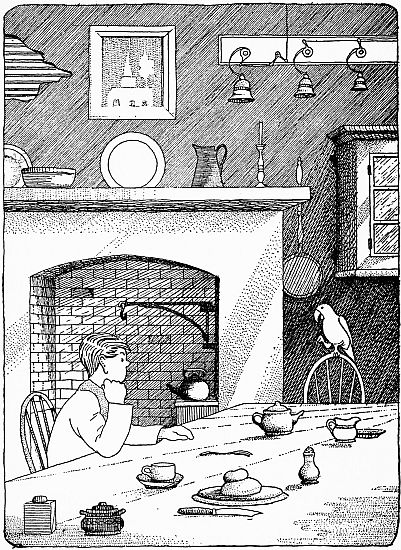 “‘Being a good noticer is terribly important’”
“Oh, I’d love that!” I cried. “Do you think theDoctor would let me?”
“Certainly,” said Polynesia—“as soon as youhave learned something about doctoring. I’llspeak of it to him myself—Sh! I hear himcoming. Quick—bring his bacon back on to thetable.”
[55]
THE NINTH CHAPTER
THE GARDEN OF DREAMSWHEN breakfast was over the Doctortook me out to show me the garden.Well, if the house had been interesting,the garden was a hundred timesmore so. Of all the gardens I have ever seen thatwas the most delightful, the most fascinating.At first you did not realize how big it was. Younever seemed to come to the end of it. When atlast you were quite sure that you had seen it all, youwould peer over a hedge, or turn a corner, or lookup some steps, and there was a whole new part younever expected to find.
It had everything—everything a garden canhave, or ever has had. There were wide, widelawns with carved stone seats, green with moss.Over the lawns hung weeping-willows, and theirfeathery bough-tips brushed the velvet grass whenthey swung with the wind. The old flagged pathshad high, clipped, yew hedges either side of them,so that they looked like the narrow streets of someold town; and through the hedges, doorways hadbeen made; and over the doorways were shapes like[56]vases and peacocks and half-moons all trimmed outof the living trees. There was a lovely marble fish-pondwith golden carp and blue water-lilies in it andbig green frogs. A high brick wall alongside thekitchen garden was all covered with pink and yellowpeaches ripening in the sun. There was a wonderfulgreat oak, hollow in the trunk, big enough forfour men to hide inside. Many summer-housesthere were, too—some of wood and some of stone;and one of them was full of books to read. In acorner, among some rocks and ferns, was an outdoorfire-place, where the Doctor used to fry liverand bacon when he had a notion to take his mealsin the open air. There was a couch as well onwhich he used to sleep, it seems, on warm summernights when the nightingales were singing at theirbest; it had wheels on it so it could be moved aboutunder any tree they sang in. But the thing thatfascinated me most of all was a tiny little tree-house,high up in the top branches of a great elm,with a long rope ladder leading to it. The Doctortold me he used it for looking at the moon and thestars through a telescope.
It was the kind of a garden where you couldwander and explore for days and days—alwayscoming upon something new, always glad to find theold spots over again. That first time that I sawthe Doctor’s garden I was so charmed by it that Ifelt I would like to live in it—always and always—and[57]never go outside of it again. For it had everythingwithin its walls to give happiness, to makeliving pleasant—to keep the heart at peace. It wasthe Garden of Dreams.
One peculiar thing I noticed immediately I cameinto it; and that was what a lot of birds there wereabout. Every tree seemed to have two or threenests in it. And heaps of other wild creaturesappeared to be making themselves at home there,too. Stoats and tortoises and dormice seemed tobe quite common, and not in the least shy. Toadsof different colors and sizes hopped about the lawnas though it belonged to them. Green lizards(which were very rare in Puddleby) sat up onthe stones in the sunlight and blinked at us. Evensnakes were to be seen.
“You need not be afraid of them,” said the Doctor,noticing that I started somewhat when a largeblack snake wiggled across the path right in frontof us. “These fellows are not poisonous. Theydo a great deal of good in keeping down many kindsof garden-pests. I play the flute to them sometimesin the evening. They love it. Stand rightup on their tails and carry on no end. Funny thing,their taste for music.”
“Why do all these animals come and live here?”I asked. “I never saw a garden with so manycreatures in it.”
“Well, I suppose it’s because they get the kind[58]of food they like; and nobody worries or disturbsthem. And then, of course, they know me. Andif they or their children get sick I presume they findit handy to be living in a doctor’s garden—Look!You see that sparrow on the sundial, swearing atthe blackbird down below? Well, he has beencoming here every summer for years. He comesfrom London. The country sparrows round abouthere are always laughing at him. They say hechirps with such a Cockney accent. He is a mostamusing bird—very brave but very cheeky. Heloves nothing better than an argument, but he alwaysends it by getting rude. He is a real citybird. In London he lives around St. Paul’s Cathedral.‘Cheapside,’ we call him.”
“Are all these birds from the country roundhere?” I asked.
“Most of them,” said the Doctor. “But a fewrare ones visit me every year who ordinarily nevercome near England at all. For instance, that handsomelittle fellow hovering over the snapdragonthere, he’s a Ruby-throated Humming-bird. Comesfrom America. Strictly speaking, he has no businessin this climate at all. It is too cool. I makehim sleep in the kitchen at night. Then every August,about the last week of the month, I have aPurple Bird-of-Paradise come all the way fromBrazil to see me. She is a very great swell.[59]Hasn’t arrived yet of course. And there are afew others, foreign birds from the tropics mostly,who drop in on me in the course of the summermonths. But come, I must show you the zoo.”
[60]
THE TENTH CHAPTER
THE PRIVATE ZOOI DID not think there could be anything leftin that garden which we had not seen. Butthe Doctor took me by the arm and startedoff down a little narrow path and after manywindings and twistings and turnings we found ourselvesbefore a small door in a high stone wall.The Doctor pushed it open.
Inside was still another garden. I had expectedto find cages with animals inside them. But therewere none to be seen. Instead there were littlestone houses here and there all over the garden;and each house had a window and a door. As wewalked in, many of these doors opened and animalscame running out to us evidently expecting food.
“Haven’t the doors any locks on them?” I askedthe Doctor.
“Oh yes,” he said, “every door has a lock. Butin my zoo the doors open from the inside, not fromthe out. The locks are only there so the animalscan go and shut themselves inany time they wantto get away from the annoyance of other animalsor from people who might come here. Every[61]animal in this zoo stays here because he likes it,not because he is made to.”
“They all look very happy and clean,” I said.“Would you mind telling me the names of some ofthem?”
“Certainly. Well now: that funny-looking thingwith plates on his back, nosing under the brick overthere, is a South American armadillo. The littlechap talking to him is a Canadian woodchuck.They both live in those holes you see at the footof the wall. The two little beasts doing antics inthe pond are a pair of Russian minks—and thatreminds me: I must go and get them some herringsfrom the town before noon—it is early-closingto-day. That animal just stepping out of his houseis an antelope, one of the smaller South Africankinds. Now let us move to the other side of thosebushes there and I will show you some more.”
“Are those deer over there?” I asked.
“Deer!” said the Doctor. “Where do youmean?”
“Over there,” I said, pointing—“nibbling thegrass border of the bed. There are two of them.”
“Oh, that,” said the Doctor with a smile. “Thatisn’t two animals: that’s one animal with two heads—theonly two-headed animal in the world. It’scalled the ‘pushmi-pullyu.’ I brought him fromAfrica. He’s very tame—acts as a kind of night-watchmanfor my zoo. He only sleeps with one[62]head at a time, you see—very handy—the otherhead stays awake all night.”
“Have you any lions or tigers?” I asked as wemoved on.
“No,” said the Doctor. “It wouldn’t be possibleto keep them here—and I wouldn’t keep themeven if I could. If I had my way, Stubbins, therewouldn’t be a single lion or tiger in captivity anywherein the world. They never take to it.They’re never happy. They never settle down.They are always thinking of the big countries theyhave left behind. You can see it in their eyes,dreaming—dreaming always of the great openspaces where they were born; dreaming of the deep,dark jungles where their mothers first taught themhow to scent and track the deer. And what arethey given in exchange for all this?” asked theDoctor, stopping in his walk and growing all redand angry—“What are they given in exchangefor the glory of an African sunrise, for the twilightbreeze whispering through the palms, for the greenshade of the matted, tangled vines, for the cool,big-starred nights of the desert, for the patter ofthe waterfall after a hard day’s hunt? What, Iask you, are they given in exchange for these?Why, a bare cage with iron bars; an ugly piece ofdead meat thrust in to them once a day; and acrowd of fools to come and stare at them withopen mouths!—No, Stubbins. Lions and tigers,[63]the Big Hunters, should never, never be seen inzoos.”
The Doctor seemed to have grown terriblyserious—almost sad. But suddenly his mannerchanged again and he took me by the arm with hissame old cheerful smile.
“But we haven’t seen the butterfly-houses yet—northe aquariums. Come along. I am veryproud of my butterfly-houses.”
Off we went again and came presently into ahedged enclosure. Here I saw several big hutsmade of fine wire netting, like cages. Inside thenetting all sorts of beautiful flowers were growingin the sun, with butterflies skimming over them.The Doctor pointed to the end of one of the hutswhere little boxes with holes in them stood in arow.
“Those are the hatching-boxes,” said he.“There I put the different kinds of caterpillars.And as soon as they turn into butterflies and mothsthey come out into these flower-gardens to feed.”
“Do butterflies have a language?” I asked.
“Oh I fancy they have,” said the Doctor—“andthe beetles too. But so far I haven’t succeededin learning much about insect languages. I havebeen too busy lately trying to master the shellfish-talk.I mean to take it up though.”
At that moment Polynesia joined us and said,“Doctor, there are two guinea-pigs at the back[64]door. They say they have run away from theboy who kept them because they didn’t get the rightstuff to eat. They want to know if you will takethem in.”
“All right,” said the Doctor. “Show them theway to the zoo. Give them the house on the left,near the gate—the one the black fox had. Tellthem what the rules are and give them a squaremeal—Now, Stubbins, we will go on to the aquariums.And first of all I must show you my big,glass, sea-water tank where I keep the shellfish.”
[65]
THE ELEVENTH CHAPTER
MY SCHOOLMASTER, POLYNESIAWELL, there were not many days afterthat, you may be sure, when I did notcome to see my new friend. IndeedI was at his house practically all dayand every day. So that one evening my motherasked me jokingly why I did not take my bed overthere and live at the Doctor’s house altogether.
After a while I think I got to be quite useful tothe Doctor, feeding his pets for him; helping tomake new houses and fences for the zoo; assistingwith the sick animals that came; doing all mannerof odd jobs about the place. So that although Ienjoyed it all very much (it was indeed like livingin a new world) I really think the Doctor wouldhave missed me if I had not come so often.
And all this time Polynesia came with mewherever I went, teaching me bird language andshowing me how to understand the talking signsof the animals. At first I thought I would neverbe able to learn at all—it seemed so difficult. Butthe old parrot was wonderfully patient with me—thoughI could see that occasionally she had hardwork to keep her temper.
[66]
Soon I began to pick up the strange chatter ofthe birds and to understand the funny talking anticsof the dogs. I used to practise listening to themice behind the wainscot after I went to bed, andwatching the cats on the roofs and pigeons in themarket-square of Puddleby.
And the days passed very quickly—as they alwaysdo when life is pleasant; and the days turned intoweeks, and weeks into months; and soon the rosesin the Doctor’s garden were losing their petals andyellow leaves lay upon the wide green lawn. Forthe summer was nearly gone.
One day Polynesia and I were talking in thelibrary. This was a fine long room with a grandmantlepiece and the walls were covered from theceiling to the floor with shelves full of books:books of stories, books on gardening, books aboutmedicine, books of travel; these I loved—and especiallythe Doctor’s great atlas with all its maps ofthe different countries of the world.
This afternoon Polynesia was showing me thebooks about animals which John Dolittle had writtenhimself.
“My!” I said, “what a lot of books the Doctorhas—all the way around the room! Goodness!I wish I could read! It must be tremendouslyinteresting. Can you read, Polynesia?”
“Only a little,” said she. “Be careful how youturn those pages—don’t tear them. No, I really[67]don’t get time enough for reading—much. Thatletter there is a kand this is a b.”
“What does this word under the picture mean?”I asked.
“Let me see,” she said, and started spelling it out.“B-A-B-O-O-N—that’s Monkey. Reading isn’t nearlyas hard as it looks, once you know the letters.”
“Polynesia,” I said, “I want to ask you somethingvery important.”
“What is it, my boy?” said she, smoothingdown the feathers of her right wing. Polynesiaoften spoke to me in a very patronizing way. ButI did not mind it from her. After all, she wasnearly two hundred years old; and I was onlyten.
“Listen,” I said, “my mother doesn’t think itis right that I come here for so many meals. AndI was going to ask you: supposing I did a wholelot more work for the Doctor—why couldn’t Icome and live here altogether? You see, insteadof being paid like a regular gardener or workman,I would get my bed and meals in exchange for thework I did. What do you think?”
“You mean you want to be a proper assistant tothe Doctor, is that it?”
“Yes. I suppose that’s what you call it,” Ianswered. “You know you said yourself that youthought I could be very useful to him.”
“Well”—she thought a moment—“I really[68]don’t see why not. But is this what you want tobe when you grow up, a naturalist?”
“Yes,” I said, “I have made up my mind. Iwould sooner be a naturalist than anything else inthe world.”
“Humph!—Let’s go and speak to the Doctorabout it,” said Polynesia. “He’s in the next room—inthe study. Open the door very gently—hemay be working and not want to be disturbed.”
I opened the door quietly and peeped in. Thefirst thing I saw was an enormous black retrieverdog sitting in the middle of the hearth-rug with hisears cocked up, listening to the Doctor who wasreading aloud to him from a letter.
“What isthe Doctor doing?” I asked Polynesiain a whisper.
“Oh, the dog has had a letter from his mistressand he has brought it to the Doctor to read for him.That’s all. He belongs to a funny little girl calledMinnie Dooley, who lives on the other side of thetown. She has pigtails down her back. She andher brother have gone away to the seaside for theSummer; and the old retriever is heart-brokenwhile the children are gone. So they write lettersto him—in English of course. And as the old dogdoesn’t understand them, he brings them here, andthe Doctor turns them into dog language for him.I think Minnie must have written that she is coming[69]back—to judge from the dog’s excitement. Justlook at him carrying on!”
Indeed the retriever seemed to be suddenly overcomewith joy. As the Doctor finished the letterthe old dog started barking at the top of his voice,wagging his tail wildly and jumping about thestudy. He took the letter in his mouth and ranout of the room snorting hard and mumbling tohimself.
“He’s going down to meet the coach,” whisperedPolynesia. “That dog’s devotion to those childrenis more than I can understand. You should seeMinnie! She’s the most conceited little minx thatever walked. She squints too.”
[70]
THE TWELFTH CHAPTER
MY GREAT IDEAPRESENTLY the Doctor looked up andsaw us at the door.
“Oh—come in, Stubbins,” said he, “didyou wish to speak to me? Come in andtake a chair.”
“Doctor,” I said, “I want to be a naturalist—likeyou—when I grow up.”
“Oh you do, do you?” murmured the Doctor.“Humph!—Well!—Dear me!—You don’t say!—Well,well! Have you er—have you spokento your mother and father about it?”
“No, not yet,” I said. “I want you to speak tothem for me. You would do it better. I want tobe your helper—your assistant, if you’ll have me.Last night my mother was saying that she didn’tconsider it right for me to come here so often formeals. And I’ve been thinking about it a gooddeal since. Couldn’t we make some arrangement—couldn’tI work for my meals and sleep here?”
“But my dear Stubbins,” said the Doctor, laughing,“you are quite welcome to come here forthree meals a day all the year round. I’m onlytoo glad to have you. Besides, you do do a lot of[71]work, as it is. I’ve often felt that I ought to payyou for what you do—But what arrangement wasit that you thought of?”
“Well, I thought,” said I, “that perhaps youwould come and see my mother and father andtell them that if they let me live here with you andwork hard, that you will teach me to read andwrite. You see my mother is awfully anxious tohave me learn reading and writing. And besides,I couldn’t be a proper naturalist without, could I?”
“Oh, I don’t know so much about that,” saidthe Doctor. “It is nice, I admit, to be able toread and write. But naturalists are not all alike,you know. For example: this young fellow CharlesDarwin that people are talking about so much now—he’sa Cambridge graduate—reads and writesvery well. And then Cuvier—he used to be atutor. But listen, the greatest naturalist of themall doesn’t even know how to write his own namenor to read the A B C.”
“Who is he?” I asked.
“He is a mysterious person,” said the Doctor—“avery mysterious person. His name is Long Arrow,the son of Golden Arrow. He is a RedIndian.”
“Have you ever seen him?” I asked.
“No,” said the Doctor, “I’ve never seen him.No white man has ever met him. I fancy Mr.Darwin doesn’t even know that he exists. He lives[72]almost entirely with the animals and with the differenttribes of Indians—usually somewhere amongthe mountains of Peru. Never stays long in oneplace. Goes from tribe to tribe, like a sort ofIndian tramp.”
“How do you know so much about him?” Iasked—“if you’ve never even seen him?”
“The Purple Bird-of-Paradise,” said the Doctor—“shetold me all about him. She says he is aperfectly marvelous naturalist. I got her to takea message to him for me last time she was here.I am expecting her back any day now. I can hardlywait to see what answer she has brought from him.It is already almost the last week of August. Ido hope nothing has happened to her on the way.”
“But why do the animals and birds come toyou when they are sick?” I said—“Why don’tthey go to him, if he is so very wonderful?”
“It seems that my methods are more up todate,” said the Doctor. “But from what the PurpleBird-of-Paradise tells me, Long Arrow’sknowledge of natural history must be positivelytremendous. His specialty is botany—plants andall that sort of thing. But he knows a lot aboutbirds and animals too. He’s very good on beesand beetles—But now tell me, Stubbins, are youquite sure that you really want to be a naturalist?”
“Yes,” said I, “my mind is made up.”
“Well you know, it isn’t a very good profession[73]for making money. Not at all, it isn’t. Most ofthe good naturalists don’t make any money whatever.All they do is spendmoney, buying butterfly-netsand cases for birds’ eggs and things. It is onlynow, after I have been a naturalist for many years,that I am beginning to make a little money fromthe books I write.”
“I don’t care about money,” I said. “I wantto be a naturalist. Won’t you please come andhave dinner with my mother and father next Thursday—Itold them I was going to ask you—and thenyou can talk to them about it. You see, there’s anotherthing: if I’m living with you, and sort of belongto your house and business, I shall be ableto come with you next time you go on a voyage.”
“Oh, I see,” said he, smiling. “So you want tocome on a voyage with me, do you?—Ah hah!”
“I want to go on all your voyages with you. Itwould be much easier for you if you had someoneto carry the butterfly-nets and note-books.Wouldn’t it now?”
For a long time the Doctor sat thinking, drummingon the desk with his fingers, while I waited,terribly impatiently, to see what he was going tosay.
At last he shrugged his shoulders and stood up.
“Well, Stubbins,” said he, “I’ll come and talk itover with you and your parents next Thursday.And—well, we’ll see. We’ll see. Give your[74]mother and father my compliments and thank themfor their invitation, will you?”
Then I tore home like the wind to tell my motherthat the Doctor had promised to come.
[75]
THE THIRTEENTH CHAPTER
A TRAVELER ARRIVESTHE next day I was sitting on the wall ofthe Doctor’s garden after tea, talkingto Dab-Dab. I had now learned somuch from Polynesia that I could talkto most birds and some animals without a greatdeal of difficulty. I found Dab-Dab a very nice,old, motherly bird—though not nearly so cleverand interesting as Polynesia. She had been housekeeperfor the Doctor many years now.
Well, as I was saying, the old duck and I weresitting on the flat top of the garden-wall that evening,looking down into the Oxenthorpe Road below.We were watching some sheep being drivento market in Puddleby; and Dab-Dab had just beentelling me about the Doctor’s adventures in Africa.For she had gone on a voyage with him to thatcountry long ago.
Suddenly I heard a curious distant noise downthe road, towards the town. It sounded like a lotof people cheering. I stood up on the wall to seeif I could make out what was coming. Presentlythere appeared round a bend a great crowd of[76]school-children following a very ragged, curious-lookingwoman.
“What in the world can it be?” cried Dab-Dab.
The children were all laughing and shouting.And certainly the woman they were following wasmost extraordinary. She had very long arms andthe most stooping shoulders I have ever seen. Shewore a straw hat on the side of her head withpoppies on it; and her skirt was so long for her itdragged on the ground like a ball-gown’s train. Icould not see anything of her face because of thewide hat pulled over her eyes. But as she gotnearer to us and the laughing of the children grewlouder, I noticed that her hands were very darkin color, and hairy, like a witch’s.
Then all of a sudden Dab-Dab at my side startledme by crying out in a loud voice,
“Why, it’s Chee-Chee!—Chee-Chee come back atlast! How dare those children tease him! I’llgive the little imps something to laugh at!”
And she flew right off the wall down into the roadand made straight for the children, squawking awayin a most terrifying fashion and pecking at theirfeet and legs. The children made off down thestreet back to the town as hard as they could run.
The strange-looking figure in the straw hat stoodgazing after them a moment and then came wearilyup to the gate. It didn’t bother to undo the latchbut just climbed right over the gate as though it[77]
[78]were something in the way. And then I noticedthat it took hold of the bars with its feet, so thatit really had four hands to climb with. But it wasonly when I at last got a glimpse of the face underthe hat that I could be really sure it was a monkey.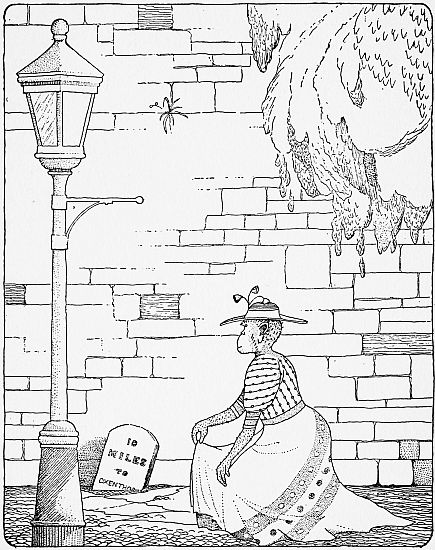 A traveler arrives
Chee-Chee—for it was he—frowned at me suspiciouslyfrom the top of the gate, as though hethought I was going to laugh at him like the otherboys and girls. Then he dropped into the gardenon the inside and immediately started taking offhis clothes. He tore the straw hat in two andthrew it down into the road. Then he took off hisbodice and skirt, jumped on them savagely andbegan kicking them round the front garden.
Presently I heard a screech from the house, andout flew Polynesia, followed by the Doctor and Jip.
“Chee-Chee!—Chee-Chee!” shouted the parrot.“You’ve come at last! I always told the Doctoryou’d find a way. How ever did you do it?”
They all gathered round him shaking him by hisfour hands, laughing and asking him a millionquestions at once. Then they all started back forthe house.
“Run up to my bedroom, Stubbins,” said theDoctor, turning to me. “You’ll find a bag of peanutsin the small left-hand drawer of the bureau.I have always kept them there in case he mightcome back unexpectedly some day. And wait aminute—see if Dab-Dab has any bananas in the pantry.[79]Chee-Chee hasn’t had a banana, he tells me,in two months.”
When I came down again to the kitchen I foundeverybody listening attentively to the monkey whowas telling the story of his journey from Africa.
[80]
THE FOURTEENTH CHAPTER
CHEE-CHEE’S VOYAGEIt seems that after Polynesia had left, Chee-Cheehad grown more homesick thanever for the Doctor and the littlehouse in Puddleby. At last he hadmade up his mind that by hook or crook he wouldfollow her. And one day, going down to the seashore,he saw a lot of people, black and white,getting on to a ship that was coming to England.He tried to get on too. But they turned him backand drove him away. And presently he noticed awhole big family of funny people passing on to theship. And one of the children in this family remindedChee-Chee of a cousin of his with whom hehad once been in love. So he said to himself,“That girl looks just as much like a monkey as Ilook like a girl. If I could only get some clothesto wear I might easily slip on to the ship amongstthese families, and people would take me for agirl. Good idea!”
So he went off to a town that was quite close,and hopping in through an open window he found askirt and bodice lying on a chair. They belonged[81]to a fashionable black lady who was taking a bath.Chee-Chee put them on. Next he went back to theseashore, mingled with the crowd there and at lastsneaked safely on to the big ship. Then he thoughthe had better hide, for fear people might look athim too closely. And he stayed hidden all the timethe ship was sailing to England—only coming outat night, when everybody was asleep, to find food.
When he reached England and tried to get off theship, the sailors saw at last that he was only a monkeydressed up in girl’s clothes; and they wantedto keep him for a pet. But he managed to givethem the slip; and once he was on shore, he divedinto the crowd and got away. But he was still along distance from Puddleby and had to come rightacross the whole breadth of England.
He had a terrible time of it. Whenever hepassed through a town all the children ran afterhim in a crowd, laughing; and often silly peoplecaught hold of him and tried to stop him, so thathe had to run up lamp-posts and climb to chimney-potsto escape from them. At night he used tosleep in ditches or barns or anywhere he could hide;and he lived on the berries he picked from thehedges and the cob-nuts that grew in the copses.At length, after many adventures and narrowsqueaks, he saw the tower of Puddleby Church andhe knew that at last he was near his old home.
When Chee-Chee had finished his story he ate[82]six bananas without stopping and drank a wholebowlful of milk.
“My!” he said, “why wasn’t I born withwings, like Polynesia, so I could fly here? You’veno idea how I grew to hate that hat and skirt.I’ve never been so uncomfortable in my life. Allthe way from Bristol here, if the wretched hatwasn’t falling off my head or catching in the trees,those beastly skirts were tripping me up and gettingwound round everything. What on earth dowomen wear those things for? Goodness, I wasglad to see old Puddleby this morning when Iclimbed over the hill by Bellaby’s farm!”
“Your bed on top of the plate-rack in the sculleryis all ready for you,” said the Doctor. “We neverhad it disturbed in case you might come back.”
“Yes,” said Dab-Dab, “and you can have the oldsmoking-jacket of the Doctor’s which you used touse as a blanket, in case it is cold in the night.”
“Thanks,” said Chee-Chee. “It’s good to beback in the old house again. Everything’s just thesame as when I left—except the clean roller-towelon the back of the door there—that’s new—Well,I think I’ll go to bed now. I need sleep.”
Then we all went out of the kitchen into thescullery and watched Chee-Chee climb the plate-racklike a sailor going up a mast. On the top, hecurled himself up, pulled the old smoking-jacket[83]over him, and in a minute he was snoring peacefully.
“Good old Chee-Chee!” whispered the Doctor.“I’m glad he’s back.”
“Yes—good old Chee-Chee!” echoed Dab-Daband Polynesia.
Then we all tip-toed out of the scullery andclosed the door very gently behind us.
[84]
THE FIFTEENTH CHAPTER
I BECOME A DOCTOR’S ASSISTANTWHEN Thursday evening came therewas great excitement at our house.My mother had asked me what werethe Doctor’s favorite dishes, and Ihad told her: spare ribs, sliced beet-root, friedbread, shrimps and treacle-tart. To-night she hadthem all on the table waiting for him; and she wasnow fussing round the house to see if everythingwas tidy and in readiness for his coming.
At last we heard a knock upon the door, and ofcourse it was I who got there first to let him in.
The Doctor had brought his own flute with himthis time. And after supper was over (which heenjoyed very much) the table was cleared awayand the washing-up left in the kitchen-sink till thenext day. Then the Doctor and my father startedplaying duets.
They got so interested in this that I began to beafraid that they would never come to talking overmy business. But at last the Doctor said,
“Your son tells me that he is anxious to becomea naturalist.”
And then began a long talk which lasted far into[85]the night. At first both my mother and fatherwere rather against the idea—as they had beenfrom the beginning. They said it was only a boyishwhim, and that I would get tired of it verysoon. But after the matter had been talked overfrom every side, the Doctor turned to my fatherand said,
“Well now, supposing, Mr. Stubbins, that yourson came to me for two years—that is, until he istwelve years old. During those two years he willhave time to see if he is going to grow tired of itor not. Also during that time, I will promise toteach him reading and writing and perhaps a littlearithmetic as well. What do you say to that?”
“I don’t know,” said my father, shaking his head.“You are very kind and it is a handsome offer youmake, Doctor. But I feel that Tommy ought tobe learning some trade by which he can earn hisliving later on.”
Then my mother spoke up. Although she wasnearly in tears at the prospect of my leaving herhouse while I was still so young, she pointed outto my father that this was a grand chance for meto get learning.
“Now Jacob,” she said, “you know that manylads in the town have been to the Grammar Schooltill they were fourteen or fifteen years old.Tommy can easily spare these two years for hiseducation; and if he learns no more than to read[86]and write, the time will not be lost. Thoughgoodness knows,” she added, getting out her handkerchiefto cry, “the house will seem terribly emptywhen he’s gone.”
“I will take care that he comes to see you, Mrs.Stubbins,” said the Doctor—“every day, if you like.After all, he will not be very far away.”
Well, at length my father gave in; and it wasagreed that I was to live with the Doctor and workfor him for two years in exchange for learning toread and write and for my board and lodging.
“Of course,” added the Doctor, “while I havemoney I will keep Tommy in clothes as well. Butmoney is a very irregular thing with me; sometimesI have some, and then sometimes I haven’t.”
“You are very good, Doctor,” said my mother,drying her tears. “It seems to me that Tommy isa very fortunate boy.”
And then, thoughtless, selfish little imp that Iwas, I leaned over and whispered in the Doctor’sear,
“Please don’t forget to say something about thevoyages.”
“Oh, by the way,” said John Dolittle, “of courseoccasionally my work requires me to travel. Youwill have no objection, I take it, to your son’s comingwith me?”
My poor mother looked up sharply, more unhappyand anxious than ever at this new turn;[87]while I stood behind the Doctor’s chair, my heartthumping with excitement, waiting for my father’sanswer.
“No,” he said slowly after a while. “If weagree to the other arrangement I don’t see thatwe’ve the right to make any objection to that.”
Well, there surely was never a happier boy inthe world than I was at that moment. My headwas in the clouds. I trod on air. I could scarcelykeep from dancing round the parlor. At last thedream of my life was to come true! At last Iwas to be given a chance to seek my fortune, tohave adventures! For I knew perfectly well thatit was now almost time for the Doctor to start uponanother voyage. Polynesia had told me that hehardly ever stayed at home for more than sixmonths at a stretch. Therefore he would besurely going again within a fortnight. And I—I,Tommy Stubbins, would go with him! Just tothink of it!—to cross the Sea, to walk on foreignshores, to roam the World!

[88]
PART TWO
THE FIRST CHAPTER
THE CREW OF “THE CURLEW”FROM that time on of course my positionin the town was very different. I wasno longer a poor cobbler’s son. I carriedmy nose in the air as I went down theHigh Street with Jip in his gold collar at my side;and snobbish little boys who had despised me beforebecause I was not rich enough to go to school nowpointed me out to their friends and whispered,“You see him? He’s a doctor’s assistant—andonly ten years old!”
But their eyes would have opened still wider withwonder if they had but known that I and the dogthat was with me could talk to one another.
Two days after the Doctor had been to ourhouse to dinner he told me very sadly that he wasafraid that he would have to give up trying to learnthe language of the shellfish—at all events for thepresent.
“I’m very discouraged, Stubbins, very. I’vetried the mussels and the clams, the oysters and thewhelks, cockles and scallops; seven different kinds[89]of crabs and all the lobster family. I think I’llleave it for the present and go at it again later on.”
“What will you turn to now?” I asked.
“Well, I rather thought of going on a voyage,Stubbins. It’s quite a time now since I’ve beenaway. And there is a great deal of work waitingfor me abroad.”
“When shall we start?” I asked.
“Well, first I shall have to wait till the PurpleBird-of-Paradise gets here. I must see if she hasany message for me from Long Arrow. She’slate. She should have been here ten days ago. Ihope to goodness she’s all right.”
“Well, hadn’t we better be seeing about gettinga boat?” I said. “She is sure to be here in a dayor so; and there will be lots of things to do to getready in the mean time, won’t there?”
“Yes, indeed,” said the Doctor. “Suppose wego down and see your friend Joe, the mussel-man.He will know about boats.”
“I’d like to come too,” said Jip.
“All right, come along,” said the Doctor, andoff we went.
Joe said yes, he had a boat—one he had justbought—but it needed three people to sail her.We told him we would like to see it anyway.
So the mussel-man took us off a little way downthe river and showed us the neatest, prettiest, littlevessel that ever was built. She was called The[90]Curlew. Joe said he would sell her to us cheap.But the trouble was that the boat needed threepeople, while we were only two.
“Of course I shall be taking Chee-Chee,” saidthe Doctor. “But although he is very quick andclever, he is not as strong as a man. We reallyought to have another person to sail a boat as bigas that.”
“I know of a good sailor, Doctor,” said Joe—“afirst-class seaman who would be glad of the job.”
“No, thank you, Joe,” said Doctor Dolittle. “Idon’t want any seamen. I couldn’t afford to hirethem. And then they hamper me so, seamen do,when I’m at sea. They’re always wanting to dothings the proper way; and I like to do them myway—Now let me see: who could we take with us?”
“There’s Matthew Mugg, the cat’s-meat-man,”I said.
“No, he wouldn’t do. Matthew’s a very nicefellow, but he talks too much—mostly about hisrheumatism. You have to be frightfully particularwhom you take with you on long voyages.”
“How about Luke the Hermit?” I asked.
“That’s a good idea—splendid—if he’ll come.Let’s go and ask him right away.”
[91]
THE SECOND CHAPTER
LUKE THE HERMITTHE Hermit was an old friend of ours, asI have already told you. He was a verypeculiar person. Far out on the marsheshe lived in a little bit of a shack—allalone except for his brindle bulldog. No oneknew where he came from—not even his name.Just “Luke the Hermit” folks called him. Henever came into the town; never seemed to wantto see or talk to people. His dog, Bob, drovethem away if they came near his hut. When youasked anyone in Puddleby who he was or why helived out in that lonely place by himself, the onlyanswer you got was, “Oh, Luke the Hermit?Well, there’s some mystery about him. Nobodyknows what it is. But there’s a mystery. Don’tgo near him. He’ll set the dog on you.”
Nevertheless there were two people who oftenwent out to that little shack on the fens: the Doctorand myself. And Bob, the bulldog, never barkedwhen he heard us coming. For we liked Luke;and Luke liked us.
This afternoon, crossing the marshes we faceda cold wind blowing from the East. As we[92]approached the hut Jip put up his ears and said,
“That’s funny!”
“What’s funny?” asked the Doctor.
“That Bob hasn’t come out to meet us. Heshould have heard us long ago—or smelt us.What’s that queer noise?”
“Sounds to me like a gate creaking,” said theDoctor. “Maybe it’s Luke’s door, only we can’tsee the door from here; it’s on the far side of theshack.”
“I hope Bob isn’t sick,” said Jip; and he letout a bark to see if that would call him. But theonly answer he got was the wailing of the windacross the wide, salt fen.
We hurried forward, all three of us thinkinghard.
When we reached the front of the shack wefound the door open, swinging and creaking dismallyin the wind. We looked inside. Therewas no one there.
“Isn’t Luke at home then?” said I. “Perhapshe’s out for a walk.”
“He is alwaysat home,” said the Doctor frowningin a peculiar sort of way. “And even if hewere out for a walk he wouldn’t leave his doorbanging in the wind behind him. There is somethingqueer about this—What are you doing inthere, Jip?”
[93]
“Nothing much—nothing worth speaking of,”said Jip examining the floor of the hut extremelycarefully.
“Come here, Jip,” said the Doctor in a sternvoice. “You are hiding something from me. Yousee signs and you know something—or you guessit. What has happened? Tell me. Where is theHermit?”
“I don’t know,” said Jip looking very guilty anduncomfortable. “I don’t know where he is.”
“Well, you know something. I can tell it fromthe look in your eye. What is it?”
But Jip didn’t answer.
For ten minutes the Doctor kept questioninghim. But not a word would the dog say.
“Well,” said the Doctor at last, “it is no useour standing around here in the cold. The Hermit’sgone. That’s all. We might as well go hometo luncheon.”
As we buttoned up our coats and started backacross the marsh, Jip ran ahead pretending he waslooking for water-rats.
“He knows something all right,” whispered theDoctor. “And I think he knows what has happenedtoo. It’s funny, his not wanting to tell me. Hehas never done that before—not in eleven years.He has always told me everything—Strange—verystrange!”
[94]
“Do you mean you think he knows all about theHermit, the big mystery about him which folkshint at and all that?”
“I shouldn’t wonder if he did,” the Doctor answeredslowly. “I noticed something in his expressionthe moment we found that door open andthe hut empty. And the way he sniffed the floortoo—it told him something, that floor did. Hesaw signs we couldn’t see—I wonder why he won’ttell me. I’ll try him again. Here, Jip! Jip!—Whereis the dog? I thought he went on in front.”
“So did I,” I said. “He was there a momentago. I saw him as large as life. Jip—Jip—Jip—JIP!”
But he was gone. We called and called. Weeven walked back to the hut. But Jip had disappeared.
“Oh well,” I said, “most likely he has just runhome ahead of us. He often does that, you know.We’ll find him there when we get back to the house.”
But the Doctor just closed his coat-collar tighteragainst the wind and strode on muttering, “Odd—veryodd!”
[95]
THE THIRD CHAPTER
JIP AND THE SECRETWHEN we reached the house the firstquestion the Doctor asked of Dab-Dabin the hall was,
“Is Jip home yet?”
“No,” said Dab-Dab, “I haven’t seen him.”
“Let me know the moment he comes in, will you,please?” said the Doctor, hanging up his hat.
“Certainly I will,” said Dab-Dab. “Don’t belong over washing your hands; the lunch is on thetable.”
Just as we were sitting down to luncheon in thekitchen we heard a great racket at the front door.I ran and opened it. In bounded Jip.
“Doctor!” he cried, “come into the library quick.I’ve got something to tell you—No, Dab-Dab, theluncheon must wait. Please hurry, Doctor.There’s not a moment to be lost. Don’t let any ofthe animals come—just you and Tommy.”
“Now,” he said, when we were inside the libraryand the door was closed, “turn the key in thelock and make sure there’s no one listening underthe windows.”
[96]
“It’s all right,” said the Doctor. “Nobody canhear you here. Now what is it?”
“Well, Doctor,” said Jip (he was badly out ofbreath from running), “I know all about the Hermit—Ihave known for years. But I couldn’t tellyou.”
“Why?” asked the Doctor.
“Because I’d promised not to tell any one. Itwas Bob, his dog, that told me. And I swore tohim that I would keep the secret.”
“Well, and are you going to tell me now?”
“Yes,” said Jip, “we’ve got to save him. Ifollowed Bob’s scent just now when I left you outthere on the marshes. And I found him. And Isaid to him, ‘Is it all right,’ I said, ‘for me to tellthe Doctor now? Maybe he can do something.’And Bob says to me, ‘Yes,’ says he, ‘it’s all rightbecause—’”
“Oh, for Heaven’s sake, go on, go on!” cried theDoctor. “Tell us what the mystery is—not whatyou said to Bob and what Bob said to you. Whathas happened? Where isthe Hermit?”
“He’s in Puddleby Jail,” said Jip. “He’s inprison.”
“In prison!”
“Yes.”
“What for?—What’s he done?”
Jip went over to the door and smelt at the bottomof it to see if any one were listening outside.[97]Then he came back to the Doctor on tiptoe andwhispered,
“He killed a man!”
“Lord preserve us!” cried the Doctor, sittingdown heavily in a chair and mopping his foreheadwith a handkerchief. “When did he do it?”
“Fifteen years ago—in a Mexican gold-mine.That’s why he has been a hermit ever since. Heshaved off his beard and kept away from peopleout there on the marshes so he wouldn’t be recognized.But last week, it seems these new-fangledpolicemen came to Town; and they heard there wasa strange man who kept to himself all alone in ashack on the fen. And they got suspicious. Fora long time people had been hunting all over theworld for the man that did that killing in the Mexicangold-mine fifteen years ago. So these policemenwent out to the shack, and they recognizedLuke by a mole on his arm. And they took him toprison.”
“Well, well!” murmured the Doctor. “Whowould have thought it?—Luke, the philosopher!—Killeda man!—I can hardly believe it.”
“It’s true enough—unfortunately,” said Jip.“Luke did it. But it wasn’t his fault. Bob saysso. And he was there and saw it all. He wasscarcely more than a puppy at the time. Bob saysLuke couldn’t help it. He hadto do it.”
“Where is Bob now?” asked the Doctor.
[98]
“Down at the prison. I wanted him to comewith me here to see you; but he won’t leave theprison while Luke is there. He just sits outsidethe door of the prison-cell and won’t move. Hedoesn’t even eat the food they give him. Won’tyou please come down there, Doctor, and see ifthere is anything you can do? The trial is to bethis afternoon at two o’clock. What time is itnow?”
“It’s ten minutes past one.”
“Bob says he thinks they are going to kill Lukefor a punishment if they can prove that he did it—orcertainly keep him in prison for the rest of his life.Won’t you please come? Perhaps if you spoketo the judge and told him what a good man Lukereally is they’d let him off.”
“Of course I’ll come,” said the Doctor gettingup and moving to go. “But I’m very much afraidthat I shan’t be of any real help.” He turned atthe door and hesitated thoughtfully.
“And yet—I wonder—”
Then he opened the door and passed out withJip and me close at his heels.
[99]
THE FOURTH CHAPTER
BOBDAB-DAB was terribly upset when shefound we were going away again withoutluncheon; and she made us takesome cold pork-pies in our pockets toeat on the way.
When we got to Puddleby Court-house (it wasnext door to the prison), we found a great crowdgathered around the building.
This was the week of the Assizes—a businesswhich happened every three months, when manypick-pockets and other bad characters were triedby a very grand judge who came all the way fromLondon. And anybody in Puddleby who had nothingspecial to do used to come to the Court-houseto hear the trials.
But to-day it was different. The crowd was notmade up of just a few idle people. It was enormous.The news had run through the countrysidethat Luke the Hermit was to be tried for killing aman and that the great mystery which had hungover him so long was to be cleared up at last. Thebutcher and the baker had closed their shops andtaken a holiday. All the farmers from round-about,[100]and all the townsfolk, were there with theirSunday clothes on, trying to get seats in the Court-houseor gossipping outside in low whispers. TheHigh Street was so crowded you could hardly movealong it. I had never seen the quiet old town insuch a state of excitement before. For Puddlebyhad not had such an Assizes since 1799, whenFerdinand Phipps, the Rector’s oldest son, hadrobbed the bank.
If I hadn’t had the Doctor with me I am sure Iwould never have been able to make my way throughthe mob packed around the Court-house door. ButI just followed behind him, hanging on to his coat-tails;and at last we got safely into the jail.
“I want to see Luke,” said the Doctor to a verygrand person in a blue coat with brass buttonsstanding at the door.
“Ask at the Superintendent’s office,” said theman. “Third door on the left down the corridor.”
“Who is that person you spoke to, Doctor?”I asked as we went along the passage.
“He is a policeman.”
“And what are policemen?”
“Policemen? They are to keep people in order.They’ve just been invented—by Sir Robert Peel.That’s why they are also called ‘peelers’ sometimes.It is a wonderful age we live in. They’realways thinking of something new—This will bethe Superintendent’s office, I suppose.”
[101]
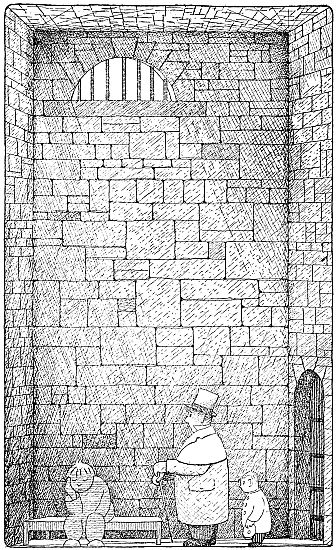 “On the bed sat the Hermit”
[102]
From there another policeman was sent with usto show us the way.
Outside the door of Luke’s cell we found Bob,the bulldog, who wagged his tail sadly when hesaw us. The man who was guiding us took a largebunch of keys from his pocket and opened the door.
I had never been inside a real prison-cell before;and I felt quite a thrill when the policeman wentout and locked the door after him, leaving us shutin the dimly-lighted, little, stone room. Before hewent, he said that as soon as we had done talkingwith our friend we should knock upon the door andhe would come and let us out.
At first I could hardly see anything, it was so diminside. But after a little I made out a low bedagainst the wall, under a small barred window. Onthe bed, staring down at the floor between his feet,sat the Hermit, his head resting in his hands.
“Well, Luke,” said the Doctor in a kindly voice,“they don’t give you much light in here, do they?”
Very slowly the Hermit looked up from thefloor.
“Hulloa, John Dolittle. What brings you here?”
“I’ve come to see you. I would have been heresooner, only I didn’t hear about all this till a fewminutes ago. I went to your hut to ask you if youwould join me on a voyage; and when I foundit empty I had no idea where you could be. Iam dreadfully sorry to hear about your bad luck.[103]I’ve come to see if there is anything I can do.”
Luke shook his head.
“No, I don’t imagine there is anything can bedone. They’ve caught me at last. That’s theend of it, I suppose.”
He got up stiffly and started walking up anddown the little room.
“In a way I’m glad it’s over,” said he. “I nevergot any peace, always thinking they were after me—afraidto speak to anyone. They were boundto get me in the end—Yes, I’m glad it’s over.”
Then the Doctor talked to Luke for more thanhalf an hour, trying to cheer him up; while I sataround wondering what I ought to say and wishingI could do something.
At last the Doctor said he wanted to see Bob; andwe knocked upon the door and were let out by thepoliceman.
“Bob,” said the Doctor to the big bulldog in thepassage, “come out with me into the porch. Iwant to ask you something.”
“How is he, Doctor?” asked Bob as we walkeddown the corridor into the Court-house porch.
“Oh, Luke’s all right. Very miserable of course,but he’s all right. Now tell me, Bob: you saw thisbusiness happen, didn’t you? You were there whenthe man was killed, eh?”
“I was, Doctor,” said Bob, “and I tell you—”
“All right,” the Doctor interrupted, “that’sall I want to know for the present. There isn’t[104]time to tell me more now. The trial is just goingto begin. There are the judge and the lawyerscoming up the steps. Now listen, Bob: I wantyou to stay with me when I go into the court-room.And whatever I tell you to do, do it. Do youunderstand? Don’t make any scenes. Don’t biteanybody, no matter what they may say about Luke.Just behave perfectly quietly and answer anyquestion I may ask you—truthfully. Do youunderstand?”
“Very well. But do you think you will be able toget him off, Doctor?” asked Bob. “He’s a goodman, Doctor. He really is. There never was abetter.”
“We’ll see, we’ll see, Bob. It’s a new thing I’mgoing to try. I’m not sure the judge will allow it.But—well, we’ll see. It’s time to go into thecourt-room now. Don’t forget what I told you.Remember: for Heaven’s sake don’t start bitingany one or you’ll get us all put out and spoil everything.”
[105]
THE FIFTH CHAPTER
MENDOZAINSIDE the court-room everything was verysolemn and wonderful. It was a high, bigroom. Raised above the floor, against thewall was the Judge’s desk; and here the judgewas already sitting—an old, handsome man in amarvelous big wig of gray hair and a gown of black.Below him was another wide, long desk at whichlawyers in white wigs sat. The whole thing remindedme of a mixture between a church and aschool.
“Those twelve men at the side,” whispered theDoctor—“those in pews like a choir, they are whatis called the jury. It is they who decide whetherLuke is guilty—whether he did it or not.”
“And look!” I said, “there’s Luke himselfin a sort of pulpit-thing with policemen each sideof him. And there’s another pulpit, the same kind,the other side of the room, see—only that one’sempty.”
“That one is called the witness-box,” said theDoctor. “Now I’m going down to speak to oneof those men in white wigs; and I want you to waithere and keep these two seats for us. Bob will[106]stay with you. Keep an eye on him—better holdon to his collar. I shan’t be more than a minuteor so.”
With that the Doctor disappeared into the crowdwhich filled the main part of the room.
Then I saw the judge take up a funny littlewooden hammer and knock on his desk with it.This, it seemed, was to make people keep quiet,for immediately every one stopped buzzing andtalking and began to listen very respectfully. Thenanother man in a black gown stood up and beganreading from a paper in his hand.
He mumbled away exactly as though he weresaying his prayers and didn’t want any one to understandwhat language they were in. But I managedto catch a few words:
“Biz—biz—biz—biz—biz—otherwise known asLuke the Hermit, of—biz—biz—biz—biz—forkilling his partner with—biz—biz—biz—otherwiseknown as Bluebeard Bill on the night of the—biz—biz—biz—inthe biz—biz—biz—of Mexico.Therefore Her Majesty’s—biz—biz—biz—”
At this moment I felt some one take hold of myarm from the back, and turning round I found theDoctor had returned with one of the men in whitewigs.
“Stubbins, this is Mr. Percy Jenkyns,” said theDoctor. “He is Luke’s lawyer. It is his businessto get Luke off—if he can.”
[107]
Mr. Jenkyns seemed to be an extremely youngman with a round smooth face like a boy. Heshook hands with me and then immediately turnedand went on talking with the Doctor.
“Oh, I think it is a perfectly precious idea,” hewas saying. “Of coursethe dog must be admittedas a witness; he was the only one who saw thething take place. I’m awfully glad you came. Iwouldn’t have missed this for anything. My hat!Won’t it make the old court sit up? They’realways frightfully dull, these Assizes. But thiswill stir things. A bulldog witness for the defense!I do hope there are plenty of reporters present—Yes,there’s one making a sketch of the prisoner.I shall become known after this—And won’t Conkeybe pleased? My hat!”
He put his hand over his mouth to smother alaugh and his eyes fairly sparkled with mischief.
“Who is Conkey?” I asked the Doctor.
“Sh! He is speaking of the judge up there, theHonorable Eustace Beauchamp Conckley.”
“Now,” said Mr. Jenkyns, bringing out a note-book,“tell me a little more about yourself, Doctor.You took your degree as Doctor of Medicine atDurham, I think you said. And the name of yourlast book was?”
I could not hear any more for they talked inwhispers; and I fell to looking round the courtagain.
[108]
Of course I could not understand everything thatwas going on, though it was all very interesting.People kept getting up in the place the Doctorcalled the witness-box, and the lawyers at the longtable asked them questions about “the night of the29th.” Then the people would get down againand somebody else would get up and be questioned.
One of the lawyers (who, the Doctor told meafterwards, was called the Prosecutor) seemed tobe doing his best to get the Hermit into trouble byasking questions which made it look as though hehad always been a very bad man. He was a nastylawyer, this Prosecutor, with a long nose.
Most of the time I could hardly keep my eyes offpoor Luke, who sat there between his two policemen,staring at the floor as though he weren’t interested.The only time I saw him take any notice at all waswhen a small dark man with wicked, little, wateryeyes got up into the witness-box. I heard Bobsnarl under my chair as this person came into thecourt-room and Luke’s eyes just blazed with angerand contempt.
This man said his name was Mendoza and thathe was the one who had guided the Mexican policeto the mine after Bluebeard Bill had been killed.And at every word he said I could hear Bob downbelow me muttering between his teeth,
“It’s a lie! It’s a lie! I’ll chew his face. It’sa lie!”
[109]
And both the Doctor and I had hard work keepingthe dog under the seat.
Then I noticed that our Mr. Jenkyns had disappearedfrom the Doctor’s side. But presently Isaw him stand up at the long table to speak to thejudge.
“Your Honor,” said he, “I wish to introduce anew witness for the defense, Doctor John Dolittle,the naturalist. Will you please step into the witness-stand,Doctor?”
There was a buzz of excitement as the Doctormade his way across the crowded room; and Inoticed the nasty lawyer with the long nose leandown and whisper something to a friend, smiling inan ugly way which made me want to pinch him.
Then Mr. Jenkyns asked the Doctor a whole lotof questions about himself and made him answerin a loud voice so the whole court could hear. Hefinished up by saying,
“And you are prepared to swear, Doctor Dolittle,that you understand the language of dogs and canmake them understand you. Is that so?”
“Yes,” said the Doctor, “that is so.”
“And what, might I ask,” put in the judge in avery quiet, dignified voice, “has all this to do withthe killing of er—er—Bluebeard Bill?”
“This, Your Honor,” said Mr. Jenkyns, talkingin a very grand manner as though he were on astage in a theatre: “there is in this court-room at[110]the present moment a bulldog, who was the onlyliving thing that saw the man killed. With theCourt’s permission I propose to put that dog in thewitness-stand and have him questioned before youby the eminent scientist, Doctor John Dolittle.”
[111]
THE SIXTH CHAPTER
THE JUDGE’S DOGAT first there was a dead silence in theCourt. Then everybody began whisperingor giggling at the same time, till thewhole room sounded like a great hiveof bees. Many people seemed to be shocked; mostof them were amused; and a few were angry.
Presently up sprang the nasty lawyer with thelong nose.
“I protest, Your Honor,” he cried, waving hisarms wildly to the judge. “I object. The dignityof this court is in peril. I protest.”
“I am the one to take care of the dignity of thiscourt,” said the judge.
Then Mr. Jenkyns got up again. (If it hadn’tbeen such a serious matter, it was almost like aPunch-and-Judy show: somebody was always poppingdown and somebody else popping up).
“If there is any doubt on the score of our beingable to do as we say, Your Honor will have noobjection, I trust, to the Doctor’s giving the Courta demonstration of his powers—of showing that heactually can understand the speech of animals?”
I thought I saw a twinkle of amusement come into[112]the old judge’s eyes as he sat considering a momentbefore he answered.
“No,” he said at last, “I don’t think so.” Thenhe turned to the Doctor.
“Are you quite sure you can do this?” he asked.
“Quite, Your Honor,” said the Doctor—“quitesure.”
“Very well then,” said the judge. “If you cansatisfy us that you really are able to understandcanine testimony, the dog shall be admitted as awitness. I do not see, in that case, how I couldobject to his being heard. But I warn you that ifyou are trying to make a laughing-stock of thisCourt it will go hard with you.”
“I protest, I protest!” yelled the long-nosedProsecutor. “This is a scandal, an outrage to theBar!”
“Sit down!” said the judge in a very stern voice.
“What animal does Your Honor wish me totalk with?” asked the Doctor.
“I would like you to talk to my own dog,” saidthe judge. “He is outside in the cloak-room. Iwill have him brought in; and then we shall see whatyou can do.”
Then someone went out and fetched the judge’sdog, a lovely great Russian wolf-hound with slenderlegs and a shaggy coat. He was a proud and beautifulcreature.
“Now, Doctor,” said the judge, “did you ever[113]see this dog before?—Remember you are in thewitness-stand and under oath.”
“No, Your Honor, I never saw him before.”
“Very well then, will you please ask him to tellyou what I had for supper last night? He waswith me and watched me while I ate.”
Then the Doctor and the dog started talking toone another in signs and sounds; and they kept atit for quite a long time. And the Doctor began togiggle and get so interested that he seemed to forgetall about the Court and the judge and everythingelse.
“What a time he takes!” I heard a fat womanin front of me whispering. “He’s only pretending.Of course he can’t do it! Who ever heard of talkingto a dog? He must think we’re children.”
“Haven’t you finished yet?” the judge asked theDoctor. “It shouldn’t take that long just to askwhat I had for supper.”
“Oh no, Your Honor,” said the Doctor. “Thedog told me that long ago. But then he went on totell me what you did after supper.”
“Never mind that,” said the judge. “Tell mewhat answer he gave you to my question.”
“He says you had a mutton-chop, two baked potatoes,a pickled walnut and a glass of ale.”
The Honorable Eustace Beauchamp Conckleywent white to the lips.
[114]
“Sounds like witchcraft,” he muttered. “Inever dreamed—”
“And after your supper,” the Doctor went on,“he says you went to see a prize-fight and then satup playing cards for money till twelve o’clock andcame home singing, ‘We won’t get—’”
“That will do,” the judge interrupted, “I amsatisfied you can do as you say. The prisoner’sdog shall be admitted as a witness.”
“I protest, I object!” screamed the Prosecutor.“Your Honor, this is—”
“Sit down!” roared the judge. “I say the dogshall be heard. That ends the matter. Put thewitness in the stand.”
And then for the first time in the solemn historyof England a dog was put in the witness-stand ofHer Majesty’s Court of Assizes. And it was I,Tommy Stubbins (when the Doctor made a sign tome across the room) who proudly led Bob up theaisle, through the astonished crowd, past the frowning,spluttering, long-nosed Prosecutor, and madehim comfortable on a high chair in the witness-box;from where the old bulldog sat scowling down overthe rail upon the amazed and gaping jury.
[115]
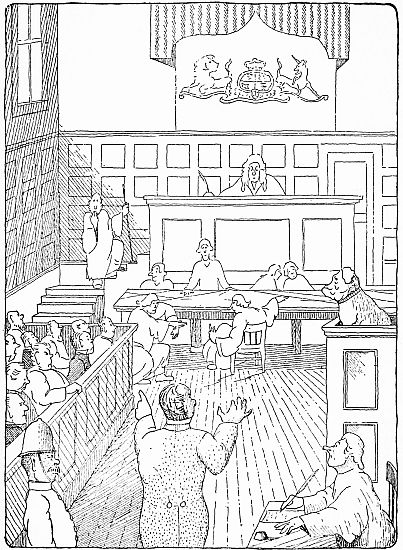 “Sat scowling down upon the amazed and gaping jury”
[116]
THE SEVENTH CHAPTER
THE END OF THE MYSTERYTHE trial went swiftly forward after that.Mr. Jenkyns told the Doctor to ask Bobwhat he saw on the “night of the 29th;”and when Bob had told all he knew andthe Doctor had turned it into English for the judgeand the jury, this was what he had to say:
“On the night of the 29th of November, 1824, Iwas with my master, Luke Fitzjohn (otherwiseknown as Luke the Hermit) and his two partners,Manuel Mendoza and William Boggs (otherwiseknown as Bluebeard Bill) on their gold-mine inMexico. For a long time these three men hadbeen hunting for gold; and they had dug a deephole in the ground. On the morning of the 29thgold was discovered, lots of it, at the bottom ofthis hole. And all three, my master and his twopartners, were very happy about it because now theywould be rich. But Manuel Mendoza asked BluebeardBill to go for a walk with him. These twomen I had always suspected of being bad. Sowhen I noticed that they left my master behind,I followed them secretly to see what they wereup to. And in a deep cave in the mountains I heard[117]them arrange together to kill Luke the Hermit sothat they should get all the gold and he have none.”
At this point the judge asked, “Where is the witnessMendoza? Constable, see that he does notleave the court.”
But the wicked little man with the watery eyeshad already sneaked out when no one was lookingand he was never seen in Puddleby again.
“Then,” Bob’s statement went on, “I went tomy master and tried very hard to make him understandthat his partners were dangerous men. Butit was no use. He did not understand dog language.So I did the next best thing: I never lethim out of my sight but stayed with him everymoment of the day and night.
“Now the hole that they had made was so deepthat to get down and up it you had to go in a bigbucket tied on the end of a rope; and the three menused to haul one another up and let one another downthe mine in this way. That was how the gold wasbrought up too—in the bucket. Well, about seveno’clock in the evening my master was standing at thetop of the mine, hauling up Bluebeard Bill who wasin the bucket. Just as he had got Bill halfway upI saw Mendoza come out of the hut where we alllived. Mendoza thought that Bill was away buyinggroceries. But he wasn’t: he was in the bucket.And when Mendoza saw Luke hauling and strainingon the rope he thought he was pulling up a bucket[118]fulof gold. So he drew a pistol from his pocketand came sneaking up behind Luke to shoot him.
“I barked and barked to warn my master of thedanger he was in; but he was so busy hauling upBill (who was a heavy fat man) that he took nonotice of me. I saw that if I didn’t do somethingquick he would surely be shot. So I did a thing I’venever done before: suddenly and savagely I bit mymaster in the leg from behind. Luke was so hurtand startled that he did just what I wanted himto do: he let go the rope with both hands at onceand turned round. And then, Crash!down wentBill in his bucket to the bottom of the mine and hewas killed.
“While my master was busy scolding me Mendozaput his pistol in his pocket, came up with asmile on his face and looked down the mine.
“‘Why, Good Gracious!’ said he to Luke,‘You’ve killed Bluebeard Bill. I must go and tellthe police’—hoping, you see, to get the whole mineto himself when Luke should be put in prison.Then he jumped on his horse and galloped away.
“And soon my master grew afraid; for he sawthat if Mendoza only told enough lies to the police,it wouldlook as though he had killed Bill on purpose.So while Mendoza was gone he and I stoleaway together secretly and came to England.Here he shaved off his beard and became a hermit.[119]And ever since, for fifteen years, we’ve remainedin hiding. This is all I have to say. And I swearit is the truth, every word.”
When the Doctor finished reading Bob’s longspeech the excitement among the twelve men of thejury was positively terrific. One, a very old manwith white hair, began to weep in a loud voice atthe thought of poor Luke hiding on the fen forfifteen years for something he couldn’t help. Andall the others set to whispering and nodding theirheads to one another.
In the middle of all this up got that horribleProsecutor again, waving his arms more wildly thanever.
“Your Honor,” he cried, “I must object to thisevidence as biased. Of course the dog would nottell the truth against his own master. I object.I protest.”
“Very well,” said the judge, “you are at libertyto cross-examine. It is your duty as Prosecutorto prove his evidence untrue. There is the dog:question him, if you do not believe what he says.”
I thought the long-nosed lawyer would have afit. He looked first at the dog, then at the Doctor,then at the judge, then back at the dog scowlingfrom the witness-box. He opened his mouth tosay something; but no words came. He waved hisarms some more. His face got redder and redder.At last, clutching his forehead, he sank weakly into[120]his seat and had to be helped out of the court-roomby two friends. As he was half carried throughthe door he was still feebly murmuring, “I protest—Iobject—I protest!”
[121]
THE EIGHTH CHAPTER
THREE CHEERSNEXT the judge made a very long speechto the jury; and when it was over all thetwelve jurymen got up and went outinto the next room. And at that pointthe Doctor came back, leading Bob, to the seat besideme.
“What have the jurymen gone out for?” I asked.
“They always do that at the end of a trial—tomake up their minds whether the prisoner did it ornot.”
“Couldn’t you and Bob go in with them and helpthem make up their minds the right way?” I asked.
“No, that’s not allowed. They have to talk itover in secret. Sometimes it takes—My Gracious,look, they’re coming back already! They didn’tspend long over it.”
Everybody kept quite still while the twelve mencame tramping back into their places in the pews.Then one of them, the leader—a little man—stoodup and turned to the judge. Every one was holdinghis breath, especially the Doctor and myself, to seewhat he was going to say. You could have hearda pin drop while the whole court-room, the whole[122]of Puddleby in fact, waited with craning necks andstraining ears to hear the weighty words.
“Your Honor,” said the little man, “the juryreturns a verdict of Not Guilty.”
“What’s that mean?” I asked, turning to theDoctor.
But I found Doctor John Dolittle, the famousnaturalist, standing on top of a chair, dancing abouton one leg like a schoolboy.
“It means he’s free!” he cried, “Luke is free!”
“Then he’ll be able to come on the voyage withus, won’t he?”
But I could not hear his answer; for the wholecourt-room seemed to be jumping up on chairs likethe Doctor. The crowd had suddenly gone crazy.All the people were laughing and calling and wavingto Luke to show him how glad they were that hewas free. The noise was deafening.
Then it stopped. All was quiet again; and thepeople stood up respectfully while the judge leftthe Court. For the trial of Luke the Hermit, thatfamous trial which to this day they are still talkingof in Puddleby, was over.
In the hush while the judge was leaving, a suddenshriek rang out, and there, in the doorwaystood a woman, her arms out-stretched to the Hermit.
“Luke!” she cried, “I’ve found you at last!”
“It’s his wife,” the fat woman in front of me[123]whispered. “She ain’t seen ’im in fifteen years,poor dear! What a lovely re-union. I’m glad Icame. I wouldn’t have missed this for anything!”
As soon as the judge had gone the noise brokeout again; and now the folks gathered round Lukeand his wife and shook them by the hand and congratulatedthem and laughed over them and criedover them.
“Come along, Stubbins,” said the Doctor, takingme by the arm, “let’s get out of this while wecan.”
“But aren’t you going to speak to Luke?” I said—“toask him if he’ll come on the voyage?”
“It wouldn’t be a bit of use,” said the Doctor.“His wife’s come for him. No man stands anychance of going on a voyage when his wife hasn’tseen him in fifteen years. Come along. Let’s gethome to tea. We didn’t have any lunch, remember.And we’ve earned something to eat. We’llhave one of those mixed meals, lunch and tea combined—withwatercress and ham. Nice change.Come along.”
Just as we were going to step out at a side doorI heard the crowd shouting,
“The Doctor! The Doctor! Where’s theDoctor? The Hermit would have hanged if ithadn’t been for the Doctor. Speech! Speech!—TheDoctor!”
And a man came running up to us and said,
[124]
“The people are calling for you, Sir.”
“I’m very sorry,” said the Doctor, “but I’m ina hurry.”
“The crowd won’t be denied, Sir,” said the man.“They want you to make a speech in the market-place.”
“Beg them to excuse me,” said the Doctor—“withmy compliments. I have an appointment atmy house—a very important one which I may notbreak. Tell Luke to make a speech. Come along,Stubbins, this way.”
“Oh Lord!” he muttered as we got out into theopen air and found another crowd waiting for himat the side door. “Let’s go up that alleyway—tothe left. Quick!—Run!”
We took to our heels, darted through a coupleof side streets and just managed to get away fromthe crowd.
It was not till we had gained the OxenthorpeRoad that we dared to slow down to a walk andtake our breath. And even when we reached theDoctor’s gate and turned to look backwards towardsthe town, the faint murmur of many voices stillreached us on the evening wind.
“They’re still clamoring for you,” I said. “Listen!”
The murmur suddenly swelled up into a lowdistant roar; and although it was a mile and halfaway you could distinctly hear the words,
[125]
“Three cheers for Luke the Hermit: Hooray!—Threecheers for his dog: Hooray!—Three cheersfor his wife: Hooray!—Three cheers for the Doctor:Hooray! Hooray! HOO-R-A-Y!”
[126]
THE NINTH CHAPTER
THE PURPLE BIRD-OF-PARADISEPOLYNESIA was waiting for us in the frontporch. She looked full of some importantnews.
“Doctor,” said she, “the Purple Bird-of-Paradisehas arrived!”
“At last!” said the Doctor. “I had begun tofear some accident had befallen her. And how isMiranda?”
From the excited way in which the Doctor fumbledhis key into the lock I guessed that we werenot going to get our tea right away, even now.
“Oh, she seemed all right when she arrived,”said Polynesia—“tired from her long journey ofcourse but otherwise all right. But what doyouthink? That mischief-making sparrow, Cheapside,insulted her as soon as she came into the garden.When I arrived on the scene she was in tears andwas all for turning round and going straight backto Brazil to-night. I had the hardest work persuadingher to wait till you came. She’s in thestudy. I shut Cheapside in one of your book-casesand told him I’d tell you exactly what had happenedthe moment you got home.”
[127]
The Doctor frowned, then walked silently andquickly to the study.
Here we found the candles lit; for the daylightwas nearly gone. Dab-Dab was standing on thefloor mounting guard over one of the glass-frontedbook-cases in which Cheapside had been imprisoned.The noisy little sparrow was still fluttering angrilybehind the glass when we came in.
In the centre of the big table, perched on theink-stand, stood the most beautiful bird I have everseen. She had a deep violet-colored breast, scarletwings and a long, long sweeping tail of gold. Shewas unimaginably beautiful but looked dreadfullytired. Already she had her head under her wing;and she swayed gently from side to side on top ofthe ink-stand like a bird that has flown long and far.
“Sh!” said Dab-Dab. “Miranda is asleep.I’ve got this little imp Cheapside in here. Listen,Doctor: for Heaven’s sake send that sparrowaway before he does any more mischief. He’snothing but a vulgar little nuisance. We’ve had aperfectly awful time trying to get Miranda to stay.Shall I serve your tea in here, or will you come intothe kitchen when you’re ready?”
“We’ll come into the kitchen, Dab-Dab,” saidthe Doctor. “Let Cheapside out before you go,please.”
Dab-Dab opened the bookcase-door and Cheapsidestrutted out trying hard not to look guilty.
[128]
“Cheapside,” said the Doctor sternly, “what didyou say to Miranda when she arrived?”
“I didn’t say nothing, Doc, straight I didn’t.That is, nothing much. I was picking up crumbsoff the gravel path when she comes swanking intothe garden, turning up her nose in all directions,as though she owned the earth—just because she’sgot a lot of colored plumage. A London sparrow’sas good as her any day. I don’t hold bythese gawdy bedizened foreigners nohow. Whydon’t they stay in their own country?”
“But what did you say to her that got her sooffended?”
“All I said was, ‘You don’t belong in an Englishgarden; you ought to be in a milliner’s window.’That’s all.”
“You ought to be ashamed of yourself, Cheapside.Don’t you realize that this bird has comethousands of miles to see me—only to be insultedby your impertinent tongue as soon as she reachesmy garden? What do you mean by it?—If shehad gone away again before I got back to-night Iwould never have forgiven you—Leave the room.”
Sheepishly, but still trying to look as though hedidn’t care, Cheapside hopped out into the passageand Dab-Dab closed the door.
The Doctor went up to the beautiful bird on theink-stand and gently stroked its back. Instantlyits head popped out from under its wing.
[129]
THE TENTH CHAPTER
LONG ARROW, THE SON OF GOLDEN ARROW“WELL, Miranda,” said the Doctor. “I’mterribly sorry this has happened. Butyou mustn’t mind Cheapside; hedoesn’t know any better. He’s a citybird; and all his life he has had to squabble for aliving. You must make allowances. He doesn’tknow any better.”
Miranda stretched her gorgeous wings wearily.Now that I saw her awake and moving I noticedwhat a superior, well-bred manner she had. Therewere tears in her eyes and her beak was trembling.
“I wouldn’t have minded so much,” she said ina high silvery voice, “if I hadn’t been so dreadfullyworn out—That and something else,” she addedbeneath her breath.
“Did you have a hard time getting here?” askedthe Doctor.
“The worst passage I ever made,” said Miranda.“The weather—Well there. What’s the use? I’mhere anyway.”
“Tell me,” said the Doctor as though he hadbeen impatiently waiting to say something for a[130]long time: “what did Long Arrow say when yougave him my message?”
The Purple Bird-of-Paradise hung her head.
“That’s the worst part of it,” she said. “Imight almost as well have not come at all. Iwasn’t able to deliver your message. I couldn’tfind him. Long Arrow, the son of Golden Arrow,has disappeared!”
“Disappeared!” cried the Doctor. “Why, what’sbecome of him?”
“Nobody knows,” Miranda answered. “Hehad often disappeared before, as I have told you—sothat the Indians didn’t know where he was. Butit’s a mighty hard thing to hide away from thebirds. I had always been able to find some owlor martin who could tell me where he was—if Iwanted to know. But not this time. That’s whyI’m nearly a fortnight late in coming to you: Ikept hunting and hunting, asking everywhere. Iwent over the whole length and breadth of SouthAmerica. But there wasn’t a living thing couldtell me where he was.”
There was a sad silence in the room after shehad finished; the Doctor was frowning in a peculiarsort of way and Polynesia scratched herhead.
“Did you ask the black parrots?” asked Polynesia.“They usually know everything.”
[131]
“Certainly I did,” said Miranda. “And I wasso upset at not being able to find out anything,that I forgot all about observing the weather-signsbefore I started my flight here. I didn’t evenbother to break my journey at the Azores, but cutright across, making for the Straits of Gibraltar—asthough it were June or July. And of course Iran into a perfectly frightful storm in mid-Atlantic.I really thought I’d never come through it. LuckilyI found a piece of a wrecked vessel floating inthe sea after the storm had partly died down; andI roosted on it and took some sleep. If I hadn’tbeen able to take that rest I wouldn’t be here to tellthe tale.”
“Poor Miranda! What a time you must havehad!” said the Doctor. “But tell me, were youable to find out whereabouts Long Arrow was lastseen?”
“Yes. A young albatross told me he had seenhim on Spidermonkey Island?”
“Spidermonkey Island? That’s somewhere offthe coast of Brazil, isn’t it?”
“Yes, that’s it. Of course I flew there rightaway and asked every bird on the island—and itis a big island, a hundred miles long. It seemsthat Long Arrow was visiting some peculiar Indiansthat live there; and that when last seen he wasgoing up into the mountains looking for rare[132]medicine-plants. I got that from a tame hawk, apet, which the Chief of the Indians keeps for huntingpartridges with. I nearly got caught and putin a cage for my pains too. That’s the worst ofhaving beautiful feathers: it’s as much as your lifeis worth to go near most humans—They say, ‘ohhow pretty!’ and shoot an arrow or a bullet intoyou. You and Long Arrow were the only twomen that I would ever trust myself near—out ofall the people in the world.”
“But was he never known to have returned fromthe mountains?”
“No. That was the last that was seen or heardof him. I questioned the sea-birds around theshores to find out if he had left the island in acanoe. But they could tell me nothing.”
“Do you think that some accident has happenedto him?” asked the Doctor in a fearful voice.
“I’m afraid it must have,” said Miranda shakingher head.
“Well,” said John Dolittle slowly, “if I couldnever meet Long Arrow face to face it would bethe greatest disappointment in my whole life. Notonly that, but it would be a great loss to the knowledgeof the human race. For, from what you havetold me of him, he knew more natural science thanall the rest of us put together; and if he has gonewithout any one to write it down for him, so theworld may be the better for it, it would be a terrible[133]
[134]thing. But you don’t really think that he is dead,do you?” “‘What else can I think?’”
“What else can I think?” asked Miranda, burstinginto tears, “when for six whole months he hasnot been seen by flesh, fish or fowl.”
[135]
THE ELEVENTH CHAPTER
BLIND TRAVELTHIS news about Long Arrow made usall very sad. And I could see from thesilent dreamy way the Doctor took histea that he was dreadfully upset. Everyonce in a while he would stop eating altogether andsit staring at the spots on the kitchen table-cloth asthough his thoughts were far away; till Dab-Dab,who was watching to see that he got a good meal,would cough or rattle the pots in the sink.
I did my best to cheer him up by reminding himof all he had done for Luke and his wife that afternoon.And when that didn’t seem to work, I wenton talking about our preparations for the voyage.
“But you see, Stubbins,” said he as we rose fromthe table and Dab-Dab and Chee-Chee began toclear away, “I don’t know where to go now. Ifeel sort of lost since Miranda brought me thisnews. On this voyage I had planned going to seeLong Arrow. I had been looking forward to itfor a whole year. I felt he might help me in learningthe language of the shellfish—and perhaps infinding some way of getting to the bottom of the[136]sea. But now?—He’s gone! And all his greatknowledge has gone with him.”
Then he seemed to fall a-dreaming again.
“Just to think of it!” he murmured. “LongArrow and I, two students—Although I’d nevermet him, I felt as though I knew him quite well.For, in his way—without any schooling—he has, allhis life, been trying to do the very things which Ihave tried to do in mine—And now he’s gone!—Awhole world lay between us—And only a bird knewus both!”
We went back into the study, where Jip broughtthe Doctor his slippers and his pipe. And afterthe pipe was lit and the smoke began to fill theroom the old man seemed to cheer up a little.
“But you will go on some voyage, Doctor, won’tyou?” I asked—“even if you can’t go to find LongArrow.”
He looked up sharply into my face; and I supposehe saw how anxious I was. Because he suddenlysmiled his old, boyish smile and said,
“Yes, Stubbins. Don’t worry. We’ll go. Wemustn’t stop working and learning, even if poorLong Arrow has disappeared—But where to go:that’s the question. Where shall we go?”
There were so many places that I wanted to gothat I couldn’t make up my mind right away. Andwhile I was still thinking, the Doctor sat up in hischair and said,
[137]
“I tell you what we’ll do, Stubbins: it’s a game Iused to play when I was young—before Sarah cameto live with me. I used to call it Blind Travel.Whenever I wanted to go on a voyage, and Icouldn’t make up my mind where to go, I wouldtake the atlas and open it with my eyes shut. Next,I’d wave a pencil, still without looking, and stick itdown on whatever page had fallen open. Then I’dopen my eyes and look. It’s a very exciting game,is Blind Travel. Because you have to swear, beforeyou begin, that you will go to the place thepencil touches, come what may. Shall we play it?”
“Oh, let’s!” I almost yelled. “How thrilling!I hope it’s China—or Borneo—or Bagdad.”
And in a moment I had scrambled up the bookcase,dragged the big atlas from the top shelf andlaid it on the table before the Doctor.
I knew every page in that atlas by heart. Howmany days and nights I had lingered over its oldfaded maps, following the blue rivers from themountains to the sea; wondering what the littletowns really looked like, and how wide were thesprawling lakes! I had had a lot of fun with thatatlas, traveling, in my mind, all over the world. Ican see it now: the first page had no map; it justtold you that it was printed in Edinburgh in 1808,and a whole lot more about the book. The nextpage was the Solar System, showing the sun andplanets, the stars and the moon. The third page[138]was the chart of the North and South Poles. Thencame the hemispheres, the oceans, the continentsand the countries.
As the Doctor began sharpening his pencil athought came to me.
“What if the pencil falls upon the North Pole,”I asked, “will we have to go there?”
“No. The rules of the game say you don’t haveto go any place you’ve been to before. You areallowed another try. I’ve been to the North Pole,”he ended quietly, “so we shan’t have to go there.”
I could hardly speak with astonishment.
“You’ve been to the North pole!” I managed togasp out at last. “But I thought it was still undiscovered.The map shows all the places explorershave reached to, tryingto get there. Why isn’tyour name down if you discovered it?”
“I promised to keep it a secret. And you mustpromise me never to tell any one. Yes, I discoveredthe North Pole in April, 1809. Butshortly after I got there the polar bears came to mein a body and told me there was a great deal ofcoal there, buried beneath the snow. They knew,they said, that human beings would do anything,and go anywhere, to get coal. So would I pleasekeep it a secret. Because once people began comingup there to start coal-mines, their beautifulwhite country would be spoiled—and there wasnowhere else in the world cold enough for polar[139]bears to be comfortable. So of course I had topromise them I would. Ah, well, it will be discoveredagain some day, by somebody else. ButI want the polar bears to have their play-groundto themselves as long as possible. And I daresayit will be a good while yet—for it certainly is afiendish place to get to—Well now, are we ready?—Good!Take the pencil and stand here close tothe table. When the book falls open, wave thepencil round three times and jab it down. Ready?—Allright. Shut your eyes.”
It was a tense and fearful moment—but verythrilling. We both had our eyes shut tight. Iheard the atlas fall open with a bang. I wonderedwhat page it was: England or Asia. If it shouldbe the map of Asia, so much would depend on wherethat pencil would land. I waved three times in acircle. I began to lower my hand. The pencil-pointtouched the page.
“All right,” I called out, “it’s done.”
[140]
THE TWELFTH CHAPTER
DESTINY AND DESTINATIONWE both opened our eyes; then bumpedour heads together with a crack inour eagerness to lean over and seewhere we were to go.
The atlas lay open at a map called, Chart of theSouth Atlantic Ocean. My pencil-point was restingright in the center of a tiny island. The nameof it was printed so small that the Doctor had toget out his strong spectacles to read it. I wastrembling with excitement.
“Spidermonkey Island,” he read out slowly.Then he whistled softly beneath his breath. “Ofall the extraordinary things! You’ve hit upon thevery island where Long Arrow was last seen onearth—I wonder—Well, well! How very singular!”
“We’ll go there, Doctor, won’t we?” I asked.
“Of course we will. The rules of the game saywe’ve got to.”
“I’m so glad it wasn’t Oxenthorpe or Bristol,” Isaid. “It’ll be a grand voyage, this. Look at allthe sea we’ve got to cross. Will it take us long?”
[141]
“Oh, no,” said the Doctor—“not very. With agood boat and a good wind we should make iteasily in four weeks. But isn’t it extraordinary?Of all the places in the world you picked out thatone with your eyes shut. Spidermonkey Islandafter all!—Well, there’s one good thing about it:I shall be able to get some Jabizri beetles.”
“What are Jabizri beetles?”
“They are a very rare kind of beetles with peculiarhabits. I want to study them. There areonly three countries in the world where they are tobe found. Spidermonkey Island is one of them.But even there they are very scarce.”
“What is this little question-mark after the nameof the island for?” I asked, pointing to the map.
“That means that the island’s position in theocean is not known very exactly—that it is somewhereaboutthere. Ships have probably seen it inthat neighborhood, that is all, most likely. It isquite possible we shall be the first white men toland there. But I daresay we shall have somedifficulty in finding it first.”
How like a dream it all sounded! The two ofus sitting there at the big study-table; the candleslit; the smoke curling towards the dim ceiling fromthe Doctor’s pipe—the two of us sitting there, talkingabout finding an island in the ocean and beingthe first white men to land upon it!
“I’ll bet it will be a great voyage,” I said. “It[142]looks a lovely island on the map. Will there beblack men there?”
“No. A peculiar tribe of Red Indians lives onit, Miranda tells me.”
At this point the poor Bird-of-Paradise stirredand woke up. In our excitement we had forgottento speak low.
“We are going to Spidermonkey Island, Miranda,”said the Doctor. “You know where it is,do you not?”
“I know where it was the last time I saw it,”said the bird. “But whether it will be there still,I can’t say.”
“What do you mean?” asked the Doctor. “It isalways in the same place surely?”
“Not by any means,” said Miranda. “Why,didn’t you know?—Spidermonkey Island is afloatingisland. It moves around all over theplace—usually somewhere near southern SouthAmerica. But of course I could surely find it foryou if you want to go there.”
At this fresh piece of news I could contain myselfno longer. I was bursting to tell some one.I ran dancing and singing from the room to findChee-Chee.
At the door I tripped over Dab-Dab, who wasjust coming in with her wings full of plates, and fellheadlong on my nose.
[143]
“Has the boy gone crazy?” cried the duck.“Where do you think you’re going, ninny?”
“To Spidermonkey Island!” I shouted, pickingmyself up and doing cart-wheels down the hall—“SpidermonkeyIsland! Hooray!—And it’s afloatingisland!”
“You’re going to Bedlam, I should say,” snortedthe housekeeper. “Look what you’ve done to mybest china!”
But I was far too happy to listen to her scolding;and I ran on, singing, into the kitchen to find Chee-Chee.
[144]
PART THREE
THE FIRST CHAPTER
THE THIRD MANTHAT same week we began our preparationsfor the voyage.
Joe, the mussel-man, had the Curlewmoved down the river and tied it upalong the river-wall, so it would be more handy forloading. And for three whole days we carriedprovisions down to our beautiful new boat andstowed them away.
I was surprised to find how roomy and big shewas inside. There were three little cabins, a saloon(or dining-room) and underneath all this, a bigplace called the hold where the food and extra sailsand other things were kept.
I think Joe must have told everybody in the townabout our coming voyage, because there was alwaysa regular crowd watching us when we brought thethings down to put aboard. And of course sooneror later old Matthew Mugg was bound to turn up.
“My Goodness, Tommy,” said he, as he watchedme carrying on some sacks of flour, “but that’s a[145]pretty boat! Where might the Doctor be goingto this voyage?”
“We’re going to Spidermonkey Island,” I saidproudly.
“And be you the only one the Doctor’s takingalong?”
“Well, he has spoken of wanting to take anotherman,” I said; “but so far he hasn’t made up hismind.”
Matthew grunted; then squinted up at the gracefulmasts of the Curlew.
“You know, Tommy,” said he, “if it wasn’t formy rheumatism I’ve half a mind to come with theDoctor myself. There’s something about a boatstanding ready to sail that always did make me feelventuresome and travelish-like. What’s that stuffin the cans you’re taking on?”
“This is treacle,” I said—“twenty pounds of treacle.”
“My Goodness,” he sighed, turning away sadly.“That makes me feel more like going with you thanever—But my rheumatism is that bad I can’thardly—”
I didn’t hear any more for Matthew had movedoff, still mumbling, into the crowd that stood aboutthe wharf. The clock in Puddleby Church strucknoon and I turned back, feeling very busy and important,to the task of loading.
But it wasn’t very long before some one else came[146]along and interrupted my work. This was a huge,big, burly man with a red beard and tattoo-marksall over his arms. He wiped his mouth with theback of his hand, spat twice on to the river-walland said,
“Boy, where’s the skipper?”
“The skipper!—Who do you mean?” I asked.
“The captain—Where’s the captain of thiscraft?” he said, pointing to the Curlew.
“Oh, you mean the Doctor,” said I. “Well, heisn’t here at present.”
At that moment the Doctor arrived with his armsfull of note-books and butterfly-nets and glass casesand other natural history things. The big manwent up to him, respectfully touching his cap.
“Good morning, Captain,” said he. “I heardyou was in need of hands for a voyage. My name’sBen Butcher, able seaman.”
“I am very glad to know you,” said the Doctor.“But I’m afraid I shan’t be able to take on any morecrew.”
“Why, but Captain,” said the able seaman, “yousurely ain’t going to face deep-sea weather withnothing more than this bit of a lad to help you—andwith a cutter that big!”
The Doctor assured him that he was; but the mandidn’t go away. He hung around and argued.He told us he had known of many ships being sunkthrough “undermanning.” He got out what he[147]
[148]called his stiffikit—a paper which said what a goodsailor he was—and implored us, if we valued ourlives, to take him. “‘Boy, where’s the skipper?’”
But the Doctor was quite firm—polite but determined—andfinally the man walked sorrowfullyaway, telling us he never expected to see us aliveagain.
Callers of one sort and another kept us quitebusy that morning. The Doctor had no soonergone below to stow away his note-books thananother visitor appeared upon the gang-plank.This was a most extraordinary-looking black man.The only other negroes I had seen had been incircuses, where they wore feathers and bone necklacesand things like that. But this one wasdressed in a fashionable frock coat with an enormousbright red cravat. On his head was a strawhat with a gay band; and over this he held a largegreen umbrella. He was very smart in everyrespect except his feet. He wore no shoes or socks.
“Pardon me,” said he, bowing elegantly, “butis this the ship of the physician Dolittle?”
“Yes,” I said, “did you wish to see him?”
“I did—if it will not be discommodious,” he answered.
“Who shall I say it is?”
“I am Bumpo Kahbooboo, Crown Prince ofJolliginki.”
I ran downstairs at once and told the Doctor.
[149]
“How fortunate!” cried John Dolittle. “Myold friend Bumpo! Well, well!—He’s studyingat Oxford, you know. How good of him to comeall this way to call on me!” And he tumbled upthe ladder to greet his visitor.
The strange black man seemed to be overcomewith joy when the Doctor appeared and shook himwarmly by the hand.
“News reached me,” he said, “that you wereabout to sail upon a voyage. I hastened to seeyou before your departure. I am sublimely ecstasiedthat I did not miss you.”
“You very nearly did miss us,” said the Doctor.“As it happened, we were delayed somewhat in gettingthe necessary number of men to sail ourboat. If it hadn’t been for that, we would havebeen gone three days ago.”
“How many men does your ship’s company yetrequire?” asked Bumpo.
“Only one,” said the Doctor—“But it is so hardto find the right one.”
“Methinks I detect something of the finger ofDestination in this,” said Bumpo. “How would Ido?”
“Splendidly,” said the Doctor. “But whatabout your studies? You can’t very well just gooff and leave your university career to take careof itself, you know.”
“I need a holiday,” said Bumpo. “Even had I[150]not gone with you, I intended at the end of thisterm to take a three-months’ absconsion—But besides,I shall not be neglecting my edification if Iaccompany you. Before I left Jolliginki myaugust father, the King, told me to be sure andtravel plenty. You are a man of great studiosity.To see the world in your company is an opportunitynot to be sneezed upon. No, no, indeed.”
“How did you like the life at Oxford?” askedthe Doctor.
“Oh, passably, passably,” said Bumpo. “I likedit all except the algebra and the shoes. The algebrahurt my head and the shoes hurt my feet. Ithrew the shoes over a wall as soon as I got out ofthe college quadrilateral this morning; and the algebraI am happily forgetting very fast—I likedCicero—Yes, I think Cicero’s fine—so simultaneous.By the way, they tell me his son is rowingfor our college next year—charming fellow.”
The Doctor looked down at the black man’s hugebare feet thoughtfully a moment.
“Well,” he said slowly, “there is something inwhat you say, Bumpo, about getting education fromthe world as well as from the college. And if youare really sure that you want to come, we shall bedelighted to have you. Because, to tell you thetruth, I think you are exactly the man we need.”
[151]
THE SECOND CHAPTER
GOOD-BYE!TWO days after that we had all in readinessfor our departure.
On this voyage Jip begged so hard tobe taken that the Doctor finally gavein and said he could come. Polynesia and Chee-Cheewere the only other animals to go with us.Dab-Dab was left in charge of the house and theanimal family we were to leave behind.
Of course, as is always the way, at the last momentwe kept remembering things we had forgotten;and when we finally closed the house up andwent down the steps to the road, we were all burdenedwith armfuls of odd packages.
Halfway to the river, the Doctor suddenly rememberedthat he had left the stock-pot boiling onthe kitchen-fire. However, we saw a blackbird flyingby who nested in our garden, and the Doctorasked her to go back for us and tell Dab-Dababout it.
Down at the river-wall we found a great crowdwaiting to see us off.
Standing right near the gang-plank were mymother and father. I hoped that they would not[152]make a scene, or burst into tears or anything likethat. But as a matter of fact they behaved quitewell—for parents. My mother said somethingabout being sure not to get my feet wet; and myfather just smiled a crooked sort of smile, pattedme on the back and wished me luck. Good-byesare awfully uncomfortable things and I was gladwhen it was over and we passed on to the ship.
We were a little surprised not to see MatthewMugg among the crowd. We had felt sure that hewould be there; and the Doctor had intended togive him some extra instructions about the food forthe animals we had left at the house.
At last, after much pulling and tugging, we gotthe anchor up and undid a lot of mooring-ropes.Then the Curlewbegan to move gently down theriver with the out-running tide, while the people onthe wall cheered and waved their handkerchiefs.
We bumped into one or two other boats gettingout into the stream; and at one sharp bend in theriver we got stuck on a mud bank for a few minutes.But though the people on the shore seemed to getvery excited at these things, the Doctor did notappear to be disturbed by them in the least.
“These little accidents will happen in the mostcarefully regulated voyages,” he said as he leanedover the side and fished for his boots which hadgot stuck in the mud while we were pushing off.“Sailing is much easier when you get out into the[153]open sea. There aren’t so many silly things tobump into.”
For me indeed it was a great and wonderfulfeeling, that getting out into the open sea, when atlength we passed the little lighthouse at the mouthof the river and found ourselves free of the land.It was all so new and different: just the sky aboveyou and sea below. This ship, which was to be ourhouse and our street, our home and our garden, forso many days to come, seemed so tiny in all thiswide water—so tiny and yet so snug, sufficient, safe.
I looked around me and took in a deep breath.The Doctor was at the wheel steering the boatwhich was now leaping and plunging gently throughthe waves. (I had expected to feel seasick at firstbut was delighted to find that I didn’t.) Bumpohad been told off to go downstairs and prepare dinnerfor us. Chee-Chee was coiling up ropes inthe stern and laying them in neat piles. My workwas fastening down the things on the deck so thatnothing could roll about if the weather should growrough when we got further from the land. Jipwas up in the peak of the boat with ears cockedand nose stuck out—like a statue, so still—his keenold eyes keeping a sharp look-out for floatingwrecks, sand-bars, and other dangers. Each oneof us had some special job to do, part of the properrunning of a ship. Even old Polynesia was takingthe sea’s temperature with the Doctor’s bath-thermometer[154]tied on the end of a string, to make surethere were no icebergs near us. As I listened toher swearing softly to herself because she couldn’tread the pesky figures in the fading light, I realizedthat the voyage had begun in earnest and that verysoon it would be night—my first night at sea!
[155]
THE THIRD CHAPTER
OUR TROUBLES BEGINJUST before supper-time Bumpo appearedfrom downstairs and went to the Doctor atthe wheel.
“A stowaway in the hold, Sir,” said he ina very business-like seafaring voice. “I just discoveredhim, behind the flour-bags.”
“Dear me!” said the Doctor. “What a nuisance!Stubbins, go down with Bumpo and bringthe man up. I can’t leave the wheel just now.”
So Bumpo and I went down into the hold; andthere, behind the flour-bags, plastered in flour fromhead to foot, we found a man. After we had sweptmost of the flour off him with a broom, we discoveredthat it was Matthew Mugg. We hauled himupstairs sneezing and took him before the Doctor.
“Why Matthew!” said John Dolittle. “Whaton earth are you doing here?”
“The temptation was too much for me, Doctor,”said the cat’s-meat-man. “You know I’ve oftenasked you to take me on voyages with you and younever would. Well, this time, knowing that youneeded an extra man, I thought if I stayed hid tillthe ship was well at sea you would find I came in[156]handy like and keep me. But I had to lie so doubledup, for hours, behind them flour-bags, that myrheumatism came on something awful. I just hadto change my position; and of course just as Istretched out my legs along comes this here Africancook of yours and sees my feet sticking out—Don’tthis ship roll something awful! How long hasthis storm been going on? I reckon this damp seaair wouldn’t be very good for my rheumatics.”
“No, Matthew it really isn’t. You ought not tohave come. You are not in any way suited to thiskind of a life. I’m sure you wouldn’t enjoy a longvoyage a bit. We’ll stop in at Penzance and putyou ashore. Bumpo, please go downstairs to mybunk; and listen: in the pocket of my dressing-gownyou’ll find some maps. Bring me the small one—withblue pencil-marks at the top. I know Penzanceis over here on our left somewhere. But I mustfind out what light-houses there are before I changethe ship’s course and sail inshore.”
“Very good, Sir,” said Bumpo, turning roundsmartly and making for the stairway.
“Now Matthew,” said the Doctor, “you cantake the coach from Penzance to Bristol. Andfrom there it is not very far to Puddleby, as youknow. Don’t forget to take the usual provisionsto the house every Thursday, and be particularlycareful to remember the extra supply of herringsfor the baby minks.”
[157]
While we were waiting for the maps Chee-Cheeand I set about lighting the lamps: a green one onthe right side of the ship, a red one on the left anda white one on the mast.
At last we heard some one trundling on the stairsagain and the Doctor said,
“Ah, here’s Bumpo with the maps at last!”
But to our great astonishment it was not Bumpoalone that appeared but threepeople.
“Good Lord deliver us! Who are these?” criedJohn Dolittle.
“Two more stowaways, Sir,” said Bumpo steppingforward briskly. “I found them in your cabinhiding under the bunk. One woman and one man,Sir. Here are the maps.”
“This is too much,” said the Doctor feebly.“Who are they? I can’t see their faces in this dimlight. Strike a match, Bumpo.”
You could never guess who it was. It was Lukeand his wife. Mrs. Luke appeared to be very miserableand seasick.
They explained to the Doctor that after theyhad settled down to live together in the little shackout on the fens, so many people came to visit them(having heard about the great trial) that life becameimpossible; and they had decided to escapefrom Puddleby in this manner—for they had nomoney to leave any other way—and try to findsome new place to live where they and their story[158]wouldn’t be so well known. But as soon as theship had begun to roll Mrs. Luke had got mostdreadfully unwell.
Poor Luke apologized many times for being sucha nuisance and said that the whole thing had beenhis wife’s idea.
The Doctor, after he had sent below for hismedicine-bag and had given Mrs. Luke some salvolatileand smelling-salts, said he thought the bestthing to do would be for him to lend them somemoney and put them ashore at Penzance with Matthew.He also wrote a letter for Luke to takewith him to a friend the Doctor had in the town ofPenzance who, it was hoped, would be able to findLuke work to do there.
As the Doctor opened his purse and took outsome gold coins I heard Polynesia, who was sittingon my shoulder watching the whole affair, mutterbeneath her breath,
“There he goes—lending his last blessed penny—threepounds ten—all the money we had for thewhole trip! Now we haven’t the price of a postage-stampaboard if we should lose an anchor orhave to buy a pint of tar—Well, let’s pray we don’trun out of food—Why doesn’t he give them theship and walk home?”
Presently with the help of the map the course ofthe boat was changed and, to Mrs. Luke’s greatrelief, we made for Penzance and dry land.
[159]
I was tremendously interested to see how a shipcould be steered into a port at night with nothingbut light-houses and a compass to guide you. Itseemed to me that the Doctor missed all the rocksand sand-bars very cleverly.
We got into that funny little Cornish harborabout eleven o’clock that night. The Doctor tookhis stowaways on shore in our small row-boat whichwe kept on the deck of the Curlewand found themrooms at the hotel there. When he got back hetold us that Mrs. Luke had gone straight to bedand was feeling much better.
It was now after midnight; so we decided to stayin the harbor and wait till morning before settingout again.
I was glad to get to bed, although I felt thatstaying up so tremendously late was great fun. AsI climbed into the bunk over the Doctor’s and pulledthe blankets snugly round me, I found I could lookout of the port-hole at my elbow, and, withoutraising my head from the pillow, could see thelights of Penzance swinging gently up and downwith the motion of the ship at anchor. It waslike being rocked to sleep with a little show goingon to amuse you. I was just deciding that I likedthe life of the sea very much when I fell fast asleep.
[160]
THE FOURTH CHAPTER
OUR TROUBLES CONTINUETHE next morning when we were eatinga very excellent breakfast of kidneysand bacon, prepared by our good cookBumpo, the Doctor said to me,
“I was just wondering, Stubbins, whether I shouldstop at the Capa Blanca Islands or run right acrossfor the coast of Brazil. Miranda said we couldexpect a spell of excellent weather now—for fourand a half weeks at least.”
“Well,” I said, spooning out the sugar at thebottom of my cocoa-cup, “I should think it wouldbe best to make straight across while we are sureof good weather. And besides the Purple Bird-of-Paradiseis going to keep a lookout for us, isn’tshe? She’ll be wondering what’s happened to usif we don’t get there in about a month.”
“True, quite true, Stubbins. On the other hand,the Capa Blancas make a very convenient stoppingplace on our way across. If we should need suppliesor repairs it would be very handy to put inthere.”
“How long will it take us from here to the CapaBlancas?” I asked.
“About six days,” said the Doctor—“Well, we[161]can decide later. For the next two days at anyrate our direction would be the same practically ineither case. If you have finished breakfast let’sgo and get under way.”
Upstairs I found our vessel surrounded by whiteand gray seagulls who flashed and circled about inthe sunny morning air, looking for food-scrapsthrown out by the ships into the harbor.
By about half past seven we had the anchor upand the sails set to a nice steady breeze; and thistime we got out into the open sea without bumpinginto a single thing. We met the Penzance fishingfleet coming in from the night’s fishing, and verytrim and neat they looked, in a line like soldiers,with their red-brown sails all leaning over the sameway and the white water dancing before their bows.
For the next three or four days everything wentsmoothly and nothing unusual happened. Duringthis time we all got settled down into our regularjobs; and in spare moments the Doctor showedeach of us how to take our turns at the wheel, theproper manner of keeping a ship on her rightcourse, and what to do if the wind changed suddenly.We divided the twenty-four hours of theday into three spells; and we took it in turns tosleep our eight hours and be awake sixteen. Sothe ship was well looked after, with two of us alwayson duty.
Besides that, Polynesia, who was an older sailor[162]than any of us, and really knew a lot about runningships, seemed to be always awake—except whenshe took her couple of winks in the sun, standingon one leg beside the wheel. You may be surethat no one ever got a chance to stay abed morethan his eight hours while Polynesia was around.She used to watch the ship’s clock; and if you overslepta half-minute, she would come down to thecabin and peck you gently on the nose till you gotup.
 “In these lower levels we came upon the shadowy shapes of deadships”Page 360
I very soon grew to be quite fond of our funnyblack friend Bumpo, with his grand way of speakingand his enormous feet which some one was alwaysstepping on or falling over. Although hewas much older than I was and had been to college,he never tried to lord it over me. He seemedto be forever smiling and kept all of us in goodhumor. It wasn’t long before I began to see theDoctor’s good sense in bringing him—in spite ofthe fact that he knew nothing whatever about sailingor travel.
On the morning of the fifth day out, just as Iwas taking the wheel over from the Doctor, Bumpoappeared and said,
“The salt beef is nearly all gone, Sir.”
“The salt beef!” cried the Doctor. “Why, webrought a hundred and twenty pounds with us.We couldn’t have eaten that in five days. Whatcan have become of it?”[163]
“I don’t know, Sir, I’m sure. Every time I godown to the stores I find another hunk missing. Ifit is rats that are eating it, then they are certainlycolossal rodents.”
Polynesia who was walking up and down a stay-ropetaking her morning exercise, put in,
“We must search the hold. If this is allowedto go on we will all be starving before a week isout. Come downstairs with me, Tommy, and wewill look into this matter.”
So we went downstairs into the store-room andPolynesia told us to keep quite still and listen.This we did. And presently we heard from a darkcorner of the hold the distinct sound of someonesnoring.
“Ah, I thought so,” said Polynesia. “It’s a man—anda big one. Climb in there, both of you, andhaul him out. It sounds as though he were behindthat barrel—Gosh! We seem to have broughthalf of Puddleby with us. Anyone would thinkwe were a penny ferry-boat. Such cheek! Haulhim out.”
So Bumpo and I lit a lantern and climbed overthe stores. And there, behind the barrel, sureenough, we found an enormous bearded man fastasleep with a well-fed look on his face. We wokehim up.
“Washamarrer?” he said sleepily.
It was Ben Butcher, the able seaman.
[164]
Polynesia spluttered like an angry fire-cracker.
“This is the last straw,” said she. “The oneman in the world we least wanted. Shiver mytimbers, what cheek!”
“Would it not be, advisable,” suggested Bumpo,“while the varlet is still sleepy, to strike him onthe head with some heavy object and push himthrough a port-hole into the sea?”
“No. We’d get into trouble,” said Polynesia.“We’re not in Jolliginki now, you know—worseluck!—Besides, there never was a port-hole bigenough to push that man through. Bring him upstairsto the Doctor.”
So we led the man to the wheel where he respectfullytouched his cap to the Doctor.
“Another stowaway, Sir,” said Bumpo smartly.
I thought the poor Doctor would have a fit.
“Good morning, Captain,” said the man. “BenButcher, able seaman, at your service. I knewyou’d need me, so I took the liberty of stowingaway—much against my conscience. But I justcouldn’t bear to see you poor landsmen set out onthis voyage without a single real seaman to helpyou. You’d never have got home alive if I hadn’tcome—Why look at your mainsail, Sir—all looseat the throat. First gust of wind come along, andaway goes your canvas overboard—Well, it’s allright now I’m here. We’ll soon get things inshipshape.”
[165]
“No, it isn’t all right,” said the Doctor, “it’sall wrong. And I’m not at all glad to see you. Itold you in Puddleby I didn’t want you. You hadno right to come.”
“But Captain,” said the able seaman, “you can’tsail this ship without me. You don’t understandnavigation. Why, look at the compass now: you’velet her swing a point and a half off her course. It’smadness for you to try to do this trip alone—ifyou’ll pardon my saying so, Sir. Why—why,you’ll lose the ship!”
“Look here,” said the Doctor, a sudden sternlook coming into his eyes, “losing a ship is nothingto me. I’ve lost ships before and it doesn’tbother me in the least. When I set out to go to aplace, I get there. Do you understand? I mayknow nothing whatever about sailing and navigation,but I get there just the same. Now you maybe the best seaman in the world, but on thisshipyou’re just a plain ordinary nuisance—very plainand very ordinary. And I am now going to callat the nearest port and put you ashore.”
“Yes, and think yourself lucky,” Polynesia putin, “that you are not locked up for stowing awayand eating all our salt beef.”
“I don’t know what the mischief we’re going todo now,” I heard her whisper to Bumpo. “We’veno money to buy any more; and that salt beef wasthe most important part of the stores.”
[166]
“Would it not be good political economy,”Bumpo whispered back, “if we salted the able seamanand ate him instead? I should judge that hewould weigh more than a hundred and twentypounds.”
“How often must I tell you that we are not inJolliginki,” snapped Polynesia. “Those things arenot done on white men’s ships—Still,” she murmuredafter a moment’s thought, “it’s an awfullybright idea. I don’t suppose anybody saw himcome on to the ship—Oh, but Heavens! we haven’tgot enough salt. Besides, he’d be sure to taste oftobacco.”
[167]
THE FIFTH CHAPTER
POLYNESIA HAS A PLANTHEN the Doctor told me to take thewheel while he made a little calculationwith his map and worked out what newcourse we should take.
“I shall have to run for the Capa Blancas afterall,” he told me when the seaman’s back was turned.“Dreadful nuisance! But I’d sooner swim back toPuddleby than have to listen to that fellow’s talkall the way to Brazil.”
Indeed he was a terrible person, this Ben Butcher.You’d think that any one after being told he wasn’twanted would have had the decency to keep quiet.But not Ben Butcher. He kept going round thedeck pointing out all the things we had wrong. Accordingto him there wasn’t a thing right on thewhole ship. The anchor was hitched up wrong;the hatches weren’t fastened down properly; thesails were put on back to front; all our knotswere the wrong kind of knots.
At last the Doctor told him to stop talking andgo downstairs. He refused—said he wasn’t going[168]to be sunk by landlubbers while he was still able tostay on deck.
This made us feel a little uneasy. He was suchan enormous man there was no knowing what hemight do if he got really obstreperous.
Bumpo and I were talking about this downstairsin the dining-saloon when Polynesia, Jip and Chee-Cheecame and joined us. And, as usual, Polynesiahad a plan.
“Listen,” she said, “I am certain this Ben Butcheris a smuggler and a bad man. I am a very goodjudge of seamen, remember, and I don’t like thecut of this man’s jib. I—”
“Do you really think,” I interrupted, “that it issafe for the Doctor to cross the Atlantic withoutany regular seamen on his ship?”
You see it had upset me quite a good deal to findthat all the things we had been doing were wrong;and I was beginning to wonder what might happenif we ran into a storm—particularly as Mirandahad only said the weather would be good for acertain time; and we seemed to be having so manydelays. But Polynesia merely tossed her headscornfully.
“Oh, bless you, my boy,” said she, “you’realways safe with John Dolittle. Remember that.Don’t take any notice of that stupid old salt. Ofcourse it is perfectly true the Doctor does do everythingwrong. But with him it doesn’t matter.[169]Mark my words, if you travel with John Dolittleyou always get there, as you heard him say. I’vebeen with him lots of times and I know. Sometimesthe ship is upside down when you get there,and sometimes it’s right way up. But you get therejust the same. And then of course there’s anotherthing about the Doctor,” she added thoughtfully:“he always has extraordinary good luck. He mayhave his troubles; but with him things seem tohave a habit of turning out all right in theend. I remember once when we were goingthrough the Straits of Magellan the wind was sostrong—”
“But what are we going to do about BenButcher?” Jip put in. “You had some planPolynesia, hadn’t you?”
“Yes. What I’m afraid of is that he may hitthe Doctor on the head when he’s not looking andmake himself captain of the Curlew. Bad sailorsdo that sometimes. Then they run the ship theirown way and take it where they want. That’swhat you call a mutiny.”
“Yes,” said Jip, “and we ought to do somethingpretty quick. We can’t reach the Capa Blancasbefore the day after to-morrow at best. I don’tlike to leave the Doctor alone with him for a minute.He smells like a very bad man to me.”
“Well, I’ve got it all worked out,” said Polynesia.“Listen: is there a key in that door?”
[170]
We looked outside the dining-room and foundthat there was.
“All right,” said Polynesia. “Now Bumpo laysthe table for lunch and we all go and hide. Thenat twelve o’clock Bumpo rings the dinner-bell downhere. As soon as Ben hears it he’ll come downexpecting more salt beef. Bumpo must hide behindthe door outside. The moment that Ben isseated at the dining-table Bumpo slams the doorand locks it. Then we’ve got him. See?”
“How stratagenious!” Bumpo chuckled. “AsCicero said, parrots cum parishioners facilime congregation.I’ll lay the table at once.”
“Yes and take that Worcestershire sauce off thedresser with you when you go out,” said Polynesia.“Don’t leave any loose eatables around. Thatfellow has had enough to last any man for threedays. Besides, he won’t be so inclined to start afight when we put him ashore at the Capa Blancasif we thin him down a bit before we let him out.”
So we all went and hid ourselves in the passagewhere we could watch what happened. And presentlyBumpo came to the foot of the stairs and rangthe dinner-bell like mad. Then he hopped behindthe dining-room door and we all kept still andlistened.
Almost immediately, thump, thump, thump, downthe stairs tramped Ben Butcher, the able seaman.He walked into the dining-saloon, sat himself down[171]at the head of the table in the Doctor’s place, tuckeda napkin under his fat chin and heaved a sigh ofexpectation.
Then, bang! Bumpo slammed the door andlocked it.
“That settles himfor a while,” said Polynesiacoming out from her hiding-place. “Now let himteach navigation to the side-board. Gosh, thecheek of the man! I’ve forgotten more about thesea than that lumbering lout will ever know. Let’sgo upstairs and tell the Doctor. Bumpo, you willhave to serve the meals in the cabin for the nextcouple of days.”
And bursting into a rollicking Norwegian sea-song,she climbed up to my shoulder and we wenton deck.
[172]
THE SIXTH CHAPTER
THE BED-MAKER OF MONTEVERDEWE remained three days in the CapaBlanca Islands.
There were two reasons why westayed there so long when we werereally in such a hurry to get away. One was theshortage in our provisions caused by the able seaman’senormous appetite. When we came to goover the stores and make a list, we found that hehad eaten a whole lot of other things besides thebeef. And having no money, we were sorely puzzledhow to buy more. The Doctor went throughhis trunk to see if there was anything he could sell.But the only thing he could find was an old watchwith the hands broken and the back dented in; andwe decided this would not bring us in enough moneyto buy much more than a pound of tea. Bumposuggested that he sing comic songs in the streetswhich he had learned in Jolliginki. But the Doctorsaid he did not think that the islanders would carefor African music.
The other thing that kept us was the bullfight.In these islands, which belonged to Spain, they hadbullfights every Sunday. It was on a Friday that[173]we arrived there; and after we had got rid of theable seaman we took a walk through the town.
It was a very funny little town, quite differentfrom any that I had ever seen. The streets wereall twisty and winding and so narrow that a wagoncould only just pass along them. The houses over-hungat the top and came so close together thatpeople in the attics could lean out of the windowsand shake hands with their neighbors on theopposite side of the street. The Doctor told usthe town was very, very old. It was called Monteverde.
As we had no money of course we did not go to ahotel or anything like that. But on the secondevening when we were passing by a bed-maker’sshop we noticed several beds, which the man hadmade, standing on the pavement outside. TheDoctor started chatting in Spanish to the bed-makerwho was sitting at his door whistling to a parrot ina cage. The Doctor and the bed-maker got veryfriendly talking about birds and things. And as itgrew near to supper-time the man asked us to stopand sup with him.
This of course we were very glad to do. Andafter the meal was over (very nice dishes they were,mostly cooked in olive-oil—I particularly likedthe fried bananas) we sat outside on the pavementagain and went on talking far into thenight.
[174]
At last when we got up to go back to our ship,this very nice shopkeeper wouldn’t hear of ourgoing away on any account. He said the streetsdown by the harbor were very badly lighted andthere was no moon. We would surely get lost.He invited us to spend the night with him and goback to our ship in the morning.
Well, we finally agreed; and as our good friendhad no spare bedrooms, the three of us, the Doctor,Bumpo and I, slept on the beds set out for sale onthe pavement before the shop. The night was sohot we needed no coverings. It was great fun tofall asleep out of doors like this, watching the peoplewalking to and fro and the gay life of thestreets. It seemed to me that Spanish peoplenever went to bed at all. Late as it was, all thelittle restaurants and cafés around us were wideopen, with customers drinking coffee and chattingmerrily at the small tables outside. The sound ofa guitar strumming softly in the distance mingledwith the clatter of chinaware and the babble ofvoices.
Somehow it made me think of my mother andfather far away in Puddleby, with their regularhabits, the evening practise on the flute and the rest—doingthe same thing every day. I felt sort ofsorry for them in a way, because they missed thefun of this traveling life, where we were doingsomething new all the time—even sleeping differently.[175]
[176]But I suppose if they had been invited togo to bed on a pavement in front of a shop theywouldn’t have cared for the idea at all. It is funnyhow some people are. “The Doctor started chatting in Spanish to the bed-maker”
[177]
THE SEVENTH CHAPTER
THE DOCTOR’S WAGERNEXT morning we were awakened by agreat racket. There was a processioncoming down the street, a number ofmen in very gay clothes followed by alarge crowd of admiring ladies and cheering children.I asked the Doctor who they were.
“They are the bullfighters,” he said. “There isto be a bullfight to-morrow.”
“What is a bullfight?” I asked.
To my great surprise the Doctor got red in theface with anger. It reminded me of the time whenhe had spoken of the lions and tigers in his privatezoo.
“A bullfight is a stupid, cruel, disgusting business,”said he. “These Spanish people are mostlovable and hospitable folk. How they can enjoythese wretched bullfights is a thing I could neverunderstand.”
Then the Doctor went on to explain to me how abull was first made very angry by teasing and thenallowed to run into a circus where men came outwith red cloaks, waved them at him, and ran away.Next the bull was allowed to tire himself out by[178]tossing and killing a lot of poor, old, broken-downhorses who couldn’t defend themselves. Then,when the bull was thoroughly out of breath andwearied by this, a man came out with a sword andkilled the bull.
“Every Sunday,” said the Doctor, “in almostevery big town in Spain there are six bulls killed likethat and as many horses.”
“But aren’t the men ever killed by the bull?”I asked.
“Unfortunately very seldom,” said he. “A bullis not nearly as dangerous as he looks, even whenhe’s angry, if you are only quick on your feet anddon’t lose your head. These bullfighters are veryclever and nimble. And the people, especiallythe Spanish ladies, think no end of them. Afamous bullfighter (or matador, as they callthem) is a more important man in Spain than aking—Here comes another crowd of them roundthe corner, look. See the girls throwing kisses tothem. Ridiculous business!”
At that moment our friend the bed-maker cameout to see the procession go past. And while hewas wishing us good morning and enquiring how wehad slept, a friend of his walked up and joined us.The bed-maker introduced this friend to us as DonEnrique Cardenas.
Don Enrique when he heard where wewere from, spoke to us in English. He appeared[179]to be a well-educated, gentlemanly sort of person.
“And you go to see the bullfight to-morrow,yes?” he asked the Doctor pleasantly.
“Certainly not,” said John Dolittle firmly. “Idon’t like bullfights—cruel, cowardly shows.”
Don Enrique nearly exploded. I never saw aman get so excited. He told the Doctor that hedidn’t know what he was talking about. He saidbullfighting was a noble sport and that the matadorswere the bravest men in the world.
“Oh, rubbish!” said the Doctor. “You nevergive the poor bull a chance. It is only when he isall tired and dazed that your precious matadorsdare to try and kill him.”
I thought the Spaniard was going to strike theDoctor he got so angry. While he was still splutteringto find words, the bed-maker came betweenthem and took the Doctor aside. He explained toJohn Dolittle in a whisper that this Don EnriqueCardenas was a very important person; that he itwas who supplied the bulls—a special, strong blackkind—from his own farm for all the bullfights in theCapa Blancas. He was a very rich man, the bed-makersaid, a most important personage. Hemustn’t be allowed to take offense on any account.
I watched the Doctor’s face as the bed-makerfinished, and I saw a flash of boyish mischief comeinto his eyes as though an idea had struck him. Heturned to the angry Spaniard.
[180]
“Don Enrique,” he said, “you tell me yourbullfighters are very brave men and skilful. Itseems I have offended you by saying that bullfightingis a poor sport. What is the name of the bestmatador you have for to-morrow’s show?”
“Pepito de Malaga,” said Don Enrique, “one ofthe greatest names, one of the bravest men, in allSpain.”
“Very well,” said the Doctor, “I have a proposalto make to you. I have never fought a bullin my life. Now supposing I were to go into thering to-morrow with Pepito de Malaga and anyother matadors you choose; and if I can do moretricks with a bull than they can, would you promiseto do something for me?”
Don Enrique threw back his head and laughed.
“Man,” he said, “you must be mad! You wouldbe killed at once. One has to be trained for yearsto become a proper bullfighter.”
“Supposing I were willing to take the risk ofthat—You are not afraid, I take it, to accept myoffer?”
The Spaniard frowned.
“Afraid!” he cried, “Sir, if you can beat Pepitode Malaga in the bull-ring I’ll promise you anythingit is possible for me to grant.”
“Very good,” said the Doctor, “now I understandthat you are quite a powerful man in theseislands. If you wished to stop all bullfighting here[181]after to-morrow, you could do it, couldn’t you?”
“Yes,” said Don Enrique proudly—“I could.”
“Well that is what I ask of you—if I win mywager,” said John Dolittle. “If I can do morewith angry bulls than can Pepito de Malaga, youare to promise me that there shall never be anotherbullfight in the Capa Blancas so long as you arealive to stop it. Is it a bargain?”
The Spaniard held out his hand.
“It is a bargain,” he said—“I promise. But Imust warn you that you are merely throwing yourlife away, for you will certainly be killed. However,that is no more than you deserve for sayingthat bullfighting is an unworthy sport. I will meetyou here to-morrow morning if you should wish toarrange any particulars. Good day, Sir.”
As the Spaniard turned and walked into the shopwith the bed-maker, Polynesia, who had been listeningas usual, flew up on to my shoulder and whisperedin my ear,
“I have a plan. Get hold of Bumpo and comesome place where the Doctor can’t hear us. I wantto talk to you.”
I nudged Bumpo’s elbow and we crossed thestreet and pretended to look into a jeweler’s window;while the Doctor sat down upon his bed tolace up his boots, the only part of his clothing hehad taken off for the night.
“Listen,” said Polynesia, “I’ve been breaking[182]my head trying to think up some way we can getmoney to buy those stores with; and at last I’ve gotit.”
“The money?” said Bumpo.
“No, stupid. The idea—to make the moneywith. Listen: the Doctor is simply bound to winthis game to-morrow, sure as you’re alive. Nowall we have to do is to make a side bet with theseSpaniards—they’re great on gambling—and thetrick’s done.”
“What’s a side bet?” I asked.
“Oh I know what that is,” said Bumpo proudly.“We used to have lots of them at Oxford whenboat-racing was on. I go to Don Enrique and say,‘I bet you a hundred pounds the Doctor wins.’Then if he does win, Don Enrique pays me a hundredpounds; and if he doesn’t, I have to pay DonEnrique.”
“That’s the idea,” said Polynesia. “Only don’tsay a hundred pounds: say two-thousand five-hundredpesetas. Now come and find old Don Ricky-tickyand try to look rich.”
So we crossed the street again and slipped intothe bed-maker’s shop while the Doctor was stillbusy with his boots.
“Don Enrique,” said Bumpo, “allow me to introducemyself. I am the Crown Prince of Jolliginki.Would you care to have a small bet withme on to-morrow’s bullfight?”
[183]
Don Enrique bowed.
“Why certainly,” he said, “I shall be delighted.But I must warn you that you are bound to lose.How much?”
“Oh a mere truffle,” said Bumpo—“just for thefun of the thing, you know. What do you say tothree-thousand pesetas?”
“I agree,” said the Spaniard bowing once more.“I will meet you after the bullfight to-morrow.”
“So that’s all right,” said Polynesia as we cameout to join the Doctor. “I feel as though quite aload had been taken off my mind.”
[184]
THE EIGHTH CHAPTER
THE GREAT BULLFIGHTTHE next day was a great day in Monteverde.All the streets were hungwith flags; and everywhere gaily dressedcrowds were to be seen flocking towardsthe bull-ring, as the big circus was called where thefights took place.
The news of the Doctor’s challenge had goneround the town and, it seemed, had caused muchamusement to the islanders. The very idea of amere foreigner daring to match himself against thegreat Pepito de Malaga!—Serve him right if he gotkilled!
The Doctor had borrowed a bullfighter’s suitfrom Don Enrique; and very gay and wonderfulhe looked in it, though Bumpo and I had hard workgetting the waistcoat to close in front and even thenthe buttons kept bursting off it in all directions.
When we set out from the harbor to walk tothe bull-ring, crowds of small boys ran after usmaking fun of the Doctor’s fatness, calling out,“Juan Hagapoco, el grueso matador!” which isthe Spanish for, “John Dolittle, the fat bullfighter.”
As soon as we arrived the Doctor said he would[185]like to take a look at the bulls before the fight began;and we were at once led to the bull pen where,behind a high railing, six enormous black bullswere tramping around wildly.
In a few hurried words and signs the Doctortold the bulls what he was going to do and gavethem careful instructions for their part of the show.The poor creatures were tremendously glad whenthey heard that there was a chance of bullfightingbeing stopped; and they promised to do exactly asthey were told.
Of course the man who took us in there didn’tunderstand what we were doing. He merelythought the fat Englishman was crazy when he sawthe Doctor making signs and talking in ox tongue.
From there the Doctor went to the matadors’dressing-rooms while Bumpo and I with Polynesiamade our way into the bull-ring and took our seatsin the great open-air theatre.
It was a very gay sight. Thousands of ladiesand gentlemen were there, all dressed in theirsmartest clothes; and everybody seemed very happyand cheerful.
Right at the beginning Don Enrique got up andexplained to the people that the first item on theprogram was to be a match between the EnglishDoctor and Pepito de Malaga. He told them whathe had promised if the Doctor should win. Butthe people did not seem to think there was much[186]chance of that. A roar of laughter went up at thevery mention of such a thing.
When Pepito came into the ring everybodycheered, the ladies blew kisses and the men clappedand waved their hats.
Presently a large door on the other side of thering was rolled back and in galloped one of thebulls; then the door was closed again. At once thematador became very much on the alert. Hewaved his red cloak and the bull rushed at him.Pepito stepped nimbly aside and the people cheeredagain.
This game was repeated several times. But Inoticed that whenever Pepito got into a tight placeand seemed to be in real danger from the bull, anassistant of his, who always hung around somewherenear, drew the bull’s attention upon himselfby waving another red cloak. Then the bull wouldchase the assistant and Pepito was left in safety.Most often, as soon as he had drawn the bull off,this assistant ran for the high fence and vaulted outof the ring to save himself. They evidently hadit all arranged, these matadors; and it didn’t seemto me that they were in any very great danger fromthe poor clumsy bull so long as they didn’t slip andfall.
After about ten minutes of this kind of thingthe small door into the matadors’ dressing-roomopened and the Doctor strolled into the ring. As[187]soon as his fat figure, dressed in sky-blue velvet,appeared, the crowd rocked in their seats withlaughter.
Juan Hagapoco, as they had called him, walkedout into the centre of the ring and bowed ceremoniouslyto the ladies in the boxes. Then he bowedto the bull. Then he bowed to Pepito. Whilehe was bowing to Pepito’s assistant the bull startedto rush at him from behind.
“Look out! Look out!—The bull! You willbe killed!” yelled the crowd.
But the Doctor calmly finished his bow. Thenturning round he folded his arms, fixed the on-rushingbull with his eye and frowned a terrible frown.
Presently a curious thing happened: the bull’sspeed got slower and slower. It almost looked asthough he were afraid of that frown. Soon hestopped altogether. The Doctor shook his fingerat him. He began to tremble. At last, tuckinghis tail between his legs, the bull turned round andran away.
The crowd gasped. The Doctor ran after him.Round and round the ring they went, both of thempuffing and blowing like grampuses. Excited whispersbegan to break out among the people. Thiswas something new in bullfighting, to have thebull running away from the man, instead of theman away from the bull. At last in the tenthlap, with a final burst of speed, Juan Hagapoco,[188]the English matador, caught the poor bull bythe tail.
Then leading the now timid creature into themiddle of the ring, the Doctor made him do allmanner of tricks: standing on the hind legs, standingon the front legs, dancing, hopping, rollingover. He finished up by making the bull kneeldown; then he got on to his back and did handspringsand other acrobatics on the beast’s horns.
Pepito and his assistant had their noses sadly outof joint. The crowd had forgotten them entirely.They were standing together by the fence not farfrom where I sat, muttering to one another andslowly growing green with jealousy.
Finally the Doctor turned towards Don Enrique’sseat and bowing said in a loud voice, “This bull isno good any more. He’s terrified and out ofbreath. Take him away, please.”
“Does the caballero wish for a fresh bull?”asked Don Enrique.
“No,” said the Doctor, “I want five fresh bulls.And I would like them all in the ring atonce, please.”
At this a cry of horror burst from the people.They had been used to seeing matadors escapingfrom one bull at a time. But five!—That mustmean certain death.
Pepito sprang forward and called to Don Enriquenot to allow it, saying it was against all the[189]
[190]rules of bullfighting. (“Ha!” Polynesia chuckledinto my ear. “It’s like the Doctor’s navigation:he breaks all the rules; but he gets there. If they’llonly let him, he’ll give them the best show for theirmoney they ever saw.”) A great argument began.Half the people seemed to be on Pepito’s side andhalf on the Doctor’s side. At last the Doctorturned to Pepito and made another very grand bowwhich burst the last button off his waistcoat. “Did acrobatics on the beast’s horns”
“Well, of course if the caballero is afraid—”he began with a bland smile.
“Afraid!” screamed Pepito. “I am afraid ofnothing on earth. I am the greatest matador inSpain. With this right hand I have killed ninehundred and fifty-seven bulls.”
“All right then,” said the Doctor, “let us seeif you can kill five more. Let the bulls in!” heshouted. “Pepito de Malaga is not afraid.”
A dreadful silence hung over the great theatreas the heavy door into the bull pen was rolled back.Then with a roar the five big bulls bounded into thering.
“Look fierce,” I heard the Doctor call to themin cattle language. “Don’t scatter. Keep close.Get ready for a rush. Take Pepito, the one inpurple, first. But for Heaven’s sake don’t killhim. Just chase him out of the ring—Now then,all together, go for him!”
The bulls put down their heads and all in line,[191]like a squadron of cavalry, charged across the ringstraight for poor Pepito.
For one moment the Spaniard tried his hardestto look brave. But the sight of the five pairs ofhorns coming at him at full gallop was too much.He turned white to the lips, ran for the fence,vaulted it and disappeared.
“Now the other one,” the Doctor hissed. Andin two seconds the gallant assistant was nowhere tobe seen. Juan Hagapoco, the fat matador, wasleft alone in the ring with five rampaging bulls.
The rest of the show was really well worth seeing.First, all five bulls went raging round thering, butting at the fence with their horns, pawingup the sand, hunting for something to kill. Theneach one in turn would pretend to catch sight of theDoctor for the first time and giving a bellow ofrage, would lower his wicked looking horns andshoot like an arrow across the ring as though hemeant to toss him to the sky.
It was really frightfully exciting. And even I,who knew it was all arranged beforehand, held mybreath in terror for the Doctor’s life when I sawhow near they came to sticking him. But just atthe last moment, when the horns’ points were twoinches from the sky-blue waistcoat, the Doctorwould spring nimbly to one side and the greatbrutes would go thundering harmlessly by, missinghim by no more than a hair.
[192]
Then all five of them went for him together, completelysurrounding him, slashing at him with theirhorns and bellowing with fury. How he escapedalive I don’t know. For several minutes his roundfigure could hardly be seen at all in that scrimmageof tossing heads, stamping hoofs and waving tails.—Itwas, as Polynesia had prophesied, the greatestbullfight ever seen.
One woman in the crowd got quite hystericaland screamed up to Don Enrique,
“Stop the fight! Stop the fight! He is toobrave a man to be killed. This is the most wonderfulmatador in the world. Let him live! Stop thefight!”
But presently the Doctor was seen to break loosefrom the mob of animals that surrounded him.Then catching each of them by the horns, one afteranother, he would give their heads a sudden twistand throw them down flat on the sand. The greatfellows acted their parts extremely well. I havenever seen trained animals in a circus do better.They lay there panting on the ground where theDoctor threw them as if they were exhausted andcompletely beaten.
Then with a final bow to the ladies John Dolittletook a cigar from his pocket, lit it and strolled outof the ring.
[193]
THE NINTH CHAPTER
WE DEPART IN A HURRYAS soon as the door closed behind theDoctor the most tremendous noise Ihave ever heard broke loose. Some ofthe men appeared to be angry (friendsof Pepito’s, I suppose); but the ladies called andcalled to have the Doctor come back into the ring.
When at length he did so, the women seemed togo entirely mad over him. They blew kisses tohim. They called him a darling. Then theystarted taking off their flowers, their rings, theirnecklaces, and their brooches and threw them downat his feet. You never saw anything like it—a perfectshower of jewelry and roses.
But the Doctor just smiled up at them, bowedonce more and backed out.
“Now, Bumpo,” said Polynesia, “this is whereyou go down and gather up all those trinkets andwe’ll sell ’em. That’s what the big matadors do:leave the jewelry on the ground and their assistantscollect it for them. We might as well lay in a goodsupply of money while we’ve got the chance—younever know when you may need it when you’retraveling with the Doctor. Never mind the roses—you[194]can leave them—but don’t leave any rings.And when you’ve finished go and get your three-thousandpesetas out of Don Ricky-ticky. Tommyand I will meet you outside and we’ll pawn the gew-gawsat that Jew’s shop opposite the bed-maker’s.Run along—and not a word to the Doctor, remember.”
Outside the bull-ring we found the crowd stillin a great state of excitement. Violent argumentswere going on everywhere. Bumpo joined us withhis pockets bulging in all directions; and we madeour way slowly through the dense crowd to thatside of the building where the matadors’ dressing-roomwas. The Doctor was waiting at the doorfor us.
“Good work, Doctor!” said Polynesia, flying onto his shoulder—“Great work!—But listen: Ismell danger. I think you had better get back tothe ship now as quick and as quietly as you can.Put your overcoat on over that giddy suit. I don’tlike the looks of this crowd. More than half ofthem are furious because you’ve won. Don Ricky-tickymust now stop the bullfighting—and you knowhow they love it. What I’m afraid of is that someof these matadors who are just mad with jealousymay start some dirty work. I think this would bea good time for us to get away.”
“I dare say you’re right, Polynesia,” said theDoctor—“You usually are. The crowd does seem[195]to be a bit restless. I’ll slip down to the ship alone—soI shan’t be so noticeable; and I’ll wait foryou there. You come by some different way. Butdon’t be long about it. Hurry!”
As soon as the Doctor had departed Bumposought out Don Enrique and said,
“Honorable Sir, you owe me three-thousandpesetas.”
Without a word, but looking cross-eyed with annoyance,Don Enrique paid his bet.
We next set out to buy the provisions; and onthe way we hired a cab and took it along with us.
Not very far away we found a big grocer’s shopwhich seemed to sell everything to eat. We wentin and bought up the finest lot of food you eversaw in your life.
As a matter of fact, Polynesia had been rightabout the danger we were in. The news of our victorymust have spread like lightning through thewhole town. For as we came out of the shop andloaded the cab up with our stores, we saw variouslittle knots of angry men hunting round the streets,waving sticks and shouting,
“The Englishmen! Where are those accursedEnglishmen who stopped the bullfighting?—Hangthem to a lamp-post!—Throw them in the sea!The Englishmen!—We want the Englishmen!”
After that we didn’t waste any time, you may besure. Bumpo grabbed the Spanish cab-driver and[196]explained to him in signs that if he didn’t drive downto the harbor as fast as he knew how and keep hismouth shut the whole way, he would choke the lifeout of him. Then we jumped into the cab on topof the food, slammed the door, pulled down theblinds and away we went.
“We won’t get a chance to pawn the jewelry now,”said Polynesia, as we bumped over the cobbly streets.“But never mind—it may come in handy later on.And anyway we’ve got two-thousand five-hundredpesetas left out of the bet. Don’t give the cabbymore than two pesetas fifty, Bumpo. That’s theright fare, I know.”
Well, we reached the harbor all right and wewere mighty glad to find that the Doctor had sentChee-Chee back with the row-boat to wait for usat the landing-wall.
Unfortunately while we were in the middle ofloading the supplies from the cab into the boat, theangry mob arrived upon the wharf and made arush for us. Bumpo snatched up a big beam ofwood that lay near and swung it round and roundhis head, letting out dreadful African battle-yellsthe while. This kept the crowd off while Chee-Cheeand I hustled the last of the stores into theboat and clambered in ourselves. Bumpo threwhis beam of wood into the thick of the Spaniardsand leapt in after us. Then we pushed off androwed like mad for the Curlew.
[197]
The mob upon the wall howled with rage, shooktheir fists and hurled stones and all manner ofthings after us. Poor old Bumpo got hit on thehead with a bottle. But as he had a very stronghead it only raised a small bump while the bottlesmashed into a thousand pieces.
When we reached the ship’s side the Doctor hadthe anchor drawn up and the sails set and everythingin readiness to get away. Looking back wesaw boats coming out from the harbor-wall afterus, filled with angry, shouting men. So we didn’tbother to unload our rowboat but just tied it on tothe ship’s stern with a rope and jumped aboard.
It only took a moment more to swing the Curlewround into the wind; and soon we were speedingout of the harbor on our way to Brazil.
“Ha!” sighed Polynesia, as we all flopped downon the deck to take a rest and get our breath.“That wasn’t a bad adventure—quite reminds meof my old seafaring days when I sailed with thesmugglers—Golly, that was the life!—Never mindyour head, Bumpo. It will be all right when theDoctor puts a little arnica on it. Think what wegot out of the scrap: a boat-load of ship’s stores,pockets full of jewelry and thousands of pesetas.Not bad, you know—not bad.”
[198]
PART FOUR
THE FIRST CHAPTER
SHELLFISH LANGUAGES AGAINMIRANDA, the Purple Bird-of-Paradisehad prophesied rightly when she hadforetold a good spell of weather.For three weeks the good ship Curlewplowed her way through smiling seas before asteady powerful wind.
I suppose most real sailors would have foundthis part of the voyage dull. But not I. As we gotfurther South and further West the face of the seaseemed different every day. And all the little thingsof a voyage which an old hand would have hardlybothered to notice were matters of great interestfor my eager eyes.
We did not pass many ships. When we did seeone, the Doctor would get out his telescope and wewould all take a look at it. Sometimes he wouldsignal to it, asking for news, by hauling up littlecolored flags upon the mast; and the ship wouldsignal back to us in the same way. The meaningof all the signals was printed in a book which theDoctor kept in the cabin. He told me it was thelanguage of the sea and that all ships could understand[199]it whether they be English, Dutch, or French.
Our greatest happening during those first weekswas passing an iceberg. When the sun shone onit it burst into a hundred colors, sparkling like ajeweled palace in a fairy-story. Through the telescopewe saw a mother polar bear with a cub sittingon it, watching us. The Doctor recognized her asone of the bears who had spoken to him when hewas discovering the North Pole. So he sailed theship up close and offered to take her and her babyon to the Curlewif she wished it. But she onlyshook her head, thanking him; she said it would befar too hot for the cub on the deck of our ship, withno ice to keep his feet cool. It had been indeed avery hot day; but the nearness of that great mountainof ice made us all turn up our coat-collars and shiverwith the cold.
During those quiet peaceful days I improved myreading and writing a great deal with the Doctor’shelp. I got on so well that he let me keep theship’s log. This is a big book kept on every ship, akind of diary, in which the number of miles run,the direction of your course and everything elsethat happens is written down.
The Doctor too, in what spare time he had, wasnearly always writing—in his note-books. I usedto peep into these sometimes, now that I could read,but I found it hard work to make out the Doctor’shandwriting. Many of these note-books seemed to[200]be about sea things. There were six thick onesfilled full with notes and sketches of different seaweeds;and there were others on sea birds; otherson sea worms; others on seashells. They were allsome day to be re-written, printed and bound likeregular books.
One afternoon we saw, floating around us, greatquantities of stuff that looked like dead grass. TheDoctor told me this was gulf-weed. A little furtheron it became so thick that it covered all the wateras far as the eye could reach; it made the Curlewlook as though she were moving across a meadowinstead of sailing the Atlantic.
Crawling about upon this weed, many crabs wereto be seen. And the sight of them reminded theDoctor of his dream of learning the language ofthe shellfish. He fished several of these crabs upwith a net and put them in his listening-tank to seeif he could understand them. Among the crabs healso caught a strange-looking, chubby, little fishwhich he told me was called a Silver Fidgit.
After he had listened to the crabs for a whilewith no success, he put the fidgit into the tank andbegan to listen to that. I had to leave him at thismoment to go and attend to some duties on the deck.But presently I heard him below shouting for meto come down again.
“Stubbins,” he cried as soon as he saw me—“amost extraordinary thing—Quite unbelievable—I’m[201]
[202]not sure whether I’m dreaming—Can’t believemy own senses. I—I—I—” “‘He talks English!’”
“Why, Doctor,” I said, “what is it?—What’sthe matter?”
“The fidgit,” he whispered, pointing with a tremblingfinger to the listening-tank in which the littleround fish was still swimming quietly, “he talksEnglish! And—and—and he whistles tunes—Englishtunes!”
“Talks English!” I cried—“Whistles!—Why,it’s impossible.”
“It’s a fact,” said the Doctor, white in the facewith excitement. “It’s only a few words, scattered,with no particular sense to them—all mixed up withhis own language which I can’t make out yet. Butthey’re English words, unless there’s something verywrong with my hearing—And the tune he whistles,it’s as plain as anything—always the same tune.Now you listen and tell me what you make of it.Tell me everything you hear. Don’t miss a word.”
I went to the glass tank upon the table while theDoctor grabbed a note-book and a pencil. Undoingmy collar I stood upon the empty packing-case hehad been using for a stand and put my right eardown under the water.
For some moments I detected nothing at all—except,with my dry ear, the heavy breathing of theDoctor as he waited, all stiff and anxious, for me tosay something. At last from within the water[203],sounding like a child singing miles and miles away,I heard an unbelievably thin, small voice.
“Ah!” I said.
“What is it?” asked the Doctor in a hoarse,trembly whisper. “What does he say?”
“I can’t quite make it out,” I said. “It’s mostlyin some strange fish language—Oh, but wait aminute!—Yes, now I get it—‘No smoking’....‘My, here’s a queer one!’ ‘Popcorn and picturepostcards here’.... ‘This way out’.... ‘Don’tspit’—What funny things to say, Doctor!—Oh, butwait!—Now he’s whistling the tune.”
“What tune is it?” gasped the Doctor.
“John Peel.”
“Ah hah,” cried the Doctor, “that’s what Imade it out to be.” And he wrote furiously in hisnote-book.
I went on listening.
“This is most extraordinary,” the Doctor keptmuttering to himself as his pencil went wigglingover the page—“Most extraordinary—but frightfullythrilling. I wonder where he—”
“Here’s some more,” I cried—“some moreEnglish.... ‘The big tank needs cleaning’....That’s all. Now he’s talking fish-talk again.”
“The big tank!” the Doctor murmured frowningin a puzzled kind of way. “I wonder where onearth he learned—”
Then he bounded up out of his chair.
[204]
“I have it,” he yelled, “this fish has escapedfrom an aquarium. Why, of course! Look at thekind of things he has learned: ‘Picture postcards’—theyalways sell them in aquariums; ‘Don’t spit’;‘No smoking’; ‘This way out’—the things the attendantssay. And then, ‘My, here’s a queer one!’That’s the kind of thing that people exclaim whenthey look into the tanks. It all fits. There’s nodoubt about it, Stubbins: we have here a fishwho has escaped from captivity. And it’s quitepossible—not certain, by any means, but quitepossible—that I may now, through him, be able toestablish communication with the shellfish. This isa great piece of luck.”
[205]
THE SECOND CHAPTER
THE FIDGIT’S STORYWELL, now that he was started oncemore upon his old hobby of the shellfishlanguages, there was no stoppingthe Doctor. He worked right throughthe night.
A little after midnight I fell asleep in a chair;about two in the morning Bumpo fell asleep at thewheel; and for five hours the Curlewwas allowed todrift where she liked. But still John Dolittleworked on, trying his hardest to understand the fidgit’slanguage, struggling to make the fidgit understandhim.
When I woke up it was broad daylight again.The Doctor was still standing at the listening-tank,looking as tired as an owl and dreadfully wet. Buton his face there was a proud and happy smile.
“Stubbins,” he said as soon as he saw me stir,“I’ve done it. I’ve got the key to the fidgit’s language.It’s a frightfully difficult language—quitedifferent from anything I ever heard. The onlything it reminds me of—slightly—is ancient Hebrew.It isn’t shellfish; but it’s a big step towards it. Now,the next thing, I want you to take a pencil and a[206]fresh notebook and write down everything I say.The fidgit has promised to tell me the story of hislife. I will translate it into English and you putit down in the book. Are you ready?”
Once more the Doctor lowered his ear beneath thelevel of the water; and as he began to speak, Istarted to write. And this is the story that thefidgit told us.
THIRTEEN MONTHS IN AN AQUARIUM“I was born in the Pacific Ocean, close to the coastof Chile. I was one of a family of two-thousandfive-hundred and ten. Soon after our mother andfather left us, we youngsters got scattered. Thefamily was broken up—by a herd of whales whochased us. I and my sister, Clippa (she was myfavorite sister) had a very narrow escape for ourlives. As a rule, whales are not very hard to getaway from if you are good at dodging—if you’veonly got a quick swerve. But this one that cameafter Clippa and myself was a very mean whale.Every time he lost us under a stone or somethinghe’d come back and hunt and hunt till he routed usout into the open again. I never saw such a nasty,persevering brute.
“Well, we shook him at last—though not beforehe had worried us for hundreds of miles northward,up the west coast of South America. But luck was[207]against us that day. While we were resting andtrying to get our breath, another family of fidgitscame rushing by, shouting, ‘Come on! Swim foryour lives! The dog-fish are coming!’
“Now dog-fish are particularly fond of fidgits.We are, you might say, their favorite food—andfor that reason we always keep away from deep,muddy waters. What’s more, dog-fish are not easyto escape from; they are terribly fast and cleverhunters. So up we had to jump and on again.
“After we had gone a few more hundred mileswe looked back and saw that the dog-fish were gainingon us. So we turned into a harbor. It happenedto be one on the west coast of the UnitedStates. Here we guessed, and hoped, the dog-fishwould not be likely to follow us. As it happened,they didn’t even see us turn in, but dashed on northwardand we never saw them again. I hope theyfroze to death in the Arctic Seas.
“But, as I said, luck was against us that day.While I and my sister were cruising gently roundthe ships anchored in the harbor looking for orange-peels,a great delicacy with us—Swoop! Bang!—wewere caught in a net.
“We struggled for all we were worth; but it wasno use. The net was small-meshed and stronglymade. Kicking and flipping we were hauled upthe side of the ship and dumped down on the deck,high and dry in a blazing noon-day sun.
[208]
“Here a couple of old men in whiskers andspectacles leant over us, making strange sounds.Some codling had got caught in the net the sametime as we were. These the old men threw backinto the sea; but us they seemed to think very precious.They put us carefully into a large jar andafter they had taken us on shore they went to abig house and changed us from the jar into glassboxes full of water. This house was on the edge ofthe harbor; and a small stream of sea-water wasmade to flow through the glass tank so we couldbreathe properly. Of course we had never livedinside glass walls before; and at first we kept ontrying to swim through them and got our nosesawfully sore bumping the glass at full speed.
“Then followed weeks and weeks of weary idleness.They treated us well, so far as they knewhow. The old fellows in spectacles came andlooked at us proudly twice a day and saw that wehad the proper food to eat, the right amount oflight and that the water was not too hot or toocold. But oh, the dullness of that life! It seemedwe were a kind of a show. At a certain hour everymorning the big doors of the house were thrownopen and everybody in the city who had nothingspecial to do came in and looked at us. There wereother tanks filled with different kinds of fishes allround the walls of the big room. And the crowdswould go from tank to tank, looking in at us[209]through the glass—with their mouths open, likehalf-witted flounders. We got so sick of it that weused to open our mouths back at them; and thisthey seemed to think highly comical.
“One day my sister said to me, ‘Think you,Brother, that these strange creatures who havecaptured us can talk?’
“‘Surely,’ said I, ‘have you not noticed thatsome talk with the lips only, some with the wholeface, and yet others discourse with the hands?When they come quite close to the glass you canhear them. Listen!’
“At that moment a female, larger than the rest,pressed her nose up against the glass, pointed atme and said to her young behind her, ‘Oh, look,here’s a queer one!’
“And then we noticed that they nearly alwayssaid this when they looked in. And for a long timewe thought that such was the whole extent of thelanguage, this being a people of but few ideas. Tohelp pass away the weary hours we learned it byheart, ‘Oh, look, here’s a queer one!’ But wenever got to know what it meant. Other phrases,however, we did get the meaning of; and we evenlearned to read a little in man-talk. Many bigsigns there were, set up upon the walls; and whenwe saw that the keepers stopped the people fromspitting and smoking, pointed to these signs angrilyand read them out loud, we knew then that these[210]writings signified, No Smokingand Don’t Spit.
“Then in the evenings, after the crowd had gone,the same aged male with one leg of wood, swept upthe peanut-shells with a broom every night. Andwhile he was so doing he always whistled the sametune to himself. This melody we rather liked;and we learned that too by heart—thinking it waspart of the language.
“Thus a whole year went by in this dismal place.Some days new fishes were brought in to the othertanks; and other days old fishes were taken out.At first we had hoped we would only be kept here fora while, and that after we had been looked atsufficiently we would be returned to freedom and thesea. But as month after month went by, and wewere left undisturbed, our hearts grew heavy withinour prison-walls of glass and we spoke to one anotherless and less.
“One day, when the crowd was thickest in thebig room, a woman with a red face fainted from theheat. I watched through the glass and saw thatthe rest of the people got highly excited—thoughto me it did not seem to be a matter of very greatimportance. They threw cold water on her andcarried her out into the open air.
“This made me think mightily; and presently agreat idea burst upon me.
“‘Sister,’ I said, turning to poor Clippa whowas sulking at the bottom of our prison trying to[211]hide behind a stone from the stupid gaze of thechildren who thronged about our tank, ‘supposingthat wepretended we were sick: do you think theywould take us also from this stuffy house?’
“‘Brother,’ said she wearily, ‘that they might do.But most likely they would throw us on a rubbish-heap,where we would die in the hot sun.’
“‘But,’ said I, ‘why should they go abroad toseek a rubbish-heap, when the harbor is so close?While we were being brought here I saw men throwingtheir rubbish into the water. If they wouldonly throw us also there, we could quickly reach thesea.’
“‘The Sea!’ murmured poor Clippa with a far-awaylook in her eyes (she had fine eyes, had mysister, Clippa). ‘How like a dream it sounds—theSea! Oh brother, will we ever swim in it again,think you? Every night as I lie awake on the floorof this evil-smelling dungeon I hear its hearty voiceringing in my ears. How I have longed for it!Just to feel it once again, the nice, big, wholesomehomeliness of it all! To jump, just to jump fromthe crest of an Atlantic wave, laughing in the tradewind’s spindrift, down into the blue-green swirlingtrough! To chase the shrimps on a summer evening,when the sky is red and the light’s all pinkwithin the foam! To lie on the top, in the doldrums’noonday calm, and warm your tummy in thetropic sun! To wander hand in hand once more[212]through the giant seaweed forests of the IndianOcean, seeking the delicious eggs of the pop-pop!To play hide-and-seek among the castles of the coraltowns with their pearl and jasper windows spanglingthe floor of the Spanish Main! To picnic inthe anemone-meadows, dim blue and lilac-gray, thatlie in the lowlands beyond the South Sea Garden!To throw somersaults on the springy sponge-bedsof the Mexican Gulf! To poke about among thedead ships and see what wonders and adventures lieinside!—And then, on winter nights when the Northeasterwhips the water into froth, to swoop downand down to get away from the cold, down to wherethe water’s warm and dark, down and still down, tillwe spy the twinkle of the fire-eels far below whereour friends and cousins sit chatting round the CouncilGrotto—chatting, Brother, over the news andgossip of the Sea!... Oh—’
“And then she broke down completely, sniffling.
“‘Stop it!’ I said. ‘You make me homesick.Look here: let’s pretend we’re sick—or better still,let’s pretend we’re dead; and see what happens. Ifthey throw us on a rubbish-heap and we fry in thesun, we’ll not be much worse off than we are here inthis smelly prison. What do you say? Will yourisk it?’
“‘I will,’ she said—‘and gladly.’
“So next morning two fidgits were found by thekeeper floating on the top of the water in their[213]tank, stiff and dead. We gave a mighty goodimitation of dead fish—although I say it myself.The keeper ran and got the old gentlemen withspectacles and whiskers. They threw up their handsin horror when they saw us. Lifting us carefullyout of the water they laid us on wet cloths. Thatwas the hardest part of all. If you’re a fish and gettaken out of the water you have to keep opening andshutting your mouth to breathe at all—and eventhat you can’t keep up for long. And all this time wehad to stay stiff as sticks and breathe silently throughhalf-closed lips.
“Well, the old fellows poked us and felt us andpinched us till I thought they’d never be done.Then, when their backs were turned a moment, awretched cat got up on the table and nearly ate us.Luckily the old men turned round in time and shooedher away. You may be sure though that we took acouple of good gulps of air while they weren’tlooking; and that was the only thing that saved usfrom choking. I wanted to whisper to Clippa to bebrave and stick it out. But I couldn’t even do that;because, as you know, most kinds of fish-talk cannotbe heard—not even a shout—unless you’reunder water.
“Then, just as we were about to give it up andlet on that we were alive, one of the old men shookhis head sadly, lifted us up and carried us out ofthe building.
[214]
“‘Now for it!’ I thought to myself. ‘We’llsoon know our fate: liberty or the garbage-can.’
“Outside, to our unspeakable horror, he madestraight for a large ash-barrel which stood againstthe wall on the other side of a yard. Most happilyfor us, however, while he was crossing this yard avery dirty man with a wagon and horses drove upand took the ash-barrel away. I suppose it was hisproperty.
“Then the old man looked around for someother place to throw us. He seemed about to castus upon the ground. But he evidently thoughtthat this would make the yard untidy and he desisted.The suspense was terrible. He moved outsidethe yard-gate and my heart sank once more asI saw that he now intended to throw us in thegutter of the roadway. But (fortune was indeedwith us that day), a large man in blue clothes andsilver buttons stopped him in the nick of time. Evidently,from the way the large man lectured andwaved a short thick stick, it was against the rulesof the town to throw dead fish in the streets.
“At last, to our unutterable joy, the old manturned and moved off with us towards the harbor.He walked so slowly, muttering to himself all theway and watching the man in blue out of the cornerof his eye, that I wanted to bite his finger to makehim hurry up. Both Clippa and I were actually atour last gasp.
[215]
“Finally he reached the sea-wall and giving us onelast sad look he dropped us into the waters of theharbor.
“Never had we realized anything like the thrillof that moment, as we felt the salt wetness closeover our heads. With one flick of our tails wecame to life again. The old man was so surprisedthat he fell right into the water, almost on top ofus. From this he was rescued by a sailor with aboat-hook; and the last we saw of him, the man inblue was dragging him away by the coat-collar,lecturing him again. Apparently it was also againstthe rules of the town to throw dead fish into theharbor.
“But we?—What time or thought had we forhis troubles? We were free!In lightning leaps,in curving spurts, in crazy zig-zags—whooping,shrieking with delight, we sped for home and theopen sea!
“That is all of my story and I will now, as Ipromised last night, try to answer any questions youmay ask about the sea, on condition that I am setat liberty as soon as you have done.”
The Doctor:“Is there any part of the sea deeperthan that known as the Nero Deep—I mean theone near the Island of Guam?”
The Fidgit:“Why, certainly. There’s one muchdeeper than that near the mouth of the Amazon[216]River. But it’s small and hard to find. Wecall it ‘The Deep Hole.’ And there’s anotherin the Antarctic Sea.”
The Doctor:“Can you talk any shellfish languageyourself?”
The Fidgit:“No, not a word. We regular fishesdon’t have anything to do with the shellfish. Weconsider them a low class.”
The Doctor:“But when you’re near them, can youhear the sound they make talking—I mean withoutnecessarily understanding what they say?”
The Fidgit:“Only with the very largest ones.Shellfish have such weak small voices it is almostimpossible for any but their own kind to hearthem. But with the bigger ones it is different.They make a sad, booming noise, rather like aniron pipe being knocked with a stone—only notnearly so loud of course.”
The Doctor:“I am most anxious to get down tothe bottom of the sea—to study many things.But we land animals, as you no doubt know, areunable to breathe under water. Have you anyideas that might help me?”
The Fidgit:“I think that for both your difficultiesthe best thing for you to do would be to try andget hold of the Great Glass Sea Snail.”
The Doctor:“Er—who, or what, is the GreatGlass Sea Snail?”
The Fidgit:“He is an enormous salt-water snail,[217]one of the winkle family, but as large as a bighouse. He talks quite loudly—when he speaks,but this is not often. He can go to any part ofthe ocean, at all depths because he doesn’t haveto be afraid of any creature in the sea. Hisshell is made of transparent mother-o’-pearl sothat you can see through it; but it’s thick andstrong. When he is out of his shell and he carriesit empty on his back, there is room in it fora wagon and a pair of horses. He has beenseen carrying his food in it when traveling.”
The Doctor:“I feel that that is just the creatureI have been looking for. He could take me andmy assistant inside his shell and we could explorethe deepest depths in safety. Do youthink you could get him for me?”
The Fidgit:“Alas! no. I would willingly if Icould; but he is hardly ever seen by ordinary fish.He lives at the bottom of the Deep Hole, andseldom comes out—And into the Deep Hole,the lower waters of which are muddy, fishes suchas we are afraid to go.”
The Doctor:“Dear me! That’s a terribledisappointment. Are there many of this kindof snail in the sea?”
The Fidgit:“Oh no. He is the only one in existence,since his second wife died long, long ago.He is the last of the Giant Shellfish. He belongsto past ages when the whales were land-animals[218]and all that. They say he is over seventythousand years old.”
The Doctor:“Good Gracious, what wonderfulthings he could tell me! I do wish I could meethim.”
The Fidgit:“Were there any more questions youwished to ask me? This water in your tank isgetting quite warm and sickly. I’d like to beput back into the sea as soon as you can spareme.”
The Doctor:“Just one more thing: when ChristopherColumbus crossed the Atlantic in 1492,he threw overboard two copies of his diary sealedup in barrels. One of them was never found.It must have sunk. I would like to get it for mylibrary. Do you happen to know where it is?”
The Fidgit:“Yes, I do. That too is in the DeepHole. When the barrel sank the currents driftedit northwards down what we call the OrinocoSlope, till it finally disappeared into the DeepHole. If it was any other part of the sea I’dtry and get it for you; but not there.”
The Doctor:“Well, that is all, I think. I hateto put you back into the sea, because I know thatas soon as I do, I’ll think of a hundred other questionsI wanted to ask you. But I must keep mypromise. Would you care for anything beforeyou go?—it seems a cold day—some cracker-crumbsor something?”
[219]
The Fidgit:“No, I won’t stop. All I want justat present is fresh sea-water.”
The Doctor:“I cannot thank you enough for allthe information you have given me. You havebeen very helpful and patient.”
The Fidgit:“Pray do not mention it. It has beena real pleasure to be of assistance to the greatJohn Dolittle. You are, as of course you know,already quite famous among the better class offishes. Goodbye!—and good luck to you, to yourship and to all your plans!”
The Doctor carried the listening-tank to a port-hole,opened it and emptied the tank into the sea.
“Good-bye!” he murmured as a faint splashreached us from without.
I dropped my pencil on the table and leaned backwith a sigh. My fingers were so stiff with writers’cramp that I felt as though I should never be ableto open my hand again. But I, at least, had hada night’s sleep. As for the poor Doctor, he wasso weary that he had hardly put the tank back uponthe table and dropped into a chair, when his eyesclosed and he began to snore.
In the passage outside Polynesia scratched angrilyat the door. I rose and let her in.
“A nice state of affairs!” she stormed. “Whatsort of a ship is this? There’s that colored manupstairs asleep under the wheel; the Doctor asleep[220]down here; and you making pot-hooks in a copybookwith a pencil! Expect the ship to steer herselfto Brazil? We’re just drifting around thesea like an empty bottle—and a week behind timeas it is. What’s happened to you all?”
She was so angry that her voice rose to a scream.But it would have taken more than that to wakethe Doctor.
I put the note-book carefully in a drawer and wenton deck to take the wheel.
[221]
THE THIRD CHAPTER
BAD WEATHERAS soon as I had the Curlewswung roundupon her course again I noticed somethingpeculiar: we were not going as fastas we had been. Our favorable windhad almost entirely disappeared.
This, at first, we did not worry about, thinkingthat at any moment it might spring up again. Butthe whole day went by; then two days; then a week,—tendays, and the wind grew no stronger. TheCurlewjust dawdled along at the speed of a toddlingbabe.
I now saw that the Doctor was becoming uneasy.He kept getting out his sextant (an instrumentwhich tells you what part of the ocean you are in)and making calculations. He was forever looking athis maps and measuring distances on them. Thefar edge of the sea, all around us, he examined withhis telescope a hundred times a day.
“But Doctor,” I said when I found him oneafternoon mumbling to himself about the mistyappearance of the sky, “it wouldn’t matter so much,would it, if we did take a little longer over thetrip? We’ve got plenty to eat on board now;[222]and the Purple Bird-of-Paradise will know that wehave been delayed by something that we couldn’thelp.”
“Yes, I suppose so,” he said thoughtfully. “ButI hate to keep her waiting. At this season of theyear she generally goes to the Peruvian mountains—forher health. And besides, the good weathershe prophesied is likely to end any day now anddelay us still further. If we could only keep movingat even a fair speed, I wouldn’t mind. It’s thishanging around, almost dead still, that gets merestless—Ah, here comes a wind—Not very strong—butmaybe it’ll grow.”
A gentle breeze from the Northeast came singingthrough the ropes; and we smiled up hopefully atthe Curlew’sleaning masts.
“We’ve only got another hundred and fifty milesto make, to sight the coast of Brazil,” said the Doctor.“If that wind would just stay with us, steady,for a full day we’d see land.”
But suddenly the wind changed, swung to theEast, then back to the Northeast—then to theNorth. It came in fitful gusts, as though it hadn’tmade up its mind which way to blow; and I waskept busy at the wheel, swinging the Curlewthis wayand that to keep the right side of it.
Presently we heard Polynesia, who was in therigging keeping a look-out for land or passing ships,screech down to us,
[223]
“Bad weather coming. That jumpy wind is anugly sign. And look!—over there in the East—seethat black line, low down? If that isn’t a stormI’m a land-lubber. The gales round here are fierce,when they do blow—tear your canvas out likepaper. You take the wheel, Doctor: it’ll need astrong arm if it’s a real storm. I’ll go wake Bumpoand Chee-Chee. This looks bad to me. We’dbest get all the sail down right away, till we seehow strong she’s going to blow.”
Indeed the whole sky was now beginning to takeon a very threatening look. The black line to theeastward grew blacker as it came nearer and nearer.A low, rumbly, whispering noise went moaning overthe sea. The water which had been so blue and smilingturned to a ruffled ugly gray. And across thedarkening sky, shreds of cloud swept like tatteredwitches flying from the storm.
I must confess I was frightened. You see I hadonly so far seen the sea in friendly moods: sometimesquiet and lazy; sometimes laughing, venturesomeand reckless; sometimes brooding and poetic,when moonbeams turned her ripples into silverthreads and dreaming snowy night-clouds piled upfairy-castles in the sky. But as yet I had not known,or even guessed at, the terrible strength of the Sea’swild anger.
When that storm finally struck us we leanedright over flatly on our side, as though some invisible[224]giant had slapped the poor Curlewon thecheek.
After that things happened so thick and so fastthat what with the wind that stopped your breath,the driving, blinding water, the deafening noise andthe rest, I haven’t a very clear idea of how ourshipwreck came about.
I remember seeing the sails, which we were nowtrying to roll up upon the deck, torn out of ourhands by the wind and go overboard like a pennyballoon—very nearly carrying Chee-Chee with them.And I have a dim recollection of Polynesia screechingsomewhere for one of us to go downstairs andclose the port-holes.
In spite of our masts being bare of sail we werenow scudding along to the southward at a greatpace. But every once in a while huge gray-blackwaves would arise from under the ship’s side likenightmare monsters, swell and climb, then crashdown upon us, pressing us into the sea; and the poorCurlewwould come to a standstill, half under water,like a gasping, drowning pig.
While I was clambering along towards the wheelto see the Doctor, clinging like a leech with handsand legs to the rails lest I be blown overboard, oneof these tremendous seas tore loose my hold, filledmy throat with water and swept me like a cork thefull length of the deck. My head struck a door withan awful bang. And then I fainted.
[225]
THE FOURTH CHAPTER
WRECKED!WHEN I awoke I was very hazy inmy head. The sky was blue and thesea was calm. At first I thoughtthat I must have fallen asleep in the sunon the deck of the Curlew. And thinking that Iwould be late for my turn at the wheel, I tried torise to my feet. I found I couldn’t; my arms weretied to something behind me with a piece of rope.By twisting my neck around I found this to be amast, broken off short. Then I realized that Iwasn’t sitting on a ship at all; I was only sitting ona piece of one. I began to feel uncomfortablyscared. Screwing up my eyes, I searched the rim ofthe sea North, East, South and West: no land:no ships; nothing was in sight. I was alone in theocean!
At last, little by little, my bruised head began toremember what had happened: first, the coming ofthe storm; the sails going overboard; then the bigwave which had banged me against the door. Butwhat had become of the Doctor and the others?What day was this, to-morrow or the day after?—Andwhy was I sitting on only part of a ship?
[226]
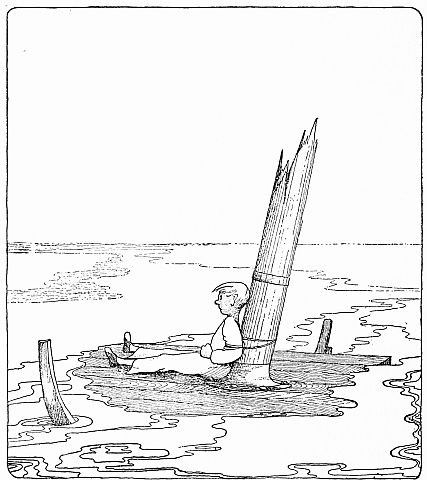 “I was alone in the ocean!”
[227]
Working my hand into my pocket, I found mypenknife and cut the rope that tied me. This remindedme of a shipwreck story which Joe had oncetold me, of a captain who had tied his son to a mastin order that he shouldn’t be washed overboard bythe gale. So of course it must have been the Doctorwho had done the same to me.
But where was he?
The awful thought came to me that the Doctorand the rest of them must be drowned, since therewas no other wreckage to be seen upon the waters.I got to my feet and stared around the sea again—Nothing—nothingbut water and sky!
Presently a long way off I saw the small darkshape of a bird skimming low down over the swell.When it came quite close I saw it was a StormyPetrel. I tried to talk to it, to see if it could giveme news. But unluckily I hadn’t learned much seabirdlanguage and I couldn’t even attract its attention,much less make it understand what I wanted.
Twice it circled round my raft, lazily, with hardlya flip of the wing. And I could not help wondering,in spite of the distress I was in, where it had spentlast night—how it, or any other living thing, hadweathered such a smashing storm. It made merealize the great big difference between differentcreatures; and that size and strength are not everything.To this petrel, a frail little thing of feathers,much smaller and weaker than I, the Sea could[228]do anything she liked, it seemed; and his only answerwas a lazy, saucy flip of the wing! Hewasthe one who should be called the able seaman. For,come raging gale, come sunlit calm, this wildernessof water was his home.
After swooping over the sea around me (justlooking for food, I supposed) he went off in thedirection from which he had come. And I wasalone once more.
I found I was somewhat hungry—and a littlethirsty too. I began to think all sorts of miserablethoughts, the way one does when he is lonesome andhas missed breakfast. What was going to becomeof me now, if the Doctor and the rest weredrowned? I would starve to death or die ofthirst. Then the sun went behind some clouds andI felt cold. How many hundreds or thousands ofmiles was I from any land? What if another stormshould come and smash up even this poor raft onwhich I stood?
I went on like this for a while, growing gloomierand gloomier, when suddenly I thought of Polynesia.“You’re always safe with the Doctor,” shehad said. “He gets there. Remember that.”
I’m sure I wouldn’t have minded so much if hehad been here with me. It was this being all alonethat made me want to weep. And yet the petrelwas alone!—What a baby I was, I told myself, tobe scared to the verge of tears just by loneliness![229]I was quite safe where I was—for the present anyhow.John Dolittle wouldn’t get scared by a littlething like this. He only got excited when he madea discovery, found a new bug or something. Andif what Polynesia had said was true, he couldn’t bedrowned and things would come out all right in theend somehow.
I threw out my chest, buttoned up my collar andbegan walking up and down the short raft to keepwarm. I would be like John Dolittle. I wouldn’tcry—And I wouldn’t get excited.
How long I paced back and forth I don’t know.But it was a long time—for I had nothing else todo.
At last I got tired and lay down to rest. Andin spite of all my troubles, I soon fell fast asleep.
This time when I woke up, stars were staringdown at me out of a cloudless sky. The sea wasstill calm; and my strange craft was rocking gentlyunder me on an easy swell. All my fine courageleft me as I gazed up into the big silent night andfelt the pains of hunger and thirst set to work inmy stomach harder than ever.
“Are you awake?” said a high silvery voice atmy elbow.
I sprang up as though some one had stuck a pinin me. And there, perched at the very end of myraft, her beautiful golden tail glowing dimly in thestarlight, sat Miranda, the Purple Bird-of-Paradise!
[230]
Never have I been so glad to see any one in mylife. I almost fell into the water as I leapt to hugher.
“I didn’t want to wake you,” said she. “Iguessed you must be tired after all you’ve beenthrough—Don’t squash the life out of me, boy:I’m not a stuffed duck, you know.”
“Oh, Miranda, you dear old thing,” said I, “I’mso glad to see you. Tell me, where is the Doctor?Is he alive?”
“Of course he’s alive—and it’s my firm beliefhe always will be. He’s over there, about fortymiles to the westward.”
“What’s he doing there?”
“He’s sitting on the other half of the Curlewshaving himself—or he was, when I left him.”
“Well, thank Heaven he’s alive!” said I—“AndBumpo—and the animals, are they all right?”
“Yes, they’re with him. Your ship broke in halfin the storm. The Doctor had tied you down whenhe found you stunned. And the part you were ongot separated and floated away. Golly, it wasastorm! One has to be a gull or an albatross tostand that sort of weather. I had been watchingfor the Doctor for three weeks, from a cliff-top;but last night I had to take refuge in a cave to keepmy tail-feathers from blowing out. As soon as Ifound the Doctor, he sent me off with some porpoises[231]to help us in our search. There had beenquite a gathering of sea-birds waiting to greet theDoctor; but the rough weather sort of broke up thearrangements that had been made to welcome himproperly. It was the petrel that first gave us thetip where you were.”
“Well, but how can I get to the Doctor, Miranda?—Ihaven’t any oars.”
“Get to him!—Why, you’re going to him now.Look behind you.”
I turned around. The moon was just rising onthe sea’s edge. And I now saw that my raft wasmoving through the water, but so gently that I hadnot noticed it before.
“What’s moving us?” I asked.
“The porpoises,” said Miranda.
I went to the back of the raft and looked downinto the water. And just below the surface I couldsee the dim forms of four big porpoises, their sleekskins glinting in the moonlight, pushing at the raftwith their noses.
“They’re old friends of the Doctor’s,” saidMiranda. “They’d do anything for John Dolittle.We should see his party soon now. We’re prettynear the place I left them—Yes, there they are!See that dark shape?—No, more to the right ofwhere you’re looking. Can’t you make out the[232]figure of the black man standing against the sky?—NowChee-Chee spies us—he’s waving. Don’tyou see them?”
I didn’t—for my eyes were not as sharp asMiranda’s. But presently from somewhere in themurky dusk I heard Bumpo singing his Africancomic songs with the full force of his enormousvoice. And in a little, by peering and peering inthe direction of the sound, I at last made out a dimmass of tattered, splintered wreckage—all that remainedof the poor Curlew—floating low downupon the water.
A hulloa came through the night. And I answeredit. We kept it up, calling to one anotherback and forth across the calm night sea. And afew minutes later the two halves of our brave littleruined ship bumped gently together again.
Now that I was nearer and the moon was higherI could see more plainly. Their half of the shipwas much bigger than mine.
It lay partly upon its side; and most of themwere perched upon the top munching ship’s biscuit.
But close down to the edge of the water, usingthe sea’s calm surface for a mirror and a piece ofbroken bottle for a razor, John Dolittle was shavinghis face by the light of the moon.
[233]
THE FIFTH CHAPTER
LAND!THEY all gave me a great greeting as Iclambered off my half of the ship on totheirs. Bumpo brought me a wonderfuldrink of fresh water which he drewfrom a barrel; and Chee-Chee and Polynesia stoodaround me feeding me ship’s biscuit.
But it was the sight of the Doctor’s smiling face—justknowing that I was with him once again—thatcheered me more than anything else. As Iwatched him carefully wipe his glass razor and putit away for future use, I could not help comparinghim in my mind with the Stormy Petrel. Indeed thevast strange knowledge which he had gained fromhis speech and friendship with animals had broughthim the power to do things which no other humanbeing would dare to try. Like the petrel, he couldapparently play with the sea in all her moods. Itwas no wonder that many of the ignorant savagepeoples among whom he passed in his voyagesmade statues of him showing him as half a fish, halfa bird, and half a man. And ridiculous though itwas, I could quite understand what Mirandameant when she said she firmly believed that he[234]could never die. Just to be with him gave you awonderful feeling of comfort and safety.
Except for his appearance (his clothes werecrumpled and damp and his battered high hat wasstained with salt water) that storm which had soterrified me had disturbed him no more than gettingstuck on the mud-bank in Puddleby River.
Politely thanking Miranda for getting me soquickly, he asked her if she would now go ahead ofus and show us the way to Spidermonkey Island.Next, he gave orders to the porpoises to leave myold piece of the ship and push the bigger half whereverthe Bird-of-Paradise should lead us.
How much he had lost in the wreck besides hisrazor I did not know—everything, most likely,together with all the money he had saved up to buythe ship with. And still he was smiling as thoughhe wanted for nothing in the world. The onlythings he had saved, as far as I could see—beyondthe barrel of water and bag of biscuit—were hisprecious note-books. These, I saw when he stoodup, he had strapped around his waist with yardsand yards of twine. He was, as old MatthewMugg used to say, a great man. He was unbelievable.
And now for three days we continued our journeyslowly but steadily—southward.
The only inconvenience we suffered from was thecold. This seemed to increase as we went forward.[235]The Doctor said that the island, disturbed from itsusual paths by the great gale, had evidently driftedfurther South than it had ever been before.
On the third night poor Miranda came back to usnearly frozen. She told the Doctor that in themorning we would find the island quite close to us,though we couldn’t see it now as it was a misty darknight. She said that she must hurry back at onceto a warmer climate; and that she would visit theDoctor in Puddleby next August as usual.
“Don’t forget, Miranda,” said John Dolittle,“if you should hear anything of what happened toLong Arrow, to get word to me.”
The Bird-of-Paradise assured him she would.And after the Doctor had thanked her again andagain for all that she had done for us, she wishedus good luck and disappeared into the night.
We were all awake early in the morning, long beforeit was light, waiting for our first glimpse ofthe country we had come so far to see. And asthe rising sun turned the eastern sky to gray, ofcourse it was old Polynesia who first shouted thatshe could see palm-trees and mountain tops.
With the growing light it became plain to all ofus: a long island with high rocky mountains in themiddle—and so near to us that you could almostthrow your hat upon the shore.
The porpoises gave us one last push and ourstrange-looking craft bumped gently on a low[236]beach. Then, thanking our lucky stars for achance to stretch our cramped legs, we all bundledoff on to the land—the first land, even though itwas floating land, that we had trodden for sixweeks. What a thrill I felt as I realized that SpidermonkeyIsland, the little spot in the atlas which mypencil had touched, lay at last beneath my feet!
When the light increased still further we noticedthat the palms and grasses of the island seemedwithered and almost dead. The Doctor said thatit must be on account of the cold that the islandwas now suffering from in its new climate. Thesetrees and grasses, he told us, were the kind thatbelonged to warm, tropical weather.
The porpoises asked if we wanted them any further.And the Doctor said that he didn’t thinkso, not for the present—nor the raft either, headded; for it was already beginning to fall to piecesand could not float much longer.
As we were preparing to go inland and explorethe island, we suddenly noticed a whole band of RedIndians watching us with great curiosity fromamong the trees. The Doctor went forward totalk to them. But he could not make them understand.He tried by signs to show them that hehad come on a friendly visit. The Indians didn’tseem to like us however. They had bows and arrowsand long hunting spears, with stone points, in their[237]hands; and they made signs back to the Doctor totell him that if he came a step nearer they wouldkill us all. They evidently wanted us to leave theisland at once. It was a very uncomfortable situation.
At last the Doctor made them understand that heonly wanted to see the island all over and that thenhe would go away—though how he meant to do it,with no boat to sail in, was more than I couldimagine.
While they were talking among themselves anotherIndian arrived—apparently with a messagethat they were wanted in some other part of the island.Because presently, shaking their spearsthreateningly at us, they went off with the newcomer.
“What discourteous pagans!” said Bumpo. “Didyou ever see such inhospitability?—Never evenasked us if we’d had breakfast, the benightedbounders!”
“Sh! They’re going off to their village,” saidPolynesia. “I’ll bet there’s a village on the otherside of those mountains. If you take my advice,Doctor, you’ll get away from this beach while theirbacks are turned. Let us go up into the higherland for the present—some place where they won’tknow where we are. They may grow friendlierwhen they see we mean no harm. They have[238]honest, open faces and look like a decent crowd tome. They’re just ignorant—probably never sawwhite folks before.”
So, feeling a little bit discouraged by our firstreception, we moved off towards the mountains inthe centre of the island.
[239]
THE SIXTH CHAPTER
THE JABIZRIWE found the woods at the feet of thehills thick and tangly and somewhathard to get through. On Polynesia’sadvice, we kept away from all pathsand trails, feeling it best to avoid meeting anyIndians for the present.
But she and Chee-Chee were good guides andsplendid jungle-hunters; and the two of them setto work at once looking for food for us. In avery short space of time they had found quite anumber of different fruits and nuts which made excellenteating, though none of us knew the namesof any of them. We discovered a nice clean streamof good water which came down from the mountains;so we were supplied with something to drink aswell.
We followed the stream up towards the heights.And presently we came to parts where the woodswere thinner and the ground rocky and steep.Here we could get glimpses of wonderful views allover the island, with the blue sea beyond.
While we were admiring one of these the Doctor[240]suddenly said, “Sh!—A Jabizri!—Don’t you hearit?”
We listened and heard, somewhere in the airabout us, an extraordinarily musical hum—likea bee, but not just one note. This hum rose andfell, up and down—almost like some one singing.
“No other insect but the Jabizri beetle hums likethat,” said the Doctor. “I wonder where he is—quitenear, by the sound—flying among the treesprobably. Oh, if I only had my butterfly-net!Why didn’t I think to strap that around my waisttoo. Confound the storm: I may miss the chanceof a lifetime now of getting the rarest beetle in theworld—Oh look! There he goes!”
A huge beetle, easily three inches long I shouldsay, suddenly flew by our noses. The Doctor gotfrightfully excited. He took off his hat to use asa net, swooped at the beetle and caught it. Henearly fell down a precipice on to the rocks belowin his wild hurry, but that didn’t bother him in theleast. He knelt down, chortling, upon the groundwith the Jabizri safe under his hat. From hispocket he brought out a glass-topped box, and intothis he very skilfully made the beetle walk fromunder the rim of the hat. Then he rose up, happyas a child, to examine his new treasure through theglass lid.
It certainly was a most beautiful insect. It was[241]pale blue underneath; but its back was glossy blackwith huge red spots on it.
“There isn’t an entymologist in the whole worldwho wouldn’t give all he has to be in my shoesto-day,” said the Doctor—“Hulloa! This Jabizri’sgot something on his leg—Doesn’t look likemud. I wonder what it is.”
He took the beetle carefully out of the box andheld it by its back in his fingers, where it waved itssix legs slowly in the air. We all crowded abouthim peering at it. Rolled around the middle sectionof its right foreleg was something that lookedlike a thin dried leaf. It was bound on very neatlywith strong spider-web.
It was marvelous to see how John Dolittle withhis fat heavy fingers undid that cobweb cord andunrolled the leaf, whole, without tearing it or hurtingthe precious beetle. The Jabizri he put backinto the box. Then he spread the leaf out flat andexamined it.
You can imagine our surprise when we found thatthe inside of the leaf was covered with signs andpictures, drawn so tiny that you almost needed amagnifying-glass to tell what they were. Some ofthe signs we couldn’t make out at all; but nearly allof the pictures were quite plain, figures of men andmountains mostly. The whole was done in acurious sort of brown ink.
For several moments there was a dead silence[242]while we all stared at the leaf, fascinated and mystified.
“I think this is written in blood,” said the Doctorat last. “It turns that color when it’s dry. Somebodypricked his finger to make these pictures.It’s an old dodge when you’re short of ink—buthighly unsanitary—What an extraordinary thingto find tied to a beetle’s leg! I wish I could talkbeetle language, and find out where the Jabizri gotit from.”
“But what is it?” I asked—“Rows of little picturesand signs. What do you make of it, Doctor?”
“It’s a letter,” he said—“a picture letter. Allthese little things put together mean a message—Butwhy give a message to a beetle to carry—and toa Jabizri, the rarest beetle in the world?—What anextraordinary thing!”
Then he fell to muttering over the pictures.
“I wonder what it means: men walking up amountain; men walking into a hole in a mountain;a mountain falling down—it’s a good drawing,that; men pointing to their open mouths; bars—prison-bars,perhaps; men praying; men lyingdown—they look as though they might be sick;and last of all, just a mountain—a peculiar-shapedmountain.”
All of a sudden the Doctor looked up sharply atme, a wonderful smile of delighted understandingspreading over his face.
[243]
“Long Arrow!” he cried, “don’t you see,Stubbins?—Why, of course! Only a naturalistwould think of doing a thing like this: giving hisletter to a beetle—not to a common beetle, but tothe rarest of all, one that other naturalists wouldtry to catch—Well, well! Long Arrow!—A picture-letterfrom Long Arrow. For pictures arethe only writing that he knows.”
“Yes, but who is the letter to?” I asked.
“It’s to me very likely. Miranda had told him,I know, years ago, that some day I meant to comehere. But if not for me, then it’s for any one whocaught the beetle and read it. It’s a letter to theworld.”
“Well, but what does it say? It doesn’t seemto me that it’s much good to you now you’ve got it.”
“Yes, it is,” he said, “because, look, I can readit now. First picture: men walking up a mountain—that’sLong Arrow and his party; men goinginto a hole in a mountain—they enter a cave lookingfor medicine-plants or mosses; a mountain fallingdown—some hanging rocks must have slipped andtrapped them, imprisoned them in the cave. Andthis was the only living creature that could carry amessage for them to the outside world—a beetle,who could burrowhis way into the open air. Ofcourse it was only a slim chance that the beetlewould be ever caught and the letter read. But itwasa chance; and when men are in great danger[244]they grab at any straw of hope.... All right.Now look at the next picture: men pointing to theiropen mouths—they are hungry; men praying—beggingany one who finds this letter to come to theirassistance; men lying down—they are sick, or starving.This letter, Stubbins, is their last cry for help.”
He sprang to his feet as he ended, snatched outa note-book and put the letter between the leaves.His hands were trembling with haste and agitation.
“Come on!” he cried—“up the mountain—all ofyou. There’s not a moment to lose. Bumpo, bringthe water and nuts with you. Heaven only knowshow long they’ve been pining underground. Let’shope and pray we’re not too late!”
“But where are you going to look?” I asked.“Miranda said the island was a hundred miles longand the mountains seem to run all the way down thecentre of it.”
“Didn’t you see the last picture?” he said, grabbingup his hat from the ground and cramming iton his head. “It was an oddly shaped mountain—lookedlike a hawk’s head. Well, there’s where heis—if he’s still alive. First thing for us to do, isto get up on a high peak and look around the islandfor a mountain shaped like a hawks’ head—Justto think of it! There’s a chance of my meetingLong Arrow, the son of Golden Arrow, afterall!—Come on! Hurry! To delay may meandeath to the greatest naturalist ever born!”
[245]
THE SEVENTH CHAPTER
HAWK’S-HEAD MOUNTAINWE all agreed afterwards that none ofus had ever worked so hard in ourlives before as we did that day. Formy part, I know I was often on thepoint of dropping exhausted with fatigue; but Ijust kept on going—like a machine—determinedthat, whatever happened, Iwould not be the firstto give up.
When we had scrambled to the top of a highpeak, almost instantly we saw the strange mountainpictured in the letter. In shape it was the perfectimage of a hawk’s head, and was, as far as we couldsee, the second highest summit in the island.
Although we were all out of breath from ourclimb, the Doctor didn’t let us rest a second as soonas he had sighted it. With one look at the sun fordirection, down he dashed again, breaking throughthickets, splashing over brooks, taking all the shortcuts. For a fat man, he was certainly the swiftestcross-country runner I ever saw.
We floundered after him as fast as we could.When I say we, I mean Bumpo and myself; for theanimals, Jip, Chee-Chee and Polynesia, were a long[246]way ahead—even beyond the Doctor—enjoying thehunt like a paper-chase.
At length we arrived at the foot of the mountainwe were making for; and we found its sides verysteep. Said the Doctor,
“Now we will separate and search for caves.This spot where we now are, will be our meeting-place.If anyone finds anything like a cave or ahole where the earth and rocks have fallen in, hemust shout and hulloa to the rest of us. If we findnothing we will all gather here in about an hour’stime—Everybody understand?”
Then we all went off our different ways.
Each of us, you may be sure, was anxious to bethe one to make a discovery. And never was amountain searched so thoroughly. But alas! nothingcould we find that looked in the least like a fallen-incave. There were plenty of places whererocks had tumbled down to the foot of the slopes;but none of these appeared as though caves or passagescould possibly lie behind them.
One by one, tired and disappointed, we straggledback to the meeting-place. The Doctor seemedgloomy and impatient but by no means inclined togive up.
“Jip,” he said, “couldn’t you smellanything likean Indian anywhere?”
“No,” said Jip. “I sniffed at every crack on themountainside. But I am afraid my nose will be[247]of no use to you here, Doctor. The trouble is, thewhole air is so saturated with the smell of spider-monkeysthat it drowns every other scent—And besides,it’s too cold and dry for good smelling.”
“It is certainly that,” said the Doctor—“and gettingcolder all the time. I’m afraid the island isstill drifting to the southward. Let’s hope it stopsbefore long, or we won’t be able to get even nutsand fruit to eat—everything in the island will perish—Chee-Chee,what luck did you have?”
“None, Doctor. I climbed to every peak andpinnacle I could see. I searched every hollow andcleft. But not one place could I find where menmight be hidden.”
“And Polynesia,” asked the Doctor, “did you seenothing that might put us on the right track?”
“Not a thing, Doctor—But I have a plan.”
“Oh good!” cried John Dolittle, full of hope renewed.“What is it? Let’s hear it.”
“You still have that beetle with you,” she asked—“theBiz-biz, or whatever it is you call thewretched insect?”
“Yes,” said the Doctor, producing the glass-toppedbox from his pocket, “here it is.”
“All right. Now listen,” said she. “If whatyou have supposed is true—that is, that Long Arrowhad been trapped inside the mountain by fallingrock, he probably found that beetle inside the cave—perhapsmany other different beetles too, eh?[248]He wouldn’t have been likely to take the Biz-bizin with him, would he?—He was hunting plants,you say, not beetles. Isn’t that right?”
“Yes,” said the Doctor, “that’s probably so.”
“Very well. It is fair to suppose then that thebeetle’s home, or his hole, is in that place—the partof the mountain where Long Arrow and his partyare imprisoned, isn’t it?”
“Quite, quite.”
“All right. Then the thing to do is to let thebeetle go—and watch him; and sooner or later he’llreturn to his home in Long Arrow’s cave. Andthere we will follow him—Or at all events,” sheadded smoothing down her wing-feathers with avery superior air, “we will follow him till the miserablebug starts nosing under the earth. But atleast he will show us what part of the mountainLong Arrow is hidden in.”
“But he may fly, if I let him out,” said the Doctor.“Then we shall just lose him and be no betteroff than we were before.”
“Lethim fly,” snorted Polynesia scornfully. “Aparrot can wing it as fast as a Biz-biz, I fancy. Ifhe takes to the air, I’ll guarantee not to let the littledevil out of my sight. And if he just crawls alongthe ground you can follow him yourself.”
“Splendid!” cried the Doctor. “Polynesia, youhave a great brain. I’ll set him to work at onceand see what happens.”
[249]
Again we all clustered round the Doctor as hecarefully lifted off the glass lid and let the big beetleclimb out upon his finger.
“Ladybug, Ladybug, fly away home!” croonedBumpo. “Your house is on fire and your chil—”
“Oh, be quiet!” snapped Polynesia crossly.“Stop insulting him! Don’t you suppose he haswits enough to go home without your telling him?”
“I thought perchance he might be of a philanderingdisposition,” said Bumpo humbly. “It couldbe that he is tired of his home and needs to beencouraged. Shall I sing him ‘Home Sweet Home,’think you?”
“No. Then he’d never go back. Your voiceneeds a rest. Don’t sing to him: just watch him—Oh,and Doctor, why not tie another message tothe creature’s leg, telling Long Arrow that we’redoing our best to reach him and that he mustn’t giveup hope?”
“I will,” said the Doctor. And in a minute hehad pulled a dry leaf from a bush near by and wascovering it with little pictures in pencil.
At last, neatly fixed up with his new mail-bag,Mr. Jabizri crawled off the Doctor’s finger to theground and looked about him. He stretched hislegs, polished his nose with his front feet and thenmoved off leisurely to the westward.
We had expected him to walk upthe mountain;instead, he walked aroundit. Do you know how[250]long it takes a beetle to walk round a mountain?Well, I assure you it takes an unbelievably longtime. As the hours dragged by, we hoped andhoped that he would get up and fly the rest, and letPolynesia carry on the work of following him. Buthe never opened his wings once. I had not realizedbefore how hard it is for a human being to walkslowly enough to keep up with a beetle. It was themost tedious thing I have ever gone through. Andas we dawdled along behind, watching him likehawks lest we lose him under a leaf or something,we all got so cross and ill-tempered we were readyto bite one another’s heads off. And when hestopped to look at the scenery or polish his nosesome more, I could hear Polynesia behind me lettingout the most dreadful seafaring swear-words youever heard.
After he had led us the whole way round themountain he brought us to the exact spot where westarted from and there he came to a dead stop.
“Well,” said Bumpo to Polynesia, “what do youthink of the beetle’s sense now? You see he doesn’tknow enough to go home.”
“Oh, be still, you Hottentot!” snapped Polynesia.“Wouldn’t youwant to stretch your legsfor exercise if you’d been shut up in a box all day.Probably his home is near here, and that’s why he’scome back.”
[251]
“But why,” I asked, “did he go the whole wayround the mountain first?”
Then the three of us got into a violent argument.But in the middle of it all the Doctor suddenlycalled out,
“Look, look!”
We turned and found that he was pointing to theJabizri, who was now walking upthe mountain ata much faster and more business-like gait.
“Well,” said Bumpo sitting down wearily; “if heis going to walk overthe mountain and back, formore exercise, I’ll wait for him here. Chee-Cheeand Polynesia can follow him.”
Indeed it would have taken a monkey or a birdto climb the place which the beetle was now walkingup. It was a smooth, flat part of the mountain’sside, steep as a wall.
But presently, when the Jabizri was no more thanten feet above our heads, we all cried out together.For, even while we watched him, he had disappearedinto the face of the rock like a raindrop soaking intosand.
“He’s gone,” cried Polynesia. “There must bea hole up there.” And in a twinkling she had flutteredup the rock and was clinging to the face of itwith her claws.
“Yes,” she shouted down, “we’ve run him toearth at last. His hole is right here, behind a[252]patch of lichen—big enough to get two fingers in.”
“Ah,” cried the Doctor, “this great slab ofrock then must have slid down from the summit andshut off the mouth of the cave like a door. Poorfellows! What a dreadful time they must havespent in there!—Oh, if we only had some picks andshovels now!”
“Picks and shovels wouldn’t do much good,” saidPolynesia. “Look at the size of the slab: a hundredfeet high and as many broad. You wouldneed an army for a week to make any impressionon it.”
“I wonder how thick it is,” said the Doctor;and he picked up a big stone and banged it with allhis might against the face of the rock. It made ahollow booming sound, like a giant drum. We allstood still listening while the echo of it died slowlyaway.
And then a cold shiver ran down my spine. For,from within the mountain, back came three answeringknocks: Boom!... Boom!... Boom!
Wide-eyed we looked at one another asthough the earth itself had spoken. And the solemnlittle silence that followed was broken by theDoctor.
“Thank Heaven,” he said in a hushed reverentvoice, “some of them at least are alive!”
[253]
PART FIVE
THE FIRST CHAPTER
A GREAT MOMENTTHE next part of our problem was thehardest of all: how to roll aside, pulldown or break open, that gigantic slab.As we gazed up at it towering above ourheads, it looked indeed a hopeless task for our tinystrength.
But the sounds of life from inside the mountainhad put new heart in us. And in a moment wewere all scrambling around trying to find any openingor crevice which would give us something towork on. Chee-Chee scaled up the sheer wall ofthe slab and examined the top of it where it leanedagainst the mountain’s side; I uprooted bushes andstripped off hanging creepers that might conceal aweak place; the Doctor got more leaves andcomposed new picture-letters for the Jabizri totake in if he should turn up again; whilst Polynesiacarried up a handful of nuts and pushed them intothe beetle’s hole, one by one, for the prisoners insideto eat.
“Nuts are so nourishing,” she said.
But Jip it was who, scratching at the foot of the[254]slab like a good ratter, made the discovery whichled to our final success.
“Doctor,” he cried, running up to John Dolittlewith his nose all covered with black mud, “this slabis resting on nothing but a bed of soft earth. Younever saw such easy digging. I guess the cavebehind must be just too high up for the Indians toreach the earth with their hands, or they couldhave scraped a way out long ago. If we can onlyscratch the earth-bed away from under, the slabmight drop a little. Then maybe the Indians canclimb out over the top.”
The Doctor hurried to examine the place whereJip had dug.
“Why, yes,” he said, “if we can get theearth away from under this front edge, the slabis standing up so straight, we might even make itfall right down in this direction. It’s well worthtrying. Let’s get at it, quick.”
We had no tools but the sticks and slivers ofstone which we could find around. A strange sightwe must have looked, the whole crew of us squattingdown on our heels, scratching and burrowing at thefoot of the mountain, like six badgers in a row.
After about an hour, during which in spite of thecold the sweat fell from our foreheads in all directions,the Doctor said,
“Be ready to jump from under, clear out of theway, if she shows signs of moving. If this slab[255]falls on anybody, it will squash him flatter than apancake.”
Presently there was a grating, grinding sound.
“Look out!” yelled John Dolittle, “here shecomes!—Scatter!”
We ran for our lives, outwards, toward the sides.The big rock slid gently down, about a foot, into thetrough which we had made beneath it. For a momentI was disappointed, for like that, it was as hopelessas before—no signs of a cave-mouth showingabove it. But as I looked upward, I saw the topcoming very slowly away from the mountainside.We had unbalanced it below. As it moved apartfrom the face of the mountain, sounds of humanvoices, crying gladly in a strange tongue, issued frombehind. Faster and faster the top swung forward,downward. Then, with a roaring crash whichshook the whole mountain-range beneath our feet,it struck the earth and cracked in halves.
How can I describe to any one that first meetingbetween the two greatest naturalists the world everknew, Long Arrow, the son of Golden Arrow andJohn Dolittle, M.D., of Puddleby-on-the-Marsh?The scene rises before me now, plain and clear inevery detail, though it took place so many, manyyears ago. But when I come to write of it, wordsseem such poor things with which to tell you of thatgreat occasion.
I know that the Doctor, whose life was surely[256]full enough of big happenings, always counted thesetting free of the Indian scientist as the greatestthing he ever did. For my part, knowing how muchthis meeting must mean to him, I was on pins andneedles of expectation and curiosity as the greatstone finally thundered down at our feet and wegazed across it to see what lay behind.
The gloomy black mouth of a tunnel, full twentyfeet high, was revealed. In the centre of this openingstood an enormous red Indian, seven feet tall,handsome, muscular, slim and naked—but for abeaded cloth about his middle and an eagle’s featherin his hair. He held one hand across his face toshield his eyes from the blinding sun which he hadnot seen in many days.
“It is he!” I heard the Doctor whisper at myelbow. “I know him by his great height and thescar upon his chin.”
And he stepped forward slowly across the fallenstone with his hand outstretched to the red man.
Presently the Indian uncovered his eyes. And Isaw that they had a curious piercing gleam in them—likethe eyes of an eagle, but kinder and more gentle.He slowly raised his right arm, the rest of himstill and motionless like a statue, and took the Doctor’shand in his. It was a great moment. Polynesianodded to me in a knowing, satisfied kind ofway. And I heard old Bumpo sniffle sentimentally.
Then the Doctor tried to speak to Long Arrow.[257]
[258]But the Indian knew no English of course, and theDoctor knew no Indian. Presently, to my surprise,I heard the Doctor trying him in different animallanguages. “It was a great moment”
“How do you do?” he said in dog-talk; “I amglad to see you,” in horse-signs; “How long haveyou been buried?” in deer-language. Still the Indianmade no move but stood there, straight andstiff, understanding not a word.
The Doctor tried again, in several other animaldialects. But with no result.
Till at last he came to the language of eagles.
“Great Red-Skin,” he said in the fierce screamsand short grunts that the big birds use, “never haveI been so glad in all my life as I am to-day to find youstill alive.”
In a flash Long Arrow’s stony face lit up with asmile of understanding; and back came the answerin eagle-tongue,
“Mighty White Man, I owe my life to you. Forthe remainder of my days I am your servant to command.”
Afterwards Long Arrow told us that this was theonly bird or animal language that he had ever beenable to learn. But that he had not spoken it in along time, for no eagles ever came to this island.
Then the Doctor signaled to Bumpo who cameforward with the nuts and water. But Long Arrowneither ate nor drank. Taking the supplies with a[259]nod of thanks, he turned and carried them into theinner dimness of the cave. We followed him.
Inside we found nine other Indians, men, womenand boys, lying on the rock floor in a dreadful stateof thinness and exhaustion.
Some had their eyes closed, as if dead. Quicklythe Doctor went round them all and listened to theirhearts. They were all alive; but one woman wastoo weak even to stand upon her feet.
At a word from the Doctor, Chee-Chee andPolynesia sped off into the jungles after more fruitand water.
While Long Arrow was handing round what foodwe had to his starving friends, we suddenly hearda sound outside the cave. Turning about we saw,clustered at the entrance, the band of Indians whohad met us so inhospitably at the beach.
They peered into the dark cave cautiously at first.But as soon as they saw Long Arrow and the otherIndians with us, they came rushing in, laughing,clapping their hands with joy and jabbering away ata tremendous rate.
Long Arrow explained to the Doctor that thenine Indians we had found in the cave with him weretwo families who had accompanied him into themountains to help him gather medicine-plants. Andwhile they had been searching for a kind of moss—goodfor indigestion—which grows only insideof damp caves, the great rock slab had slid down[260]and shut them in. Then for two weeks they hadlived on the medicine-moss and such fresh water ascould be found dripping from the damp walls of thecave. The other Indians on the island had giventhem up for lost and mourned them as dead; and theywere now very surprised and happy to find theirrelatives alive.
When Long Arrow turned to the newcomers andtold them in their own language that it was the whiteman who had found and freed their relatives, theygathered round John Dolittle, all talking at onceand beating their breasts.
Long Arrow said they were apologizing and tryingto tell the Doctor how sorry they were thatthey had seemed unfriendly to him at the beach.They had never seen a white man before and hadreally been afraid of him—especially when they sawhim conversing with the porpoises. They hadthought he was the Devil, they said.
Then they went outside and looked at the greatstone we had thrown down, big as a meadow; andthey walked round and round it, pointing to thebreak running through the middle and wonderinghow the trick of felling it was done.
Travelers who have since visited SpidermonkeyIsland tell me that that huge stone slab is now oneof the regular sights of the island. And that theIndian guides, when showing it to visitors, alwaystell theirstory of how it came there. They say that[261]when the Doctor found that the rocks had entrappedhis friend, Long Arrow, he was so angry that heripped the mountain in halves with his bare handsand let him out.
[262]
THE SECOND CHAPTER
“THE MEN OF THE MOVING LAND”FROM that time on the Indians’ treatmentof us was very different. We were invitedto their village for a feast to celebrate therecovery of the lost families. And afterwe had made a litter from saplings to carry the sickwoman in, we all started off down the mountain.
On the way the Indians told Long Arrow somethingwhich appeared to be sad news, for on hearingit, his face grew very grave. The Doctor asked himwhat was wrong. And Long Arrow said he hadjust been informed that the chief of the tribe, an oldman of eighty, had died early that morning.
“That,” Polynesia whispered in my ear, “musthave been what they went back to the village for,when the messenger fetched them from the beach.—Remember?”
“What did he die of?” asked the Doctor.
“He died of cold,” said Long Arrow.
Indeed, now that the sun was setting, we wereall shivering ourselves.
“This is a serious thing,” said the Doctor to me.“The island is still in the grip of that wretched currentflowing southward. We will have to look into[263]this to-morrow. If nothing can be done about it,the Indians had better take to canoes and leave theisland. The chance of being wrecked will be betterthan getting frozen to death in the ice-floes of theAntarctic.”
Presently we came over a saddle in the hills, andlooking downward on the far side of the island, wesaw the village—a large cluster of grass huts andgaily colored totem-poles close by the edge of thesea.
“How artistic!” said the Doctor—“Delightfullysituated. What is the name of the village?”
“Popsipetel,” said Long Arrow. “That is thename also of the tribe. The word signifies in Indiantongue, The Men of The Moving Land. There aretwo tribes of Indians on the island: the Popsipetelsat this end and the Bag-jagderags at the other.”
“Which is the larger of the two peoples?”
“The Bag-jagderags, by far. Their city coverstwo square leagues. But,” added Long Arrow aslight frown darkening his handsome face, “for me,I would rather have one Popsipetel than a hundredBag-jagderags.”
The news of the rescue we had made had evidentlygone ahead of us. For as we drew nearer to thevillage we saw crowds of Indians streaming out togreet the friends and relatives whom they had neverthought to see again.
These good people, when they too were told how[264]the rescue had been the work of the strange whitevisitor to their shores, all gathered round the Doctor,shook him by the hands, patted him and huggedhim. Then they lifted him up upon their strongshoulders and carried him down the hill into thevillage.
There the welcome we received was even morewonderful. In spite of the cold air of the comingnight, the villagers, who had all been shiveringwithin their houses, threw open their doors and cameout in hundreds. I had no idea that the little villagecould hold so many. They thronged about us,smiling and nodding and waving their hands; andas the details of what we had done were recited byLong Arrow they kept shouting strange singingnoises, which we supposed were words of gratitudeor praise.
We were next escorted to a brand-new grasshouse, clean and sweet-smelling within, and informedthat it was ours. Six strong Indian boys were toldoff to be our servants.
On our way through the village we noticed ahouse, larger than the rest, standing at the end of themain street. Long Arrow pointed to it and toldus it was the Chief’s house, but that it was nowempty—no new chief having yet been elected totake the place of the old one who had died.
Inside our new home a feast of fish and fruit hadbeen prepared. Most of the more important men[265]of the tribe were already seating themselves at thelong dining-table when we got there. Long Arrowinvited us to sit down and eat.
This we were glad enough to do, as we were allhungry. But we were both surprised and disappointedwhen we found that the fish had not beencooked. The Indians did not seem to think thisextraordinary in the least, but went ahead gobblingthe fish with much relish the way it was, raw.
With many apologies, the Doctor explained toLong Arrow that if they had no objection we wouldprefer our fish cooked.
Imagine our astonishment when we found thatthe great Long Arrow, so learned in the naturalsciences, did not know what the word cookedmeant!
Polynesia who was sitting on the bench betweenJohn Dolittle and myself pulled the Doctor by thesleeve.
“I’ll tell you what’s wrong, Doctor,” she whisperedas he leant down to listen to her: “these peoplehave no fires! They don’t know how to makea fire. Look outside: It’s almost dark, and thereisn’t a light showing in the whole village. This isa fireless people.”
[266]
THE THIRD CHAPTER
FIRETHEN the Doctor asked Long Arrow ifhe knew what fire was, explaining it tohim by pictures drawn on the buckskintable-cloth. Long Arrow said he hadseen such a thing—coming out of the tops of volcanoes;but that neither he nor any of the Popsipetelsknew how it was made.
“Poor perishing heathens!” muttered Bumpo.“No wonder the old chief died of cold!”
At that moment we heard a crying sound at thedoor. And turning round, we saw a weeping Indianmother with a baby in her arms. She said somethingto the Indians which we could not understand;and Long Arrow told us the baby was sick and shewanted the white doctor to try and cure it.
“Oh Lord!” groaned Polynesia in my ear—“Justlike Puddleby: patients arriving in the middleof dinner. Well, one thing: the food’s raw, sonothing can get cold anyway.”
The Doctor examined the baby and found at oncethat it was thoroughly chilled.
“Fire—fire! That’s what it needs,” he saidturning to Long Arrow—“That’s what you all need.[267]This child will have pneumonia if it isn’t kept warm.”
“Aye, truly. But how to make a fire,” said LongArrow—“where to get it: that is the difficulty.All the volcanoes in this land are dead.”
Then we fell to hunting through our pockets tosee if any matches had survived the shipwreck.The best we could muster were two whole ones anda half—all with the heads soaked off them by saltwater.
“Hark, Long Arrow,” said the Doctor: “diversways there be of making fire without the aid ofmatches. One: with a strong glass and the rays ofthe sun. That however, since the sun has set, we cannotnow employ. Another is by grinding a hard stickinto a soft log—Is the daylight gone without?—Alasyes. Then I fear we must await the morrow; forbesides the different woods, we need an old squirrel’snest for fuel—And that without lamps you couldnot find in your forests at this hour.”
“Great are your cunning and your skill, oh WhiteMan,” Long Arrow replied. “But in this you dous an injustice. Know you not that all fireless peoplescan see in the dark? Having no lamps we areforced to train ourselves to travel through the blackestnight, lightless. I will despatch a messengerand you shall have your squirrel’s nest within thehour.”
He gave an order to two of our boy-servantswho promptly disappeared running. And sure[268]enough, in a very short space of time a squirrel’s nest,together with hard and soft woods, was broughtto our door.
The moon had not yet risen and within the houseit was practically pitch-black. I could feel and hear,however, that the Indians were moving about comfortablyas though it were daylight. The task ofmaking fire the Doctor had to perform almost entirelyby the sense of touch, asking Long Arrow andthe Indians to hand him his tools when he mislaidthem in the dark. And then I made a curious discovery:now that I had to, I found that I was beginningto see a little in the dark myself. And forthe first time I realized that of course there isnosuch thing as pitch-dark, so long as you have a dooropen or a sky above you.
Calling for the loan of a bow, the Doctor loosenedthe string, put the hard stick into a loop and begangrinding this stick into the soft wood of the log.Soon I smelt that the log was smoking. Then hekept feeding the part that was smoking with theinside lining of the squirrel’s nest, and he asked meto blow upon it with my breath. He made the stickdrill faster and faster. More smoke filled theroom. And at last the darkness about us was suddenlylit up. The squirrel’s nest had burst intoflame.
The Indians murmured and grunted with astonishment.At first they were all for falling on their[269]knees and worshiping the fire. Then they wantedto pick it up with their bare hands and play with it.We had to teach them how it was to be used; andthey were quite fascinated when we laid our fishacross it on sticks and cooked it. They sniffed theair with relish as, for the first time in history, thesmell of fried fish passed through the village ofPopsipetel.
Then we got them to bring us piles and stacksof dry wood; and we made an enormous bonfirein the middle of the main street. Round this,when they felt its warmth, the whole tribe gatheredand smiled and wondered. It was a striking sight,one of the pictures from our voyages that I mostfrequently remember: that roaring jolly blaze beneaththe black night sky, and all about it a vastring of Indians, the firelight gleaming on bronzecheeks, white teeth and flashing eyes—a whole towntrying to get warm, giggling and pushing like school-children.
In a little, when we had got them more used tothe handling of fire, the Doctor showed them how itcould be taken into their houses if a hole were onlymade in the roof to let the smoke out. And beforewe turned in after that long, long, tiring day, wehad fires going in every hut in the village.
The poor people were so glad to get really warmagain that we thought they’d never go to bed.Well on into the early hours of the morning the[270]little town fairly buzzed with a great low murmur:the Popsipetels sitting up talking of their wonderfulpale-faced visitor and this strange good thing hehad brought with him—fire!
[271]
THE FOURTH CHAPTER
WHAT MAKES AN ISLAND FLOATVERY early in our experience of Popsipetelkindness we saw that if we wereto get anything done at all, we wouldalmost always have to do it secretly.The Doctor was so popular and loved by all that assoon as he showed his face at his door in the morningcrowds of admirers, waiting patiently outside,flocked about him and followed him wherever hewent. After his fire-making feat, this childlike peopleexpected him, I think, to be continually doingmagic; and they were determined not to miss a trick.
It was only with great difficulty that we escapedfrom the crowd the first morning and set out withLong Arrow to explore the island at our leisure.
In the interior we found that not only the plantsand trees were suffering from the cold: the animallife was in even worse straits. Everywhere shiveringbirds were to be seen, their feathers all fluffedout, gathering together for flight to summer lands.And many lay dead upon the ground. Going downto the shore, we watched land-crabs in large numberstaking to the sea to find some better home. Whileaway to the Southeast we could see many icebergs[272]floating—a sign that we were now not far fromthe terrible region of the Antarctic.
As we were looking out to sea, we noticed ourfriends the porpoises jumping through the waves.The Doctor hailed them and they came inshore.
He asked them how far we were from the SouthPolar Continent.
About a hundred miles, they told him. And thenthey asked why he wanted to know.
“Because this floating island we are on,” said he,“is drifting southward all the time in a current.It’s an island that ordinarily belongs somewhere inthe tropic zone—real sultry weather, sunstrokesand all that. If it doesn’t stop going southwardpretty soon everything on it is going to perish.”
“Well,” said the porpoises, “then the thing todo is to get it back into a warmer climate, isn’t it?”
“Yes, but how?” said the Doctor. “We can’trowit back.”
“No,” said they, “but whales could push it—ifyou only got enough of them.”
“What a splendid idea!—Whales, the verything!” said the Doctor. “Do you think you couldget me some?”
“Why, certainly,” said the porpoises, “we passedone herd of them out there, sporting about amongthe icebergs. We’ll ask them to come over. Andif they aren’t enough, we’ll try and hunt up somemore. Better have plenty.”
[273]
“Thank you,” said the Doctor. “You are verykind—By the way, do you happen to know howthis island came to be a floating island? At leasthalf of it, I notice, is made of stone. It is very oddthat it floats at all, isn’t it?”
“It is unusual,” they said. “But the explanationis quite simple. It used to be a mountainous part ofSouth America—an overhanging part—sort of anawkward corner, you might say. Way back in theglacial days, thousands of years ago, it broke offfrom the mainland; and by some curious accident theinside of it, which is hollow, got filled with airas it fell into the ocean. You can only see less thanhalf of the island: the bigger half is under water.And in the middle of it, underneath, is a huge rockair-chamber, running right up inside the mountains.And that’s what keeps it floating.”
“What a pecurious phenometer!” said Bumpo.
“It is indeed,” said the Doctor. “I must makea note of that.” And out came the everlastingnote-book.
The porpoises went bounding off towards theicebergs. And not long after, we saw the seaheaving and frothing as a big herd of whales cametowards us at full speed.
They certainly were enormous creatures; andthere must have been a good two hundred of them.
“Here they are,” said the porpoises, poking theirheads out of the water.
[274]
“Good!” said the Doctor. “Now just explainto them, will you please? that this is a very seriousmatter for all the living creatures in this land. Andask them if they will be so good as to go down tothe far end of the island, put their noses againstit and push it back near the coast of SouthernBrazil.”
The porpoises evidently succeeded in persuadingthe whales to do as the Doctor asked; for presentlywe saw them thrashing through the seas, goingoff towards the south end of the island.
Then we lay down upon the beach and waited.
After about an hour the Doctor got up and threwa stick into the water. For a while this floatedmotionless. But soon we saw it begin to movegently down the coast.
“Ah!” said the Doctor, “see that?—The islandis going North at last. Thank goodness!”
Faster and faster we left the stick behind; andsmaller and dimmer grew the icebergs on the skyline.
The Doctor took out his watch, threw more sticksinto the water and made a rapid calculation.
“Humph!—Fourteen and a half knots an hour,”he murmured—“A very nice speed. It should takeus about five days to get back near Brazil. Well,that’s that—Quite a load off my mind. I declareI feel warmer already. Let’s go and get somethingto eat.”
[275]
THE FIFTH CHAPTER
WAR!ON our way back to the village the Doctorbegan discussing natural history withLong Arrow. But their most interestingtalk, mainly about plants, had hardlybegun when an Indian runner came dashing up tous with a message.
Long Arrow listened gravely to the breathless,babbled words, then turned to the Doctor and saidin eagle tongue,
“Great White Man, an evil thing has befallenthe Popsipetels. Our neighbors to the southward,the thievish Bag-jagderags, who for so long havecast envious eyes on our stores of ripe corn, havegone upon the war-path; and even now are advancingto attack us.”
“Evil news indeed,” said the Doctor. “Yet letus not judge harshly. Perhaps it is that they aredesperate for food, having their own crops frost-killedbefore harvest. For are they not even nearerthe cold South than you?”
“Make no excuses for any man of the tribe of theBag-jagderags,” said Long Arrow shaking his head.“They are an idle shiftless race. They do but see[276]a chance to get corn without the labor of husbandry.If it were not that they are a much bigger tribeand hope to defeat their neighbor by sheer force ofnumbers, they would not have dared to make openwar upon the brave Popsipetels.”
When we reached the village we found it in agreat state of excitement. Everywhere men wereseen putting their bows in order, sharpening spears,grinding battle-axes and making arrows by the hundred.Women were raising a high fence of bamboopoles all round the village. Scouts and messengerskept coming and going, bringing news of the movementsof the enemy. While high up in the treesand hills about the village we could see look-outswatching the mountains to the southward.
Long Arrow brought another Indian, short butenormously broad, and introduced him to the Doctoras Big Teeth, the chief warrior of the Popsipetels.
The Doctor volunteered to go and see the enemyand try to argue the matter out peacefully withthem instead of fighting; for war, he said, was atbest a stupid wasteful business. But the two shooktheir heads. Such a plan was hopeless, they said.In the last war when they had sent a messenger todo peaceful arguing, the enemy had merely hit himwith an ax.
While the Doctor was asking Big Teeth how hemeant to defend the village against attack, a cryof alarm was raised by the look-outs.
[277]
“They’re coming!—The Bag-jagderags—swarmingdown the mountains in thousands!”
“Well,” said the Doctor, “it’s all in the day’swork, I suppose. I don’t believe in war; but if thevillage is attacked we must help defend it.”
And he picked up a club from the ground andtried the heft of it against a stone.
“This,” he said, “seems like a pretty good toolto me.” And he walked to the bamboo fence andtook his place among the other waiting fighters.
Then we all got hold of some kind of weapon withwhich to help our friends, the gallant Popsipetels:I borrowed a bow and a quiver full of arrows; Jipwas content to rely upon his old, but still strongteeth; Chee-Chee took a bag of rocks and climbeda palm where he could throw them down upon theenemies’ heads; and Bumpo marched after theDoctor to the fence armed with a young tree inone hand and a door-post in the other.
When the enemy drew near enough to be seenfrom where we stood we all gasped with astonishment.The hillsides were actually covered withthem—thousands upon thousands. They made oursmall army within the village look like a mere handful.
“Saints alive!” muttered Polynesia, “our littlelot will stand no chance against that swarm. Thiswill never do. I’m going off to get some help.”
Where she was going and what kind of help[278]she meant to get, I had no idea. She just disappearedfrom my side. But Jip, who had heard her,poked his nose between the bamboo bars ofthe fence to get a better view of the enemy andsaid,
“Likely enough she’s gone after the Black Parrots.Let’s hope she finds them in time. Justlook at those ugly ruffians climbing down the rocks—millionsof ’em! This fight’s going to keep usall hopping.”
And Jip was right. Before a quarter of anhour had gone by our village was completely surroundedby one huge mob of yelling, raging Bag-jagderags.
I now come again to a part in the story of ourvoyages where things happened so quickly, one uponthe other, that looking backwards I see the pictureonly in a confused kind of way. I know that if ithad not been for the Terrible Three—as theycame afterwards to be fondly called in Popsipetelhistory—Long Arrow, Bumpo and the Doctor, thewar would have been soon over and the whole islandwould have belonged to the worthless Bag-jagderags.But the Englishman, the African and the Indianwere a regiment in themselves; and between themthey made that village a dangerous place for anyman to try to enter.
The bamboo fencing which had been hastily setup around the town was not a very strong affair;[279]
[280]and right from the start it gave way in one placeafter another as the enemy thronged and crowdedagainst it. Then the Doctor, Long Arrow andBumpo would hurry to the weak spot, a terrifichand-to-hand fight would take place and the enemybe thrown out. But almost instantly a cry ofalarm would come from some other part of thevillage-wall; and the Three would have to rush offand do the same thing all over again.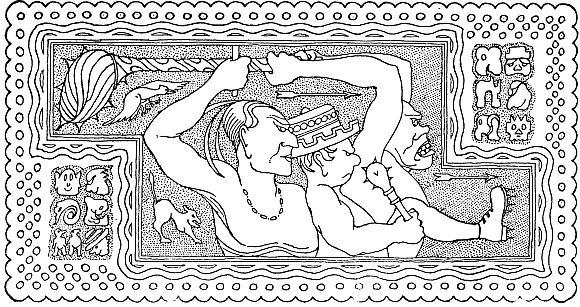 The Terrible Three
From an Indian rock-engraving found on Hawks’-Head Mountain, Spidermonkey IslandThe Popsipetels were themselves no meanfighters; but the strength and weight of those threemen of different lands and colors, standing closetogether, swinging their enormous war-clubs, wasreally a sight for the wonder and admiration ofany one.
Many weeks later when I was passing an Indiancamp-fire at night I heard this song being sung.It has since become one of the traditional folksongsof the Popsipetels.
THE SONG OF THE TERRIBLE THREEOh hear ye the Song of the Terrible ThreeAnd the fight that they fought by the edge of the sea.Down from the mountains, the rocks and the crags,Swarming like wasps, came the Bag-jagderags.Surrounding our village, our walls they broke down.Oh, sad was the plight of our men and our town!But Heaven determined our land to set free[281]And sent us the help of the Terrible Three.One was a Black—he was dark as the night;One was a Red-skin, a mountain of height;But the chief was a White Man, round like a bee;And all in a row stood the Terrible Three.Shoulder to shoulder, they hammered and hit.Like demons of fury they kicked and they bit.Like a wall of destruction they stood in a row,Flattening enemies, six at a blow.Oh, strong was the Red-skin fierce was the Black.Bag-jagderags trembled and tried to turn back.But ’twas of the White Man they shouted, “Beware!He throws men in handfuls, straight up in the air!”Long shall they frighten bad children at nightWith tales of the Red and the Black and the White.And long shall we sing of the Terrible ThreeAnd the fight that they fought by the edge of the sea.[282]
THE SIXTH CHAPTER
GENERAL POLYNESIABUT alas! even the Three, mighty thoughthey were, could not last forever againstan army which seemed to have no end.In one of the hottest scrimmages, whenthe enemy had broken a particularly wide holethrough the fence, I saw Long Arrow’s great figuretopple and come down with a spear sticking in hisbroad chest.
For another half-hour Bumpo and the Doctorfought on side by side. How their strength heldout so long I cannot tell, for never a second werethey given to get their breath or rest their arms.
The Doctor—the quiet, kindly, peaceable, littleDoctor!—well, you wouldn’t have known him if youhad seen him that day dealing out whacks you couldhear a mile off, walloping and swatting in all directions.
As for Bumpo, with staring eye-balls and grimset teeth, he was a veritable demon. None daredcome within yards of that wicked, wide-circling door-post.But a stone, skilfully thrown, struck him atlast in the centre of the forehead. And down went[283]the second of the Three. John Dolittle, the lastof the Terribles, was left fighting alone.
Jip and I rushed to his side and tried to take theplaces of the fallen ones. But, far too light andtoo small, we made but a poor exchange. Anotherlength of the fence crashed down, and through thewidened gap the Bag-jagderags poured in on uslike a flood.
“To the canoes!—To the sea!” shouted the Popsipetels.“Fly for your lives!—All is over!—Thewar is lost!”
But the Doctor and I never got a chance tofly for our lives. We were swept off our feet andknocked down flat by the sheer weight of the mob.And once down, we were unable to get up again. Ithought we would surely be trampled to death.
But at that moment, above the din and racket ofthe battle, we heard the most terrifying noise thatever assaulted human ears: the sound of millionsand millions of parrots all screeching with fury together.
The army, which in the nick of time Polynesiahad brought to our rescue, darkened the whole skyto the westward. I asked her afterwards, howmany birds there were; and she said she didn’tknow exactly but that they certainly numberedsomewhere between sixty and seventy millions. Inthat extraordinarily short space of time she hadbrought them from the mainland of South America.
[284]
If you have ever heard a parrot screech withanger you will know that it makes a truly frightfulsound; and if you have ever been bitten by one,you will know that its bite can be a nasty and a painfulthing.
The Black Parrots (coal-black all over, they were—exceptfor a scarlet beak and a streak of redin wing and tail) on the word of command fromPolynesia set to work upon the Bag-jagderags whowere now pouring through the village looking forplunder.
And the Black Parrots’ method of fighting waspeculiar. This is what they did: on the head ofeach Bag-jagderag three or four parrots settled andtook a good foot-hold in his hair with their claws;then they leant down over the sides of his head andbegan clipping snips out of his ears, for all theworld as though they were punching tickets. Thatis all they did. They never bit them anywhere elseexcept the ears. But it won the war for us.
With howls pitiful to hear, the Bag-jagderagsfell over one another in their haste to get out ofthat accursed village. It was no use their tryingto pull the parrots off their heads; because for eachhead there were always four more parrots waitingimpatiently to get on.
Some of the enemy were lucky; and with onlya snip or two managed to get outside the fence—wherethe parrots immediately left them alone.[285]But with most, before the black birds had donewith them, the ears presented a very singularappearance—like the edge of a postage-stamp.This treatment, very painful at the time, did nothowever do them any permanent harm beyond thechange in looks. And it later got to be the tribalmark of the Bag-jagderags. No really smart younglady of this tribe would be seen walking with a manwho did not have scalloped ears—for such was aproof that he had been in the Great War. Andthat (though it is not generally known to scientists)is how this people came to be called by the otherIndian nations, the Ragged-Eared Bag-jagderags.
As soon as the village was cleared of the enemythe Doctor turned his attention to the wounded.
In spite of the length and fierceness of the struggle,there were surprisingly few serious injuries.Poor Long Arrow was the worst off. However,after the Doctor had washed his wound and got himto bed, he opened his eyes and said he already feltbetter. Bumpo was only badly stunned.
With this part of the business over, the Doctorcalled to Polynesia to have the Black Parrots drivethe enemy right back into their own country and towait there, guarding them all night.
Polynesia gave the short word of command; andlike one bird those millions of parrots opened theirred beaks and let out once more their terrifyingbattle-scream.
[286]
The Bag-jagderags didn’t wait to be bitten asecond time, but fled helter-skelter over the mountainsfrom which they had come; whilst Polynesiaand her victorious army followed watchfully behindlike a great, threatening, black cloud.
The Doctor picked up his high hat which hadbeen knocked off in the fight, dusted it carefully andput it on.
“To-morrow,” he said, shaking his fist towardsthe hills, “we will arrange the terms of peace—andwe will arrange them—in the City of Bag-jagderag!”
His words were greeted with cheers of triumphfrom the admiring Popsipetels. The war was over.
[287]
THE SEVENTH CHAPTER
THE PEACE OF THE PARROTSTHE next day we set out for the far endof the island, and reaching it in canoes(for we went by sea) after a journeyof twenty-five hours, we remained nolonger than was necessary in the City of Bag-jagderag.
When he threw himself into that fight at Popsipetel,I saw the Doctor really angry for the firsttime in my life. But his anger, once aroused, wasslow to die. All the way down the coast of theisland he never ceased to rail against this cowardlypeople who had attacked his friends, the Popsipetels,for no other reason but to rob them of theircorn, because they were too idle to till the landthemselves. And he was still angry when hereached the City of Bag-jagderag.
Long Arrow had not come with us for he wasas yet too weak from his wound. But the Doctor—alwaysclever at languages—was already gettingfamiliar with the Indian tongue. Besides, amongthe half-dozen Popsipetels who accompanied us topaddle the canoes, was one boy to whom we hadtaught a little English. He and the Doctor between[288]them managed to make themselves understoodto the Bag-jagderags. This people, withthe terrible parrots still blackening the hills abouttheir stone town, waiting for the word to descendand attack, were, we found, in a very humble mood.
Leaving our canoes we passed up the main streetto the palace of the chief. Bumpo and I couldn’thelp smiling with satisfaction as we saw how thewaiting crowds which lined the roadway bowedtheir heads to the ground, as the little, round, angryfigure of the Doctor strutted ahead of us with hischin in the air.
At the foot of the palace-steps the chief and allthe more important personages of the tribe werewaiting to meet him, smiling humbly and holdingout their hands in friendliness. The Doctor tooknot the slightest notice. He marched right by them,up the steps to the door of the palace. There heturned around and at once began to address thepeople in a firm voice.
I never heard such a speech in my life—and I amquite sure that they never did either. First hecalled them a long string of names: cowards, loafers,thieves, vagabonds, good-for-nothings, bulliesand what not. Then he said he was still seriouslythinking of allowing the parrots to drive them oninto the sea, in order that this pleasant land mightbe rid, once for all, of their worthless carcases.
At this a great cry for mercy went up, and the[289]chief and all of them fell on their knees, calling outthat they would submit to any conditions of peacehe wished.
Then the Doctor called for one of their scribes—thatis, a man who did picture-writing. And on thestone walls of the palace of Bag-jagderag he badehim write down the terms of the peace as he dictatedit. This peace is known as The Peace of TheParrots, and—unlike most peaces—was, and is,strictly kept—even to this day.
It was quite long in words. The half of thepalace-front was covered with picture-writing, andfifty pots of paint were used, before the weary scribehad done. But the main part of it all was thatthere should be no more fighting; and that the twotribes should give solemn promise to help oneanother whenever there was corn-famine or otherdistress in the lands belonging to either.
This greatly surprised the Bag-jagderags. Theyhad expected from the Doctor’s angry face that hewould at least chop a couple of hundred heads off—andprobably make the rest of them slaves for life.
But when they saw that he only meant kindly bythem, their great fear of him changed to a tremendousadmiration. And as he ended his long speechand walked briskly down the steps again on his wayback to the canoes, the group of chieftains threwthemselves at his feet and cried,
“Do but stay with us, Great Lord, and all the[290]riches of Bag-jagderag shall be poured intoyour lap. Gold-mines we know of in the mountainsand pearl-beds beneath the sea. Only staywith us, that your all-powerful wisdom may lead ourCouncil and our people in prosperity and peace.”
The Doctor held up his hand for silence.
“No man,” said he, “would wish to be the guestof the Bag-jagderags till they had proved by theirdeeds that they are an honest race. Be true to theterms of the Peace and from yourselves shall comegood government and prosperity—Farewell!”
Then he turned and followed by Bumpo, thePopsipetels and myself, walked rapidly down to thecanoes.
[291]
THE EIGHTH CHAPTER
THE HANGING STONEBUT the change of heart in the Bag-jagderagswas really sincere. The Doctorhad made a great impression on them—adeeper one than even he himself realizedat the time. In fact I sometimes think thatthat speech of his from the palace-steps had moreeffect upon the Indians of Spidermonkey Island thanhad any of his great deeds which, great though theywere, were always magnified and exaggerated whenthe news of them was passed from mouth to mouth.
A sick girl was brought to him as he reached theplace where the boats lay. She turned out to havesome quite simple ailment which he quickly gave theremedy for. But this increased his popularity stillmore. And when he stepped into his canoe, thepeople all around us actually burst into tears. Itseems (I learned this afterwards) that they thoughthe was going away across the sea, for good, to themysterious foreign lands from which he had come.
Some of the chieftains spoke to the Popsipetels aswe pushed off. What they said I did not understand;but we noticed that several canoes filled with[292]Bag-jagderags followed us at a respectful distanceall the way back to Popsipetel.
The Doctor had determined to return by theother shore, so that we should be thus able to makea complete trip round the island’s shores.
Shortly after we started, while still off the lowerend of the island, we sighted a steep point on thecoast where the sea was in a great state of turmoil,white with soapy froth. On going nearer, wefound that this was caused by our friendly whaleswho were still faithfully working away with theirnoses against the end of the island, driving us northward.We had been kept so busy with the war thatwe had forgotten all about them. But as wepaused and watched their mighty tails lashing andchurning the sea, we suddenly realized that we hadnot felt cold in quite a long while. Speeding up ourboat lest the island be carried away from us altogether,we passed on up the coast; and here andthere we noticed that the trees on the shore alreadylooked greener and more healthy. SpidermonkeyIsland was getting back into her home climates.
About halfway to Popsipetel we went ashore andspent two or three days exploring the central partof the island. Our Indian paddlers took us up intothe mountains, very steep and high in this region,overhanging the sea. And they showed us whatthey called the Whispering Rocks.
This was a very peculiar and striking piece of[293]
[294]scenery. It was like a great vast basin, or circus,in the mountains, and out of the centre of it thererose a table of rock with an ivory chair upon it.All around this the mountains went up like stairs,or theatre-seats, to a great height—except at onenarrow end which was open to a view of the sea.You could imagine it a council-place or concert-hallfor giants, and the rock table in the centre the stagefor performers or the stand for the speaker. “Working away with their noses against the end of theisland”
We asked our guides why it was called the WhisperingRocks; and they said, “Go down into it andwe will show you.”
The great bowl was miles deep and miles wide.We scrambled down the rocks and they showed ushow, even when you stood far, far apart from oneanother, you merely had to whisper in that greatplace and every one in the theatre could hear you.This was, the Doctor said, on account of the echoeswhich played backwards and forwards between thehigh walls of rock.
Our guides told us that it was here, in days longgone by when the Popsipetels owned the whole ofSpidermonkey Island, that the kings were crowned.The ivory chair upon the table was the throne inwhich they sat. And so great was the big theatrethat all the Indians in the island were able to getseats in it to see the ceremony.
They showed us also an enormous hanging stoneperched on the edge of a volcano’s crater—the[295]
[296]highest summit in the whole island. Although itwas very far below us, we could see it quite plainly;and it looked wobbly enough to be pushed off itsperch with the hand. There was a legend amongthe people, they said, that when the greatest of allPopsipetel kings should be crowned in the ivorychair, this hanging stone would tumble into thevolcano’s mouth and go straight down to the centreof the earth.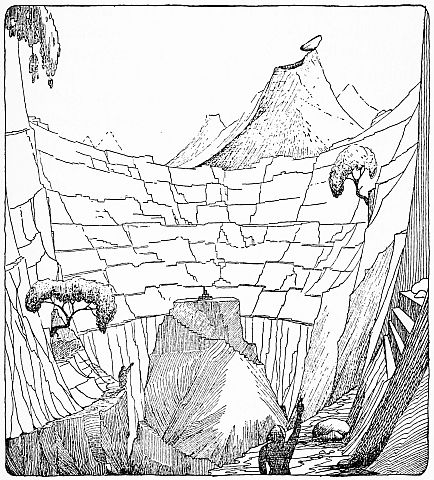 “The Whispering Rocks”
The Doctor said he would like to go and examineit closer.
And when we were come to the lip of the volcano(it took us half a day to get up to it) we found thestone was unbelievably large—big as a cathedral.Underneath it we could look right down into ablack hole which seemed to have no bottom. TheDoctor explained to us that volcanoes sometimesspurted up fire from these holes in their tops; butthat those on floating islands were always cold anddead.
“Stubbins,” he said, looking up at the great stonetowering above us, “do you know what would mostlikely happen if that boulder should fall in?”
“No,” said I, “what?”
“You remember the air-chamber which the porpoisestold us lies under the centre of the island?”
“Yes.”
“Well, this stone is heavy enough, if it fell into[297]the volcano, to break through into that air-chamberfrom above. And once it did, the air would escapeand the floating island would float no more. Itwould sink.”
“But then everybody on it would be drowned,wouldn’t they?” said Bumpo.
“Oh no, not necessarily. That would depend onthe depth of the sea where the sinking took place.The island might touch bottom when it had onlygone down, say, a hundred feet. But there wouldbe lots of it still sticking up above the water then,wouldn’t there?”
“Yes,” said Bumpo, “I suppose there would.Well, let us hope that the ponderous fragment doesnotlose its equilibriosity, for I don’t believe itwould stop at the centre of the earth—more likelyit would fall right through the world and come outthe other side.”
Many other wonders there were which these menshowed us in the central regions of their island.But I have not time or space to tell you of themnow.
Descending towards the shore again, we noticedthat we were still being watched, even here amongthe highlands, by the Bag-jagderags who had followedus. And when we put to sea once more aboatload of them proceeded to go ahead of usin the direction of Popsipetel. Having lighter[298]canoes, they traveled faster than our party; and wejudged that they should reach the village—if thatwas where they were going—many hours before wecould.
The Doctor was now becoming anxious to seehow Long Arrow was getting on, so we all tookturns at the paddles and went on traveling by moonlightthrough the whole night.
We reached Popsipetel just as the dawn wasbreaking.
To our great surprise we found that not only we,but the whole village also, had been up all night.A great crowd was gathered about the dead chief’shouse. And as we landed our canoes upon thebeach we saw a large number of old men, the seniorsof the tribe, coming out at the main door.
We inquired what was the meaning of all this;and were told that the election of a new chief hadbeen going on all through the whole night. Bumpoasked the name of the new chief; but this, it seemed,had not yet been given out. It would be announcedat mid-day.
As soon as the Doctor had paid a visit to LongArrow and seen that he was doing nicely, weproceeded to our own house at the far end of thevillage. Here we ate some breakfast and then laydown to take a good rest.
Rest, indeed, we needed; for life had been strenuous[299]and busy for us ever since we had landed onthe island. And it wasn’t many minutes after ourweary heads struck the pillows that the whole crewof us were sound asleep.
[300]
THE NINTH CHAPTER
THE ELECTIONWE were awakened by music. The glaringnoonday sunlight was streamingin at our door, outside of which somekind of a band appeared to be playing.We got up and looked out. Our house was surroundedby the whole population of Popsipetel.We were used to having quite a number of curiousand admiring Indians waiting at our door at allhours; but this was quite different. The vastcrowd was dressed in its best clothes. Brightbeads, gawdy feathers and gay blankets gave cheerfulcolor to the scene. Every one seemed in verygood humor, singing or playing on musical instruments—mostlypainted wooden whistles ordrums made from skins.
We found Polynesia—who while we slept hadarrived back from Bag-jagderag—sitting on ourdoor-post watching the show. We asked her whatall the holiday-making was about.
“The result of the election has just been announced,”said she. “The name of the new chiefwas given out at noon.”
“And who is the new chief?” asked the Doctor.
[301]
“You are,” said Polynesia quietly.
“I!” gasped the Doctor—“Well, of all things!”
“Yes,” said she. “You’re the one—And what’smore, they’ve changed your surname for you. Theydidn’t think that Dolittle was a proper or respectfulname for a man who had done so much. So you arenow to be known as Jong Thinkalot. How do youlike it?”
“But I don’t wantto be a chief,” said the Doctorin an irritable voice.
“I’m afraid you’ll have hard work to get out of itnow,” said she—“unless you’re willing to put to seaagain in one of their rickety canoes. You see you’vebeen elected not merely the Chief of the Popsipetels;you’re to be a king—the King of the whole of SpidermonkeyIsland. The Bag-jagderags, who were soanxious to have you govern them, sent spies andmessengers ahead of you; and when they found thatyou had been elected Chief of the Popsipetels overnightthey were bitterly disappointed. However,rather than lose you altogether, the Bag-jagderagswere willing to give up their independence, and insistedthat they and their lands be united to the Popsipetelsin order that you could be made king ofboth. So now you’re in for it.”
“Oh Lord!” groaned the Doctor, “I do wishthey wouldn’t be so enthusiastic! Bother it, Idon’t wantto be a king!”
“I should think, Doctor,” said I, “you’d feel[302]rather proud and glad. I wish Ihad a chance tobe a king.”
“Oh I know it sounds grand,” said he, pulling onhis boots miserably. “But the trouble is, you can’ttake up responsibilities and then just drop them againwhen you feel like it. I have my own workto do. Scarcely one moment have I had to give tonatural history since I landed on this island. I’vebeen doing some one else’s business all the time.And now they want me to go on doing it! Why,once I’m made King of the Popsipetels, that’s theend of me as a useful naturalist. I’d be too busyfor anything. All I’d be then is just a er—er—justa king.”
“Well, that’s something!” said Bumpo. “Myfather is a king and has a hundred and twentywives.”
“That would make it worse,” said the Doctor—“ahundred and twenty times worse. I have mywork to do. I don’t want to be a king.”
“Look,” said Polynesia, “here come the head mento announce your election. Hurry up and get yourboots laced.”
The throng before our door had suddenly partedasunder, making a long lane; and down this we nowsaw a group of personages coming towards us.The man in front, a handsome old Indian with awrinkled face, carried in his hands a wooden crown—atruly beautiful and gorgeous crown, even though[303]of wood. Wonderfully carved and painted, it hadtwo lovely blue feathers springing from the frontof it. Behind the old man came eight strongIndians bearing a litter, a sort of chair with longhandles underneath to carry it by.
Kneeling down on one knee, bending his headalmost to the ground, the old man addressed theDoctor who now stood in the doorway putting onhis collar and tie.
“Oh, Mighty One,” said he, “we bring you wordfrom the Popsipetel people. Great are your deedsbeyond belief, kind is your heart and your wisdom,deeper than the sea. Our chief is dead. Thepeople clamor for a worthy leader. Our oldenemies, the Bag-jagderags are become, through you,our brothers and good friends. They too desireto bask beneath the sunshine of your smile. Beholdthen, I bring to you the Sacred Crown of Popsipetelwhich, since ancient days when this island and itspeoples were one, beneath one monarch, has restedon no kingly brow. Oh Kindly One, we are biddenby the united voices of the peoples of thisland to carry you to the Whispering Rocks, thatthere, with all respect and majesty, you may becrowned our king—King of all the MovingLand.”
The good Indians did not seem to have even consideredthe possibility of John Dolittle’s refusing.As for the poor Doctor, I never saw him so upset[304]by anything. It was in fact the only time I haveknown him to get thoroughly fussed.
“Oh dear!” I heard him murmur, looking aroundwildly for some escape. “What shallI do?—Didany of you see where I laid that stud of mine?—Howon earth can I get this collar on without a stud?What a day this is, to be sure!—Maybe it rolledunder the bed, Bumpo—I do think they might havegiven me a day or so to think it over in. Who everheard of waking a man right out of his sleep, andtelling him he’s got to be a king, before he haseven washed his face? Can’t any of you find it?Maybe you’re standing on it, Bumpo. Move yourfeet.”
“Oh don’t bother about your stud,” said Polynesia.“You will have to be crowned without a collar.They won’t know the difference.”
“I tell you I’m not going to be crowned,” criedthe Doctor—“not if I can help it. I’ll make thema speech. Perhaps that will satisfy them.”
He turned back to the Indians at the door.
“My friends,” he said, “I am not worthy of thisgreat honor you would do me. Little or no skillhave I in the arts of kingcraft. Assuredly amongyour own brave men you will find many better fittedto lead you. For this compliment, this confidenceand trust, I thank you. But, I pray you, do notthink of me for such high duties which I could notpossibly fulfil.”
[305]
The old man repeated his words to the peoplebehind him in a louder voice. Stolidly they shooktheir heads, moving not an inch. The old manturned back to the Doctor.
“You are the chosen one,” said he. “They willhave none but you.”
Into the Doctor’s perplexed face suddenly therecame a flash of hope.
“I’ll go and see Long Arrow,” he whispered tome. “Perhaps he will know of some way to getme out of this.”
And asking the personages to excuse him a moment,he left them there, standing at his door, andhurried off in the direction of Long Arrow’s house.I followed him.
We found our big friend lying on a grass bedoutside his home, where he had been moved that hemight witness the holiday-making.
“Long Arrow,” said the Doctor speaking quicklyin eagle tongue so that the bystanders should notoverhear, “in dire peril I come to you for help.These men would make me their king. If such athing befall me, all the great work I hoped to domust go undone, for who is there unfreer than aking? I pray you speak with them and persuadetheir kind well-meaning hearts that what they planto do would be unwise.”
Long Arrow raised himself upon his elbow.
“Oh Kindly One,” said he (this seemed now to[306]have become the usual manner of address whenspeaking to the Doctor), “sorely it grieves me thatthe first wish you ask of me I should be unable togrant. Alas! I can do nothing. These peoplehave so set their hearts on keeping you for king thatif I tried to interfere they would drive me from theirland and likely crown you in the end in any case.A king you must be, if only for a while. We mustso arrange the business of governing that you mayhave time to give to Nature’s secrets. Later wemay be able to hit upon some plan to relieve you ofthe burden of the crown. But for now you mustbe king. These people are a headstrong tribe andthey will have their way. There is no other course.”
Sadly the Doctor turned away from the bed andfaced about. And there behind him stood the oldman again, the crown still held in his wrinkledhands and the royal litter waiting at his elbow. Witha deep reverence the bearers motioned towardsthe seat of the chair, inviting the white man to get in.
Once more the poor Doctor looked wildly, hopelesslyabout him for some means of escape. For amoment I thought he was going to take to his heelsand run for it. But the crowd around us was fartoo thick and densely packed for anyone to breakthrough it. A band of whistles and drums near bysuddenly started the music of a solemn processionalmarch. He turned back pleadingly again to LongArrow in a last appeal for help. But the big[307]Indian merely shook his head and pointed, like thebearers, to the waiting chair.
At last, almost in tears, John Dolittle steppedslowly into the litter and sat down. As he washoisted on to the broad shoulders of the bearersI heard him still feebly muttering beneath his breath,
“Botheration take it!—I don’t wantto be aking!”
“Farewell!” called Long Arrow from his bed,“and may good fortune ever stand within theshadow of your throne!”
“He comes!—He comes!” murmured the crowd.“Away! Away!—To the Whispering Rocks!”
And as the procession formed up to leave the village,the crowd about us began hurrying off in thedirection of the mountains to make sure of goodseats in the giant theatre where the crowning ceremonywould take place.
[308]
THE TENTH CHAPTER
THE CORONATION OF KING JONGIN my long lifetime I have seen many grandand inspiring things, but never anything thatimpressed me half as much as the sight of theWhispering Rocks as they looked on the dayKing Jong was crowned. As Bumpo, Chee-Chee,Polynesia, Jip and I finally reached the dizzy edgeof the great bowl and looked down inside it, itwas like gazing over a never-ending ocean of copper-coloredfaces; for every seat in the theatre wasfilled, every man, woman and child in the island—includingLong Arrow who had been carried up onhis sick bed—was there to see the show.
Yet not a sound, not a pin-drop, disturbed thesolemn silence of the Whispering Rocks. It wasquite creepy and sent chills running up and downyour spine. Bumpo told me afterwards that it tookhis breath away too much for him to speak, butthat he hadn’t known before that there were thatmany people in the world.
Away down by the Table of the Throne stood abrand-new, brightly colored totem-pole. All theIndian families had totem-poles and kept them set[309]up before the doors of their houses. The idea ofa totem-pole is something like a door-plate or avisiting card. It represents in its carvings thedeeds and qualities of the family to which it belongs.This one, beautifully decorated and much higherthan any other, was the Dolittle or, as it was to behenceforth called, the Royal Thinkalot totem. Ithad nothing but animals on it, to signify the Doctor’sgreat knowledge of creatures. And the animalschosen to be shown were those which to theIndians were supposed to represent good qualitiesof character, such as, the deer for speed; the oxfor perseverance; the fish for discretion, and so on.But at the top of the totem is always placed the signor animal by which the family is most proud to beknown. This, on the Thinkalot pole, was an enormousparrot, in memory of the famous Peace of theParrots.
The Ivory Throne had been all polished withscented oil and it glistened whitely in the strongsunlight. At the foot of it there had been strewngreat quantities of branches of flowering trees,which with the new warmth of milder climates werenow blossoming in the valleys of the island.
Soon we saw the royal litter, with the Doctorseated in it, slowly ascending the winding steps ofthe Table. Reaching the flat top at last, it haltedand the Doctor stepped out upon the flowery carpet.So still and perfect was the silence that even at that[310]distance above I distinctly heard a twig snap beneathhis tread.
Walking to the throne accompanied by the oldman, the Doctor got up upon the stand and satdown. How tiny his little round figure looked whenseen from that tremendous height! The throne hadbeen made for longer-legged kings; and when hewas seated, his feet did not reach the ground butdangled six inches from the top step.
Then the old man turned round and looking upat the people began to speak in a quiet even voice;but every word he said was easily heard in thefurthest corner of the Whispering Rocks.
First he recited the names of all the great Popsipetelkings who in days long ago had been crownedin this ivory chair. He spoke of the greatness ofthe Popsipetel people, of their triumphs, of theirhardships. Then waving his hand towards the Doctorhe began recounting the things which this king-to-behad done. And I am bound to say that theyeasily outmatched the deeds of those who had gonebefore him.
As soon as he started to speak of what the Doctorhad achieved for the tribe, the people, still strictlysilent, all began waving their right hands towardsthe throne. This gave to the vast theatre a verysingular appearance: acres and acres of somethingmoving—with never a sound.
At last the old man finished his speech and stepping[311]up to the chair, very respectfully removed theDoctor’s battered high hat. He was about toput it upon the ground; but the Doctor took it fromhim hastily and kept it on his lap. Then taking upthe Sacred Crown he placed it upon John Dolittle’shead. It did not fit very well (for it had beenmade for smaller-headed kings), and when the windblew in freshly from the sunlit sea the Doctor hadsome difficulty in keeping it on. But it looked verysplendid.
Turning once more to the people, the old mansaid,
“Men of Popsipetel, behold your elected king!—Areyou content?”
And then at last the voice of the people brokeloose.
“Jong! Jong!” they shouted, “Long LiveKing Jong!”
The sound burst upon the solemn silence with thecrash of a hundred cannon. There, where evena whisper carried miles, the shock of it was like ablow in the face. Back and forth the mountainsthrew it to one another. I thought the echoes of itwould never die away as it passed rumbling throughthe whole island, jangling among the lower valleys,booming in the distant sea-caves.
Suddenly I saw the old man point upward, to thehighest mountain in the island; and looking overmy shoulder, I was just in time to see the Hanging[312]Stone topple slowly out of sight—down into theheart of the volcano.
“See ye, Men of the Moving Land!” the old mancried: “The stone has fallen and our legend hascome true: the King of Kings is crowned this day!”
The Doctor too had seen the stone fall and he wasnow standing up looking at the sea expectantly.
“He’s thinking of the air-chamber,” said Bumpoin my ear. “Let us hope that the sea isn’t very deepin these parts.”
After a full minute (so long did it take the stoneto fall that depth) we heard a muffled, distant,crunching thud—and then immediately after, agreat hissing of escaping air. The Doctor, his facetense with anxiety, sat down in the throne againstill watching the blue water of the ocean with staringeyes.
Soon we felt the island slowly sinking beneathus. We saw the sea creep inland over the beachesas the shores went down—one foot, three feet, tenfeet, twenty, fifty, a hundred. And then, thankgoodness, gently as a butterfly alighting on a rose,it stopped! Spidermonkey Island had come to reston the sandy bottom of the Atlantic, and earth wasjoined to earth once more.
Of course many of the houses near the shoreswere now under water. Popsipetel Village itselfhad entirely disappeared. But it didn’t matter.No one was drowned; for every soul in the island[313]was high up in the hills watching the coronation ofKing Jong.
The Indians themselves did not realize at thetime what was taking place, though of course theyhad felt the land sinking beneath them. The Doctortold us afterwards that it must have been theshock of that tremendous shout, coming from amillion throats at once, which had toppled theHanging Stone off its perch. But in Popsipetelhistory the story was handed down (and it is firmlybelieved to this day) that when King Jong sat uponthe throne, so great was his mighty weight, thatthe very island itself sank down to do him honorand never moved again.
[314]
PART SIX
THE FIRST CHAPTER
NEW POPSIPETELJONG THINKALOT had not ruled over hisnew kingdom for more than a couple of daysbefore my notions about kings and the kindof lives they led changed very considerably.I had thought that all that kings had to do was tosit on a throne and have people bow down beforethem several times a day. I now saw that a kingcan be the hardest-working man in the world—ifhe attends properly to his business.
From the moment that he got up, early in themorning, till the time he went to bed, late at night—sevendays in the week—John Dolittle was busy,busy, busy. First of all there was the new townto be built. The village of Popsipetel had disappeared:the City of New Popsipetel must bemade. With great care a place was chosen for it—anda very beautiful position it was, at the mouthof a large river. The shores of the island at thispoint formed a lovely wide bay where canoes—andships too, if they should ever come—could lie peacefullyat anchor without danger from storms.
In building this town the Doctor gave the Indians[315]a lot of new ideas. He showed them what town-sewerswere, and how garbage should be collectedeach day and burnt. High up in the hills he madea large lake by damming a stream. This was thewater-supply for the town. None of these thingshad the Indians ever seen; and many of the sicknesseswhich they had suffered from before werenow entirely prevented by proper drainage and puredrinking-water.
Peoples who don’t use fire do not of course havemetals either; because without fire it is almost impossibleto shape iron and steel. One of the firstthings that John Dolittle did was to search themountains till he found iron and copper mines.Then he set to work to teach the Indians how thesemetals could be melted and made into knives andplows and water-pipes and all manner of things.
In his kingdom the Doctor tried his hardest todo away with most of the old-fashioned pomp andgrandeur of a royal court. As he said to Bumpoand me, if he must be a king he meant to be athoroughly democratic one, that is a king who ischummy and friendly with his subjects and doesn’tput on airs. And when he drew up the plans forthe City of New Popsipetel he had no palace shownof any kind. A little cottage in a back street wasall that he had provided for himself.
But this the Indians would not permit on anyaccount. They had been used to having their kings[316]rule in a truly grand and kingly manner; and theyinsisted that he have built for himself the mostmagnificent palace ever seen. In all else they lethim have his own way absolutely; but they wouldn’tallow him to wriggle out of any of the ceremony orshow that goes with being a king. A thousand servantshe had to keep in his palace, night and day, towait on him. The Royal Canoe had to be kept up—agorgeous, polished mahogany boat, seventy feetlong, inlaid with mother-o’-pearl and paddled bythe hundred strongest men in the island. Thepalace-gardens covered a square mile and employeda hundred and sixty gardeners.
Even in his dress the poor man was compelledalways to be grand and elegant and uncomfortable.The beloved and battered high hat was put away ina closet and only looked at secretly. State robeshad to be worn on all occasions. And when theDoctor did once in a while manage to sneak off fora short, natural-history expedition he never daredto wear his old clothes, but had to chase his butterflieswith a crown upon his head and a scarlet cloakflying behind him in the wind.
There was no end to the kinds of duties the Doctorhad to perform and the questions he had todecide upon—everything, from settling disputesabout lands and boundaries, to making peace betweenhusband and wife who had been throwingshoes at one another. In the east wing of the[317]
[318]Royal Palace was the Hall of Justice. And hereKing Jong sat every morning from nine to elevenpassing judgment on all cases that were brought beforehim. “Had to chase his butterflies with a crown upon his head”
Then in the afternoon he taught school. Thesort of things he taught were not always those youfind in ordinary schools. Grown-ups as well aschildren came to learn. You see, these Indianswere ignorant of many of the things that quite smallwhite children know—though it is also true thatthey knew a lot that white grown-ups never dreamedof.
Bumpo and I helped with the teaching as far aswe could—simple arithmetic, and easy things likethat. But the classes in astronomy, farming science,the proper care of babies, with a host of othersubjects, the Doctor had to teach himself. TheIndians were tremendously keen about the schoolingand they came in droves and crowds; so that evenwith the open-air classes (a school-house was impossibleof course) the Doctor had to take them inrelays and batches of five or six thousand at a timeand used a big megaphone or trumpet to make himselfheard.
The rest of his day was more than filled withroad-making, building water-mills, attending thesick and a million other things.
In spite of his being so unwilling to become a[319]king, John Dolittle made a very good one—once hegot started. He may not have been as dignified asmany kings in history who were always running offto war and getting themselves into romantic situations;but since I have grown up and seen somethingof foreign lands and governments I have oftenthought that Popsipetel under the reign of JongThinkalot was perhaps the best ruled state in thehistory of the world.
The Doctor’s birthday came round after we hadbeen on the island six months and a half. Thepeople made a great public holiday of it and therewas much feasting, dancing, fireworks, speechmakingand jollification.
Towards the close of the day the chief men of thetwo tribes formed a procession and passed throughthe streets of the town, carrying a very gorgeouslypainted tablet of ebony wood, ten feet high. Thiswas a picture-history, such as they preserved foreach of the ancient kings of Popsipetel to recordtheir deeds.
With great and solemn ceremony it was set upover the door of the new palace: and everybodythen clustered round to look at it. It had six pictureson it commemorating the six great events inthe life of King Jong and beneath were written theverses that explained them. They were composedby the Court Poet; and this is a translation:
[320]
I(His Landing on The Island)Heaven-sent,In his dolphin-drawn canoeFrom worlds unknownHe landed on our shores.The very palmsBowed down their headsIn welcome to the coming King.II(His Meeting With The Beetle)By moonlight in the mountainsHe communed with beasts.The shy Jabizri brings him picture-wordsOf great distress.III(He liberates The Lost Families)Big was his heart with pity;Big were his hands with strength.See how he tears the mountain like a yam!See how the lost onesDance forth to greet the day!IV(He Makes Fire)Our land was cold and dying.He waved his hand and lo!Lightning leapt from cloudless skies;[321]The sun leant down;And Fire was born!Then while we crowded roundThe grateful glow, pushed heOur wayward, floating landBack to peaceful anchorageIn sunny seas.V(He Leads The People To Victory in War)Once onlyWas his kindly countenanceDarkened by a deadly frown.Woe to the wicked enemyThat dares attackThe tribe with Thinkalot for Chief!VI(He Is Crowned King)The birds of the air rejoiced;The Sea laughed and gambolled with her shores;All Red-skins wept for joyThe day we crowned him King.He is the Builder, the Healer, the Teacher and the Prince;He is the greatest of them all.May he live a thousand thousand years,Happy in his heart,To bless our land with Peace.[322]
THE SECOND CHAPTER
THOUGHTS OF HOMEIN the Royal Palace Bumpo and I had a beautifulsuite of rooms of our very own—whichPolynesia, Jip and Chee-Chee shared with us.Officially Bumpo was Minister of the Interior;while I was First Lord of the Treasury. LongArrow also had quarters there; but at present hewas absent, traveling abroad.
One night after supper when the Doctor was awayin the town somewhere visiting a new-born baby,we were all sitting round the big table in Bumpo’sreception-room. This we did every evening, to talkover the plans for the following day and variousaffairs of state. It was a kind of Cabinet Meeting.
To-night however we were talking about England—andalso about things to eat. We had got a littletired of Indian food. You see, none of the nativesknew how to cook; and we had the most discouragingtime training a chef for the Royal Kitchen. Mostof them were champions at spoiling good food.Often we got so hungry that the Doctor would sneakdownstairs with us into the palace basement, afterall the cooks were safe in bed, and fry pancakessecretly over the dying embers of the fire. The[323]Doctor himself was the finest cook that ever lived.But he used to make a terrible mess of the kitchen;and of course we had to be awfully careful that wedidn’t get caught.
Well, as I was saying, to-night food was the subjectof discussion at the Cabinet Meeting; and I hadjust been reminding Bumpo of the nice dishes we hadhad at the bed-maker’s house in Monteverde.
“I tell you what I would like now,” said Bumpo:“a large cup of cocoa with whipped cream on thetop of it. In Oxford we used to be able to get themost wonderful cocoa. It is really too bad theyhaven’t any cocoa-trees in this island, or cows to givecream.”
“When do you suppose,” asked Jip, “the Doctorintends to move on from here?”
“I was talking to him about that only yesterday,”said Polynesia. “But I couldn’t get any satisfactoryanswer out of him. He didn’t seem to want tospeak about it.”
There was a pause in the conversation.
“Do you know what I believe?” she added presently.“I believe the Doctor has given up eventhinking of going home.”
“Good Lord!” cried Bumpo. “You don’t say!”
“Sh!” said Polynesia. “What’s that noise?”
We listened; and away off in the distant corridorsof the palace we heard the sentries crying,
“The King!—Make way!—The King!”
[324]
“It’s he—at last,” whispered Polynesia—“late,as usual. Poor man, how he does work!—Chee-Chee,get the pipe and tobacco out of the cupboardand lay the dressing-gown ready on his chair.”
When the Doctor came into the room he lookedserious and thoughtful. Wearily he took off hiscrown and hung it on a peg behind the door. Thenhe exchanged the royal cloak for the dressing-gown,dropped into his chair at the head of the table witha deep sigh and started to fill his pipe.
“Well,” asked Polynesia quietly, “how did youfind the baby?”
“The baby?” he murmured—his thoughts stillseemed to be very far away—“Ah yes. The babywas much better, thank you—It has cut its secondtooth.”
Then he was silent again, staring dreamily at theceiling through a cloud of tobacco-smoke; while weall sat round quite still, waiting.
“We were wondering, Doctor,” said I at last,—“justbefore you came in—when you would be startinghome again. We will have been on this islandseven months to-morrow.”
The Doctor sat forward in his chair looking ratheruncomfortable.
“Well, as a matter of fact,” said he after a moment,“I meant to speak to you myself this eveningon that very subject. But it’s—er—a little hard[325]to make any one exactly understand the situation.I am afraid that it would be impossible for me toleave the work I am now engaged on.... Youremember, when they first insisted on making meking, I told you it was not easy to shake off responsibilities,once you had taken them up. These peoplehave come to rely on me for a great number ofthings. We found them ignorant of much thatwhite people enjoy. And we have, one might say,changed the current of their lives considerably.Now it is a very ticklish business, to change the livesof other people. And whether the changes we havemade will be, in the end, for good or for bad, is ourlookout.”
He thought a moment—then went on in a quieter,sadder voice:
“I would like to continue my voyages and mynatural history work; and I would like to go backto Puddleby—as much as any of you. This isMarch, and the crocuses will be showing in the lawn....But that which I feared has come true: I cannotclose my eyes to what might happen if I shouldleave these people and run away. They would probablygo back to their old habits and customs: wars,superstitions, devil-worship and what not; and manyof the new things we have taught them might be putto improper use and make their condition, then,worse by far than that in which we found them.[326]...They like me; they trust me; they have come tolook to me for help in all their problems and troubles.And no man wants to do unfair things tothem who trust him.... And then again, Ilikethem. They are, as it were, my children—I neverhad any children of my own—and I am terriblyinterested in how they will grow up. Don’t yousee what I mean?—How can I possibly run awayand leave them in the lurch?... No. I havethought it over a good deal and tried to decidewhat was best. And I am afraid that the workI took up when I assumed the crown I must stickto. I’m afraid—I’ve got to stay.”
“For good—for your whole life?” asked Bumpoin a low voice.
For some moments the Doctor, frowning, madeno answer.
“I don’t know,” he said at last—“Anyhow for thepresent there is certainly no hope of my leaving.It wouldn’t be right.”
The sad silence that followed was broken finallyby a knock upon the door.
With a patient sigh the Doctor got up and puton his crown and cloak again.
“Come in,” he called, sitting down in his chaironce more.
The door opened and a footman—one of thehundred and forty-three who were always on nightduty—stood bowing in the entrance.
[327]
“Oh, Kindly One,” said he, “there is a travelerat the palace-gate who would have speech withYour Majesty.”
“Another baby’s been born, I’ll bet a shilling,”muttered Polynesia.
“Did you ask the traveler’s name?” enquired theDoctor.
“Yes, Your Majesty,” said the footman. “Itis Long Arrow, the son of Golden Arrow.”
[328]
THE THIRD CHAPTER
THE RED MAN’S SCIENCE“LONG ARROW!” cried the Doctor.“How splendid! Show him in—showhim in at once.”
“I’m so glad,” he continued, turningto us as soon as the footman had gone. “I’vemissed Long Arrow terribly. He’s an awfully goodman to have around—even if he doesn’t talk much.Let me see: it’s five months now since he went offto Brazil. I’m so glad he’s back safe. He doestake such tremendous chances with that canoe ofhis—clever as he is. It’s no joke, crossing a hundredmiles of open sea in a twelve-foot canoe. Iwouldn’t care to try it.”
Another knock; and when the door swung openin answer to the Doctor’s call, there stood our bigfriend on the threshold, a smile upon his strong,bronzed face. Behind him appeared two porterscarrying loads done up in Indian palm-matting.These, when the first salutations were over, LongArrow ordered to lay their burdens down.
“Behold, oh Kindly One,” said he, “I bring you,as I promised, my collection of plants which I had[329]hidden in a cave in the Andes. These treasuresrepresent the labors of my life.”
The packages were opened; and inside were manysmaller packages and bundles. Carefully they werelaid out in rows upon the table.
It appeared at first a large but disappointing display.There were plants, flowers, fruits, leaves,roots, nuts, beans, honeys, gums, bark, seeds, beesand a few kinds of insects.
The study of plants—or botany, as it is called—wasa kind of natural history which had neverinterested me very much. I had considered it, comparedwith the study of animals, a dull science. Butas Long Arrow began taking up the various thingsin his collection and explaining their qualities to us,I became more and more fascinated. And beforehe had done I was completely absorbed by the wondersof the Vegetable Kingdom which he hadbrought so far.
“These,” said he, taking up a little packet ofbig seeds, “are what I have called laughing-beans.’”
“What are they for?” asked Bumpo.
“To cause mirth,” said the Indian.
Bumpo, while Long Arrow’s back was turned,took three of the beans and swallowed them.
“Alas!” said the Indian when he discovered whatBumpo had done. “If he wished to try the powersof these seeds he should have eaten no more than a[330]quarter of a one. Let us hope that he does not dieof laughter.”
The beans’ effect upon Bumpo was most extraordinary.First he broke into a broad smile;then he began to giggle; finally he burst into suchprolonged roars of hearty laughter that we had tocarry him into the next room and put him to bed.The Doctor said afterwards that he probably wouldhave died laughing if he had not had such a strongconstitution. All through the night he gurgledhappily in his sleep. And even when we woke himup the next morning he rolled out of bed still chuckling.
Returning to the Reception Room, we were shownsome red roots which Long Arrow told us had theproperty, when made into a soup with sugar andsalt, of causing people to dance with extraordinaryspeed and endurance. He asked us to try them;but we refused, thanking him. After Bumpo’s exhibitionwe were a little afraid of any more experimentsfor the present.
There was no end to the curious and useful thingsthat Long Arrow had collected: an oil from a vinewhich would make hair grow in one night; an orangeas big as a pumpkin which he had raised in his ownmountain-garden in Peru; a black honey (he hadbrought the bees that made it too and the seeds ofthe flowers they fed on) which would put you tosleep, just with a teaspoonful, and make you wake[331]up fresh in the morning; a nut that made the voicebeautiful for singing; a water-weed that stoppedcuts from bleeding; a moss that cured snake-bite;a lichen that prevented sea-sickness.
The Doctor of course was tremendously interested.Well into the early hours of the morning hewas busy going over the articles on the table oneby one, listing their names and writing their propertiesand descriptions into a note-book as Long Arrowdictated.
“There are things here, Stubbins,” he said as heended, “which in the hands of skilled druggists willmake a vast difference to the medicine and chemistryof the world. I suspect that this sleeping-honey byitself will take the place of half the bad drugs wehave had to use so far. Long Arrow has discovereda pharmacopæia of his own. Miranda was right:he is a great naturalist. His name deserves to beplaced beside Linnæus. Some day I must get allthese things to England—But when,” he addedsadly—“Yes, that’s the problem: when?”
[332]
THE FOURTH CHAPTER
THE SEA-SERPENTFOR a long time after that Cabinet Meetingof which I have just told you we did notask the Doctor anything further aboutgoing home. Life in Spidermonkey Islandwent forward, month in month out, busily andpleasantly. The Winter, with Christmas celebrations,came and went, and Summer was with us onceagain before we knew it.
As time passed the Doctor became more and moretaken up with the care of his big family; and thehours he could spare for his natural history workgrew fewer and fewer. I knew that he often stillthought of his house and garden in Puddleby andof his old plans and ambitions; because once in awhile we would notice his face grow thoughtful anda little sad, when something reminded him of Englandor his old life. But he never spoke of thesethings. And I truly believe he would have spent theremainder of his days on Spidermonkey Island ifit hadn’t been for an accident—and for Polynesia.
The old parrot had grown very tired of the Indiansand she made no secret of it.
“The very idea,” she said to me one day as we[333]were walking on the seashore—“the idea of thefamous John Dolittle spending his valuable lifewaiting on these greasy natives!—Why, it’s preposterous!”
All that morning we had been watching the Doctorsuperintend the building of the new theatre inPopsipetel—there was already an opera-house anda concert-hall; and finally she had got so grouchyand annoyed at the sight that I had suggested hertaking a walk with me.
“Do you really think,” I asked as we sat downon the sands, “that he will never go back to Puddlebyagain?”
“I don’t know,” said she. “At one time I feltsure that the thought of the pets he had left behindat the house would take him home soon. Butsince Miranda brought him word last August thateverything was all right there, that hope’s gone.For months and months I’ve been racking my brainsto think up a plan. If we could only hit upon somethingthat would turn his thoughts back to naturalhistory again—I mean something big enough to gethim really excited—we might manage it. Buthow?”—she shrugged her shoulders in disgust—“How?—whenall he thinks of now is pavingstreets and teaching papooses that twice one aretwo!”
It was a perfect Popsipetel day, bright and hot,blue and yellow. Drowsily I looked out to sea[334]thinking of my mother and father. I wondered ifthey were getting anxious over my long absence.Beside me old Polynesia went on grumbling awayin low steady tones; and her words began to mingleand mix with the gentle lapping of the waves uponthe shore. It may have been the even murmur ofher voice, helped by the soft and balmy air, thatlulled me to sleep. I don’t know. Anyhow I presentlydreamed that the island had moved again—notfloatingly as before, but suddenly, jerkily, asthough something enormously powerful had heavedit up from its bed just once and let it down.
How long I slept after that I have no idea. Iwas awakened by a gentle pecking on the nose.
“Tommy!—Tommy!” (it was Polynesia’s voice)“Wake up!—Gosh, what a boy, to sleep through anearthquake and never notice it!—Tommy, listen:here’s our chance now. Wake up, for goodness’sake!”
“What’s the matter?” I asked sitting up with ayawn.
“Sh!—Look!” whispered Polynesia pointing outto sea.
Still only half awake, I stared before me withbleary, sleep-laden eyes. And in the shallow water,not more than thirty yards from shore I saw anenormous pale pink shell. Dome-shaped, it toweredup in a graceful rainbow curve to a tremendousheight; and round its base the surf broke gently in[335]little waves of white. It could have belonged tothe wildest dream.
“What in the world is it?” I asked.
“That,” whispered Polynesia, “is what sailorsfor hundreds of years have called the Sea-serpent.I’ve seen it myself more than once from the decksof ships, at long range, curving in and out of thewater. But now that I see it close and still, Ivery strongly suspect that the Sea-serpent of historyis no other than the Great Glass Sea-snail that thefidgit told us of. If that isn’t the only fish of itskind in the seven seas, call me a carrion-crow—Tommy,we’re in luck. Our job is to get the Doctordown here to look at that prize specimen beforeit moves off to the Deep Hole. If we can, thentrust me, we may leave this blessed island yet. Youstay here and keep an eye on it while I go afterthe Doctor. Don’t move or speak—don’t evenbreathe heavy: he might get scared—awful timidthings, snails. Just watch him; and I’ll be back intwo shakes.”
Stealthily creeping up the sands till she could getbehind the cover of some bushes before she tookto her wings, Polynesia went off in the direction ofthe town; while I remained alone upon the shorefascinatedly watching this unbelievable monster wallowingin the shallow sea.
It moved very little. From time to time it liftedits head out of the water showing its enormously[336]long neck and horns. Occasionally it would try anddraw itself up, the way a snail does when he goesto move, but almost at once it would sink downagain as if exhausted. It seemed to me to act asthough it were hurt underneath; but the lower partof it, which was below the level of the water, I couldnot see.
I was still absorbed in watching the great beastwhen Polynesia returned with the Doctor. Theyapproached so silently and so cautiously that Ineither saw nor heard them coming till I foundthem crouching beside me on the sand.
One sight of the snail changed the Doctor completely.His eyes just sparkled with delight. Ihad not seen him so thrilled and happy since thetime we caught the Jabizri beetle when we firstlanded on the island.
“It is he!” he whispered—“the Great Glass Sea-snailhimself—not a doubt of it. Polynesia, godown the shore away and see if you can find any ofthe porpoises for me. Perhaps they can tell uswhat the snail is doing here—It’s very unusual forhim to be in shallow water like this. And Stubbins,you go over to the harbor and bring me a smallcanoe. But be most careful how you paddle itround into this bay. If the snail should take frightand go out into the deeper water, we may never geta chance to see him again.”
“And don’t tell any of the Indians,” Polynesia[337]added in a whisper as I moved to go. “We mustkeep this a secret or we’ll have a crowd of sightseersround here in five minutes. It’s mighty luckywe found the snail in a quiet bay.”
Reaching the harbor, I picked out a small lightcanoe from among the number that were lying thereand without telling any one what I wanted it for,got in and started off to paddle it down the shore.
I was mortally afraid that the snail might haveleft before I got back. And you can imagine howdelighted I was, when I rounded a rocky cape andcame in sight of the bay, to find he was still there.
Polynesia, I saw, had got her errand done andreturned ahead of me, bringing with her a pair ofporpoises. These were already conversing in lowtones with John Dolittle. I beached the canoe andwent up to listen.
“What I want to know,” the Doctor was saying,“is how the snail comes to be here. I was given tounderstand that he usually stayed in the Deep Hole;and that when he did come to the surface it wasalways in mid-ocean.”
“Oh, didn’t you know?—Haven’t you heard?” theporpoises replied: “you covered up the Deep Holewhen you sank the island. Why yes: you let it downright on top of the mouth of the Hole—sort ofput the lid on, as it were. The fishes that were init at the time have been trying to get out ever since.The Great Snail had the worst luck of all: the[338]island nipped him by the tail just as he was leavingthe Hole for a quiet evening stroll. And he washeld there for six months trying to wriggle himselffree. Finally he had to heave the whole island upat one end to get his tail loose. Didn’t you feela sort of an earthquake shock about an hour ago?”
“Yes I did,” said the Doctor, “it shook downpart of the theatre I was building.”
“Well, that was the snail heaving up the islandto get out of the Hole,” they said. “All the otherfishes saw their chance and escaped when he raisedthe lid. It was lucky for them he’s so big and strong.But the strain of that terrific heave told on him:he sprained a muscle in his tail and it started swellingrather badly. He wanted some quiet place to restup; and seeing this soft beach handy he crawledin here.”
“Dear me!” said the Doctor. “I’m terriblysorry. I suppose I should have given some sort ofnotice that the island was going to be let down.But, to tell the truth, we didn’t know it ourselves;it happened by a kind of an accident. Do youimagine the poor fellow is hurt very badly?”
“We’re not sure,” said the porpoises; “becausenone of us can speak his language. But we swamright around him on our way in here, and he didnot seem to be really seriously injured.”
“Can’t any of your people speak shellfish?” theDoctor asked.
[339]
“Not a word,” said they. “It’s a most frightfullydifficult language.”
“Do you think that you might be able to find mesome kind of a fish that could?”
“We don’t know,” said the porpoises. “Wemight try.”
“I should be extremely grateful to you if youwould,” said the Doctor. “There are many importantquestions I want to ask this snail—Andbesides, I would like to do my best to cure his tailfor him. It’s the least I can do. After all, it wasmy fault, indirectly, that he got hurt.”
“Well, if you wait here,” said the porpoises,“we’ll see what can be done.”
[340]
THE FIFTH CHAPTER
THE SHELLFISH RIDDLE SOLVED AT LASTSO Doctor Dolittle with a crown on his headsat down upon the shore like King Knut,and waited. And for a whole hour theporpoises kept going and coming, bringingup different kinds of sea-beasts from the deep to seeif they could help him.
Many and curious were the creatures they produced.It would seem however that there were veryfew things that spoke shellfish except the shellfishthemselves. Still, the porpoises grew a little morehopeful when they discovered a very old sea-urchin(a funny, ball-like, little fellow with long whiskersall over him) who said he could not speak pureshellfish, but he used to understand starfish—enoughto get along—when he was young. This was comingnearer, even if it wasn’t anything to go crazyabout. Leaving the urchin with us, the porpoiseswent off once more to hunt up a starfish.
They were not long getting one, for they werequite common in those parts. Then, using thesea-urchin as an interpreter, they questioned thestarfish. He was a rather stupid sort of creature;but he tried his best to be helpful. And after a[341]little patient examination we found to our delightthat he could speak shellfish moderately well.
Feeling quite encouraged, the Doctor and I nowgot into the canoe; and, with the porpoises, the urchinand the starfish swimming alongside, we paddledvery gently out till we were close under the toweringshell of the Great Snail.
And then began the most curious conversation Ihave ever witnessed. First the starfish would askthe snail something; and whatever answer the snailgave, the starfish would tell it to the sea-urchin, theurchin would tell it to the porpoises and the porpoiseswould tell it to the Doctor.
In this way we obtained considerable information,mostly about the very ancient history of the AnimalKingdom; but we missed a good many of thefiner points in the snail’s longer speeches on accountof the stupidity of the starfish and all this translatingfrom one language to another.
While the snail was speaking, the Doctor and Iput our ears against the wall of his shell and foundthat we could in this way hear the sound of hisvoice quite plainly. It was, as the fidgit had described,deep and bell-like. But of course we couldnot understand a single word he said. However theDoctor was by this time terrifically excited aboutgetting near to learning the language he had soughtso long. And presently by making the other fishesrepeat over and over again short phrases which the[342]snail used, he began to put words together for himself.You see, he was already familiar with one ortwo fish languages; and that helped him quite a little.After he had practised for a while like this he leantover the side of the canoe and putting his face belowthe water, tried speaking to the snail direct.
It was hard and difficult work; and hours went bybefore he got any results. But presently I could tellby the happy look on his face that little by little hewas succeeding.
The sun was low in the West and the cool eveningbreeze was beginning to rustle softly through thebamboo-groves when the Doctor finally turned fromhis work and said to me,
“Stubbins, I have persuaded the snail to comein on to the dry part of the beach and let me examinehis tail. Will you please go back to thetown and tell the workmen to stop working on thetheatre for to-day? Then go on to the palace andget my medicine-bag. I think I left it under thethrone in the Audience Chamber.”
“And remember,” Polynesia whispered as Iturned away, “not a word to a soul. If you getasked questions, keep your mouth shut. Pretendyou have a toothache or something.”
This time when I got back to the shore—with themedicine-bag—I found the snail high and dry onthe beach. Seeing him in his full length like this,it was easy to understand how old-time, superstitious[343]sailors had called him the Sea-serpent. He certainlywas a most gigantic, and in his way, a graceful,beautiful creature. John Dolittle was examininga swelling on his tail.
From the bag which I had brought the Doctortook a large bottle of embrocation and began rubbingthe sprain. Next he took all the bandages hehad in the bag and fastened them end to end. Buteven like that, they were not long enough to go morethan halfway round the enormous tail. The Doctorinsisted that he must get the swelling strappedtight somehow. So he sent me off to the palaceonce more to get all the sheets from the RoyalLinen-closet. These Polynesia and I tore into bandagesfor him. And at last, after terrific exertions,we got the sprain strapped to his satisfaction.
The snail really seemed to be quite pleased withthe attention he had received; and he stretchedhimself in lazy comfort when the Doctor was done.In this position, when the shell on his back wasempty, you could look right through it and see thepalm-trees on the other side.
“I think one of us had better sit up with him allnight,” said the Doctor. “We might put Bumpoon that duty; he’s been napping all day, I know—inthe summer-house. It’s a pretty bad sprain, that;and if the snail shouldn’t be able to sleep, he’ll behappier with some one with him for company. He’llget all right though—in a few days I should judge.[344]If I wasn’t so confoundedly busy I’d sit up with himmyself. I wish I could, because I still have a lotof things to talk over with him.”
“But Doctor,” said Polynesia as we prepared togo back to the town, “you ought to take a holiday.All Kings take holidays once in the while—everyone of them. King Charles, for instance—ofcourse Charles was before your time—but he!—why,he was alwaysholiday-making. Not that hewas ever what you would call a model king. Butjust the same, he was frightfully popular. Everybodyliked him—even the golden-carp in the fish-pondat Hampton Court. As a king, the only thingI had against him was his inventing those stupid,little, snappy dogs they call King Charles Spaniels.There are lots of stories told about poor Charles;but that, in my opinion, is the worst thing he did.However, all this is beside the point. As I wassaying, kings have to take holidays the same asanybody else. And you haven’t taken one sinceyou were crowned, have you now?”
“No,” said the Doctor, “I suppose that’s true.”
“Well now I tell you what you do,” said she:“as soon as you get back to the palace you publish aroyal proclamation that you are going away for aweek into the country for your health. And you’regoing without any servants, you understand—justlike a plain person. It’s called traveling incognito,when kings go off like that. They all do it—It’s[345]the only way they can ever have a good time. Thenthe week you’re away you can spend lolling on thebeach back there with the snail. How’s that?”
“I’d like to,” said the Doctor. “It sounds mostattractive. But there’s that new theatre to bebuilt; none of our carpenters would know how toget those rafters on without me to show them—Andthen there are the babies: these native mothersare so frightfully ignorant.”
“Oh bother the theatre—and the babies too,”snapped Polynesia. “The theatre can wait a week.And as for babies, they never have anything morethan colic. How do you suppose babies got alongbefore you came here, for heaven’s sake?—Take aholiday.... You need it.”
[346]
THE SIXTH CHAPTER
THE LAST CABINET MEETINGFROM the way Polynesia talked, I guessedthat this idea of a holiday was part of herplan.
The Doctor made no reply; and wewalked on silently towards the town. I could see,nevertheless that her words had made an impressionon him.
After supper he disappeared from the palacewithout saying where he was going—a thing he hadnever done before. Of course we all knew wherehe had gone: back to the beach to sit up with thesnail. We were sure of it because he had saidnothing to Bumpo about attending to the matter.
As soon as the doors were closed upon the CabinetMeeting that night, Polynesia addressed theMinistry:
“Look here, you fellows,” said she: “we’ve simplygot to get the Doctor to take this holiday somehow—unlesswe’re willing to stay in this blessedisland for the rest of our lives.”
“But what difference,” Bumpo asked, “is his takinga holiday going to make?”
Impatiently Polynesia turned upon the Minister ofthe Interior.
[347]
“Don’t you see? If he has a clear week to getthoroughly interested in his natural history again—marinestuff, his dream of seeing the floor of theocean and all that—there may be some chance of hisconsenting to leave this pesky place. But while heis here on duty as king he never gets a moment tothink of anything outside of the business of government.”
“Yes, that’s true. He’s far too consententious,”Bumpo agreed.
“And besides,” Polynesia went on, “his only hopeof ever getting away from here would be to escapesecretly. He’s got to leave while he is holiday-making,incognito—when no one knows where he isor what he’s doing, but us. If he built a ship bigenough to cross the sea in, all the Indians would seeit, and hear it, being built; and they’d ask what itwas for. They would interfere. They’d soonerhave anything happen than lose the Doctor. Why,I believe if they thought he had any idea of escapingthey would put chains on him.”
“Yes, I really think they would,” I agreed. “Yetwithout a ship of some kind I don’t see how theDoctor is going to get away, even secretly.”
“Well, I’ll tell you,” said Polynesia. “If we dosucceed in making him take this holiday, our nextstep will be to get the sea-snail to promise to takeus all in his shell and carry us to the mouth ofPuddleby River. If we can once get the snail willing,[348]the temptation will be too much for John Dolittleand he’ll come, I know—especially as he’llbe able to take those new plants and drugs of LongArrow’s to the English doctors, as well as see thefloor of the ocean on the way.”
“How thrilling!” I cried. “Do you mean thesnail could take us under the sea all the way backto Puddleby?”
“Certainly,” said Polynesia, “a little trip likethat is nothing to him. He would crawl along thefloor of the ocean and the Doctor could see all thesights. Perfectly simple. Oh, John Dolittle willcome all right, if we can only get him to take thatholiday—andif the snail will consent to give us theride.”
“Golly, I hope he does!” sighed Jip. “I’m sick ofthese beastly tropics—they make you feel so lazyand good-for-nothing. And there are no rats oranything here—not that a fellow would have theenergy to chase ’em even if there were. My,wouldn’t I be glad to see old Puddleby and thegarden again! And won’t Dab-Dab be glad tohave us back!”
“By the end of next month,” said I, “it will betwo whole years since we left England—since wepulled up the anchor at Kingsbridge and bumped ourway out into the river.”
“And got stuck on the mud-bank,” added Chee-Cheein a dreamy, far-away voice.
[349]
“Do you remember how all the people wavedto us from the river-wall?” I asked.
“Yes. And I suppose they’ve often talked aboutus in the town since,” said Jip—“wondering whetherwe’re dead or alive.”
“Cease,” said Bumpo, “I feel I am about to weepfrom sediment.”
[350]
THE SEVENTH CHAPTER
THE DOCTOR’S DECISIONWELL, you can guess how glad we werewhen next morning the Doctor, afterhis all-night conversation with thesnail, told us that he had made up hismind to take the holiday. A proclamation was publishedright away by the Town Crier that His Majestywas going into the country for a seven-day rest,but that during his absence the palace and the governmentoffices would be kept open as usual.
Polynesia was immensely pleased. She at onceset quietly to work making arrangements for ourdeparture—taking good care the while that no oneshould get an inkling of where we were going, whatwe were taking with us, the hour of our leaving orwhich of the palace-gates we would go out by.
Cunning old schemer that she was, she forgotnothing. And not even we, who were of the Doctor’sparty, could imagine what reasons she hadfor some of her preparations. She took me insideand told me that the one thing I must rememberto bring with me was allof the Doctor’s note-books.Long Arrow, who was the only Indian let into the secretof our destination, said he would like to come[351]with us as far as the beach to see the Great Snail;and him Polynesia told to be sure and bring hiscollection of plants. Bumpo she ordered to carrythe Doctor’s high hat—carefully hidden under hiscoat. She sent off nearly all the footmen who wereon night duty to do errands in the town, so that thereshould be as few servants as possible to see us leave.And midnight, the hour when most of the townspeoplewould be asleep, she finally chose for ourdeparture.
We had to take a week’s food-supply with us forthe royal holiday. So, with our other packages,we were heavy laden when on the stroke of twelvewe opened the west door of the palace and steppedcautiously and quietly into the moonlit garden.
“Tiptoe incognito,” whispered Bumpo as wegently closed the heavy doors behind us.
No one had seen us leave.
At the foot of the stone steps leading from thePeacock Terrace to the Sunken Rosary, somethingmade me pause and look back at the magnificentpalace which we had built in this strange, far-offland where no white men but ourselves had evercome. Somehow I felt it in my bones that we wereleaving it to-night never to return again. And Iwondered what other kings and ministers woulddwell in its splendid halls when we were gone. Theair was hot; and everything was deadly still but forthe gentle splashing of the tame flamingoes paddling[352]in the lily-pond. Suddenly the twinkling lanternof a night watchman appeared round the corner ofa cypress hedge. Polynesia plucked at my stockingand, in an impatient whisper, bade me hurry beforeour flight be discovered.
On our arrival at the beach we found the snailalready feeling much better and now able to movehis tail without pain.
The porpoises (who are by nature inquisitivecreatures) were still hanging about in the offing tosee if anything of interest was going to happen.Polynesia, the plotter, while the Doctor was occupiedwith his new patient, signaled to them anddrew them aside for a little private chat.
“Now see here, my friends,” said she speakinglow: “you know how much John Dolittle has donefor the animals—given his whole life up to them,one might say. Well, here is your chance to dosomething for him. Listen: he got made king ofthis island against his will, see? And now that hehas taken the job on, he feels that he can’t leaveit—thinks the Indians won’t be able to get alongwithout him and all that—which is nonsense, as youand I very well know. All right. Then here’s thepoint: if this snail were only willing to take him andus—and a little baggage—not very much, thirty orforty pieces, say—inside his shell and carry us toEngland, we feel sure that the Doctor would go;because he’s just crazy to mess about on the floor of[353]
[354]the ocean. What’s more this would be his one andonly chance of escape from the island. Now it ishighly important that the Doctor return to his owncountry to carry on his proper work which meanssuch a lot to the animals of the world. So whatwe want you to do is to tell the sea-urchin to tellthe starfish to tell the snail to take us in his shelland carry us to Puddleby River. Is that plain?”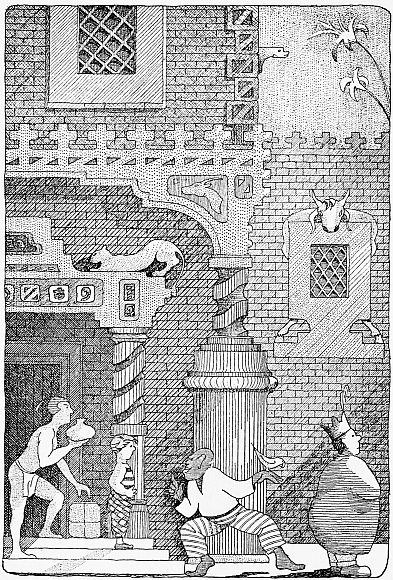 “‘Tiptoe incognito,’ whispered Bumpo”
“Quite, quite,” said the porpoises. “And wewill willingly do our very best to persuade him—forit is, as you say, a perfect shame for the greatman to be wasting his time here when he is so muchneeded by the animals.”
“And don’t let the Doctor know what you’reabout,” said Polynesia as they started to move off.“He might balk if he thought we had any hand init. Get the snail to offer on his own account to takeus. See?”
John Dolittle, unaware of anything save the workhe was engaged on, was standing knee-deep in theshallow water, helping the snail try out his mendedtail to see if it were well enough to travel on. Bumpoand Long Arrow, with Chee-Chee and Jip, werelolling at the foot of a palm a little way up thebeach. Polynesia and I now went and joined them.
Half an hour passed.
What success the porpoises had met with, we didnot know, till suddenly the Doctor left the snail’sside and came splashing out to us, quite breathless.
[355]
“What doyou think?” he cried, “while I wastalking to the snail just now he offered, of his ownaccord, to take us all back to England inside hisshell. He says he has got to go on a voyage ofdiscovery anyway, to hunt up a new home, now thatthe Deep Hole is closed. Said it wouldn’t be muchout of his way to drop us at Puddleby River, if wecared to come along—Goodness, what a chance!I’d love to go. To examine the floor of the oceanall the way from Brazil to Europe! No man everdid it before. What a glorious trip!—Oh that Ihad never allowed myself to be made king! NowI must see the chance of a lifetime slip by.”
He turned from us and moved down the sandsagain to the middle beach, gazing wistfully, longinglyout at the snail. There was something peculiarlysad and forlorn about him as he stood thereon the lonely, moonlit shore, the crown upon hishead, his figure showing sharply black against theglittering sea behind.
Out of the darkness at my elbow Polynesia roseand quietly moved down to his side.
“Now Doctor,” said she in a soft persuasive voiceas though she were talking to a wayward child,“you know this king business is not your real workin life. These natives will be able to get alongwithout you—not so well as they do with you ofcourse—but they’ll manage—the same as they didbefore you came. Nobody can say you haven’t[356]done your duty by them. It was their fault: theymade you king. Why not accept the snail’s offer;and just drop everything now, and go? The workyou’ll do, the information you’ll carry home, willbe of far more value than what you’re doing here.”
“Good friend,” said the Doctor turning to hersadly, “I cannot. They would go back to their oldunsanitary ways: bad water, uncooked fish, no drainage,enteric fever and the rest.... No. I mustthink of their health, their welfare. I began lifeas a people’s doctor: I seem to have come back to itin the end. I cannot desert them. Later perhapssomething will turn up. But I cannot leave themnow.”
“That’s where you’re wrong, Doctor,” said she.“Now is when you should go. Nothing will ‘turnup.’ The longer you stay, the harder it will be toleave—Go now. Go to-night.”
“What, steal away without even saying good-byeto them! Why, Polynesia, what a thing tosuggest!”
“A fat chance they would give you to say good-bye!”snorted Polynesia growing impatient at last.“I tell you, Doctor, if you go back to that palacetonight, for goodbys or anything else, you willstay there. Now—this moment—is the time foryou to go.”
The truth of the old parrot’s words seemed to[357]be striking home; for the Doctor stood silent a minute,thinking.
“But there are the note-books,” he said presently:“I would have to go back to fetch them.”
“I have them here, Doctor,” said I, speaking up—“allof them.”
Again he pondered.
“And Long Arrow’s collection,” he said. “Iwould have to take that also with me.”
“It is here, Oh Kindly One,” came the Indian’sdeep voice from the shadow beneath the palm.
“But what about provisions,” asked the Doctor—“foodfor the journey?”
“We have a week’s supply with us, for our holiday,”said Polynesia—“that’s more than we willneed.”
For a third time the Doctor was silent andthoughtful.
“And then there’s my hat,” he said fretfully atlast. “That settles it: I’ll haveto go back to thepalace. I can’t leave without my hat. How couldI appear in Puddleby with this crown on my head?”
“Here it is, Doctor,” said Bumpo producing thehat, old, battered and beloved, from under his coat.
Polynesia had indeed thought of everything.
Yet even now we could see the Doctor was stilltrying to think up further excuses.
“Oh Kindly One,” said Long Arrow, “why tempt[358]ill fortune? Your way is clear. Your future andyour work beckon you back to your foreign homebeyond the sea. With you will go also what loreI too have gathered for mankind—to lands whereit will be of wider use than it can ever here. I seethe glimmerings of dawn in the eastern heaven.Day is at hand. Go before your subjects areabroad. Go before your project is discovered.For truly I believe that if you go not now you willlinger the remainder of your days a captive king inPopsipetel.”
Great decisions often take no more than a momentin the making. Against the now paling skyI saw the Doctor’s figure suddenly stiffen. Slowlyhe lifted the Sacred Crown from off his head andlaid it on the sands.
And when he spoke his voice was choked withtears.
“They will find it here,” he murmured, “whenthey come to search for me. And they will knowthat I have gone.... My children, my poor children!—Iwonder will they ever understand why itwas I left them.... I wonder will they ever understand—andforgive.”
He took his old hat from Bumpo; then facingLong Arrow, gripped his outstretched hand insilence.
“You decide aright, oh Kindly One,” said theIndian—“though none will miss and mourn you[359]more than Long Arrow, the son of Golden Arrow—Farewell,and may good fortune ever lead you bythe hand!”
It was the first and only time I ever saw the Doctorweep. Without a word to any of us, he turnedand moved down the beach into the shallow waterof the sea.
The snail humped up its back and made anopening between its shoulders and the edge of itsshell. The Doctor clambered up and passedwithin. We followed him, after handing up thebaggage. The opening shut tight with a whistlingsuction noise.
Then turning in the direction of the East, thegreat creature began moving smoothly forward,down the slope into the deeper waters.
Just as the swirling dark green surf was closingin above our heads, the big morning sun popped hisrim up over the edge of the ocean. And throughour transparent walls of pearl we saw the wateryworld about us suddenly light up with that mostwondrously colorful of visions, a daybreak beneaththe sea.
The rest of the story of our homeward voyageis soon told.
Our new quarters we found very satisfactory.Inside the spacious shell, the snail’s wide back was[360]extremely comfortable to sit and lounge on—betterthan a sofa, when you once got accustomed to thedamp and clammy feeling of it. He asked us,shortly after we started, if we wouldn’t mind takingoff our boots, as the hobnails in them hurt his backas we ran excitedly from one side to another to seethe different sights.
The motion was not unpleasant, very smooth andeven; in fact, but for the landscape passing outside,you would not know, on the level going, that youwere moving at all.
I had always thought for some reason or otherthat the bottom of the sea was flat. I found thatit was just as irregular and changeful as the surfaceof the dry land. We climbed over great mountain-ranges,with peaks towering above peaks. Wethreaded our way through dense forests of tallsea-plants. We crossed wide empty stretches ofsandy mud, like deserts—so vast that you went onfor a whole day with nothing ahead of you buta dim horizon. Sometimes the scene was moss-covered,rolling country, green and restful to theeye like rich pastures; so that you almost looked tosee sheep cropping on these underwater downs.And sometimes the snail would roll us forwardinside him like peas, when he suddenly dipped downwardto descend into some deep secluded valleywith steeply sloping sides.
In these lower levels we often came upon the[361]shadowy shapes of dead ships, wrecked and sunkHeaven only knows how many years ago; andpassing them we would speak in hushed whisperslike children seeing monuments in churches.
Here too, in the deeper, darker waters, monstrousfishes, feeding quietly in caves and hollowswould suddenly spring up, alarmed at our approach,and flash away into the gloom with the speed of anarrow. While other bolder ones, all sorts of unearthlyshapes and colors, would come right up andpeer in at us through the shell.
“I suppose they think we are a sort of sanaquarium,”said Bumpo—“I’d hate to be a fish.”
It was a thrilling and ever-changing show. TheDoctor wrote or sketched incessantly. Before longwe had filled all the blank note-books we hadleft. Then we searched our pockets for any oddscraps of paper on which to jot down still more observations.We even went through the used booksa second time, writing in between the lines, scribblingall over the covers, back and front.
Our greatest difficulty was getting enough lightto see by. In the lower waters it was very dim.On the third day we passed a band of fire-eels, a sortof large, marine glow-worm; and the Doctor askedthe snail to get them to come with us for a way.This they did, swimming alongside; and their lightwas very helpful, though not brilliant.
How our giant shellfish found his way across[362]that vast and gloomy world was a great puzzle tous. John Dolittle asked him by what means henavigated—how he knew he was on the right roadto Puddleby River. And what the snail said inreply got the Doctor so excited, that having nopaper left, he tore out the lining of his precioushat and covered it with notes.
By night of course it was impossible to see anything;and during the hours of darkness the snailused to swim instead of crawl. When he did so hecould travel at a terrific speed, just by wagglingthat long tail of his. This was the reason why wecompleted the trip in so short a time—five and ahalf days.
The air of our chamber, not having a change inthe whole voyage, got very close and stuffy; andfor the first two days we all had headaches. Butafter that we got used to it and didn’t mind it inthe least.
Early in the afternoon of the sixth day, we noticedwe were climbing a long gentle slope. As wewent upward it grew lighter. Finally we saw thatthe snail had crawled right out of the water altogetherand had now come to a dead stop on along strip of gray sand.
Behind us we saw the surface of the sea rippledby the wind. On our left was the mouth of a riverwith the tide running out. While in front, the lowflat land stretched away into the mist—which[363]prevented one from seeing very far in any direction.A pair of wild ducks with craning necks and whirringwings passed over us and disappeared likeshadows, seaward.
As a landscape, it was a great change from thehot brilliant sunshine of Popsipetel.
With the same whistling suction sound, the snailmade the opening for us to crawl out by. As westepped down upon the marshy land we noticed thata fine, drizzling autumn rain was falling.
“Can this be Merrie England?” asked Bumpo,peering into the fog—“doesn’t look like any placein particular. Maybe the snail hasn’t brought usright after all.”
“Yes,” sighed Polynesia, shaking the rain off herfeathers, “this is England all right—You can tellit by the beastly climate.”
“Oh, but fellows,” cried Jip, as he sniffed up theair in great gulps, “it has a smell—a good and glorioussmell!—Excuse me a minute: I see a water-rat.”
“Sh!—Listen!” said Chee-Chee through teeththat chattered with the cold. “There’s Puddlebychurch-clock striking four. Why don’t we divideup the baggage and get moving. We’ve got a longway to foot it home across the marshes.”
“Let’s hope,” I put in, “that Dab-Dab has a nicefire burning in the kitchen.”
“I’m sure she will,” said the Doctor as he picked[364]out his old handbag from among the bundles—“Withthis wind from the East she’ll need it tokeep the animals in the house warm. Come on.Let’s hug the river-bank so we don’t miss our wayin the fog. You know, there’s something ratherattractive in the bad weather of England—whenyou’ve got a kitchen-fire to look forward to....Four o’clock! Come along—we’ll just be in nicetime for tea.”

Transcriber’s Notes:Varied hyphenation retained. Obvious punctuation errors repaired.
Page 20, “he” changed to “be” (Don’t be alarmed)
Page 135, “shellflsh” changed to “shellfish” (of the shellfish)
Page 137, “way” changed to “may” (come what may)
Page 188, Part Four, THE FIRST CHAPTERmade italic tomatch rest of usage.
Page 218, “is” changed to “it” (where it is)
Page 249, “musn’t” changed to “mustn’t” (that he musn’t give)
Page 324, “Polnesia” changed to “Polynesia” (whispered Polynesia)
Page 347, “thoroughy” changed to “thoroughly” (thoroughly interested in)
Page 357, “Poynesia” changed to “Polynesia” (said Polynesia—“that’s more)
- Recently updated
-
-
2026-07-29 22:47:07The Project Gutenberg eBook of The Masque of the Red Death, by Edgar Allan Poe
-
2026-07-29 22:47:07The Messengers, by R. H. Davis
-
2026-07-29 22:47:07The Project Gutenberg eBook of Hamlet, by William Shakespeare
-
2026-07-29 22:47:07La Grande Bretèche, by Balzac
-
2026-07-29 22:47:07Saltbush Bill, J.p., and Other Verses, by A. B. Paterson
-
2026-07-29 22:47:07The Project Gutenberg eBook of Sir John Oldcastle, by
-
2026-07-29 22:47:07Sister Songs, by Francis Thompson
-
2026-07-29 22:47:07Facino Cane, by Honore de Balzac
-
- Hot ranking
-
-
2026-07-29 22:47:07The Apology, by Xenophon
-
2026-07-29 22:47:07The Man Who Could Not Lose, by Richard Harding Davis
-
2026-07-29 22:47:07Tattine, by Ruth Ogden
-
2026-07-29 22:47:07The Project Gutenberg eBook of King Richard II, by William Shakespeare
-
2026-07-29 22:47:07La Grenadiere, by Honore de Balzac
-
2026-07-29 22:47:07The Poetical Works of John Milton, by John Milton
-
2026-07-29 22:47:07A History of Science, Vol. II by Henry Smith Williams
-
2026-07-29 22:47:07The Boys' Life of Abraham Lincoln, by Helen Nicolay
-
- Friendly links
-
- baby sensory toys for 12 months under 25 dollars best bead kits for 8 year olds under 50 dollars best electronic learning toys for 14 year olds under 100 dollars sewing kits for 2 year olds under 50 dollars best sewing kits for 9 year olds under 10 dollars best magnetic building sticks for 2 year olds under 50 dollars best plush sea animals for 10 year olds under 30 dollars kids ukuleles for 12 year olds under 30 dollars music boxes for 11 year olds under 50 dollars affordable toy drums under 25 dollars
- Sunday under Three Heads, by Charles Dickens
- The Project Gutenberg Etext of Alice's Adventures in Wonderland
- The Project Gutenberg eBook The Fall of the House ofUsher, by Edgar Allan Poe
- The Project Gutenberg eBook of The Master of Ballantrae, by Robert Louis Stevenson
- Letters from the Cape, by Lady Duff Gordon
- A House of Pomegranates, by Oscar Wilde
- Style, by Walter Raleigh
- The Project Gutenberg eBook of Master and Man, by Leo Tolstoy
- Uncle Josh's Punkin Centre Stories, by Cal Stewart
- The Dominion of the Air, by J. M. Bacon